Market snapshot
- ASX 200: +0.6% to 8,663 points (live data below)
- Australian dollar: -flat at 69.3 US cents
- Wall Street: Dow Jones (flat), S&P 500 (+0.2%), Nasdaq Composite (flat)
- Europe: Stoxx 600 (-1.3%), DAX (-1%), FTSE (-1.7%)
- Spot gold: -0.4% to $US4,162/ounce
- Oil (Brent futures): +0.2% to $US102.52/barrel
- Iron ore: -1.5% to $US90.95/tonne
- Bitcoin: +0.6% to $US85,083
- 10-year bonds: US 5.26%, Australia 5.37%
Prices current at around 12:55pm AEST
USD at 17-month high
The US dollar is heading for its third straight week of gains as a bond market rout pushes borrowing costs to multi-decade peaks.
Yields on benchmark US 10-year Treasuries hit 5.344 per cent yesterday, their highest since 2002, ahead of a US jobs report that could influence the near-term policy outlook.
The dollar index, which measures the US currency against six rivals, was at 102.08, set for a 1 per cent gain this week, its third consecutive weekly gain, a run it last had in May 2025.
Charu Chanana, chief investment strategist at Saxo, says investors are confronting the uncomfortable mix of sticky inflation, heavy government borrowing and large bond supply.
“The fact that long-end yields are pushing higher even as expectations for an immediate Fed hike have eased suggests this is increasingly about the term premium and fiscal risk, not just the next Fed decision,” she said.
Data on Wednesday showed US consumer prices rose less than expected in August, along with downward revisions to July’s figure, leading traders to rein in wagers of a rate hike from the Federal Reserve later this month.
Two of the Fed’s top policymakers this week staked out an unusually clear case for taking in more data before deciding about another hike.
That has sharpened the focus on the US payroll report due later in the day, with data likely to show that job growth slowed in September, and that the unemployment rate is forecast to have been 4.1 per cent for a third straight month.
“With the Fed now myopically focused on inflation and price pressures, a hot wages print could prove particularly influential for US rates, Treasuries and the USD,” said Chris Weston, head of research at Pepperstone.
Brent crude futures were back above $100 per barrel as traders kept an eye on the stalled talks between the US and Iran to end the conflict in the Middle East.
Sterling was at $1.3187 while the Australian dollar was 0.18 per cent softer at $0.6918, as both hovered around their three-month lows.
With Reuters
The KPMG audits scandal that rocked the corporate world
ANZ cutting ties with its long-time auditor KPMG after nearly 60 years working together is just the latest consequence the firm has faced since its dirty laundry was aired earlier this year.
In March, Senator Deborah O’Neill exposed in a speech to parliament allegations from a whistleblower that KPMG had used confidential client data to win corporate audit contracts for two years.
The whistleblower alleged that for two years, KPMG had batted away accusations that information obtained during an audit of Lendlease accounts was used to win work elsewhere.
It was also alleged the auditors had been expressly forbidden by the company to access the confidential board documents.
In the six months since, KPMG has been in almost constant upheaval.
Some of the allegations were substantiated and chief executive Andrew Yates and audit boss Julian McPherson left the firm.
KPMG was also referred to the National Anti-Corruption Commission.
The firm apologised and admitted its internal investigations were conducted without the “necessary rigour required”.
KPMG agreed to a three-month freeze on new Commonwealth government contract bids that ran until September 30.
This prompted KPMG to lay off about 5% of its staff, which was about 400 people.
The firm’s revenue fell from $2.28 billion the previous year to $2.26 billion in the 2026 financial year, and KPMG Australia chief executive John Sams expected more revenue falls.
Lendlease unsurprisingly cut ties with the big four accounting firm.
In August, so did Macquarie Bank.
The ABC has contacted KPMG for comment in the wake of ANZ ending their business relationship. A call was returned by veteran crisis communicator David Luff, who said the firm declined to comment.
You can read more on the context of this scandal-plagued firm from a piece my colleague Ian Verrender wrote a few months ago.
Another one bites the dust: More on ANZ dropping KPMG
The new auditor will not commence until FY2029.
KPMG has reportedly made $24 million a year from its ANZ business.
Macquarie Bank and Lendlease have also recently dumped the auditor.
The ABC has contacted KPMG for comment.
Major bank drops KPMG in wake of audit leaks scandal
After 57 years, ANZ is ending its relationship with KPMG, making it the latest client to sever ties with the firm amid its audit leaks scandal.
In a statement to the ASX, the bank says:
“The board of ANZ Group today announced it will commence a competitive tender process to select the next provider of ANZ Group external audit services.”
ANZ has used KPMG for its external audit since 1969 but says “a tenure of this length is no longer considered appropriate and has been under consideration by the board for some time”.
KPMG is accused of misusing client data and then mishandling a whistleblower’s complaint about it.
ANZ says it will find a new auditor through a tender process and that:
“KPMG will not be eligible to participate.”
Nike’s share price savaged amid poor results, job cuts on horizon
Nike’s share price has dropped almost 9% in after-hours trading following disappointing results and revelations that job cuts are in the works.

Overnight, the sportswear juggernaut released its results for the first fiscal quarter, showing it made revenue of $US11.21 billion, representing a 4% decline from the same reporting period in the previous year.
Nike also warned that revenues are expected to keep declining, largely blaming its flailing China arm — which reported a drop of 26% in revenue — for the poor results.
The brand revealed plans to start a major restructure, which will involve layoffs from next year.
Nike chief executive Ellliot Hill has told analysts that the company is “moving with urgency”.
Disney announces layoffs as part of restructure
Disney shares dropped 3.5% in US trade after the Wall Street Journal reported the entertainment giant is expected to lay off hundreds of workers as part of its restructuring process.
Since Josh D’Amaro got the top job in March, there have been sweeping changes with layoffs across marketing, Pixar, ABC News and ESPN. He used to lead Disney’s parks division — which has kept the company afloat in recent years as it struggled to make a profit from its streaming and movie businesses.
The WSJ reports D’Amaro’s goal is to consolidate Disney’s “fiefdoms” so the company starts thinking of itself as a unified digital entertainment operation.
One interesting move has been to launch a voluntary early-retirement initiative open to executives over 50 with at least 10 years of experience.
Done your mortgage sums yet? Why not try our rates calculator?
The Reserve Bank of Australia has raised interest rates. You know it’s just a few more weeks until you get a polite letter from your bank telling you that you will be paying more.
Why not get ahead and try out our handy mortgage calculator.
ICYMI: Australian trade minister floats idea of investing in US lamb industry, cops backlash
Trade Minister Don Farrell has sparked outrage after revealing he asked the Trump administration to spare Australian sheep farmers from further tariff pain, in exchange for Australian investment in the US lamb industry.
Farrell floated the idea — which could see Australians’ superannuation savings invested in American meat-processing facilities — during this week’s G20 trade meetings in Milwaukee.
Opposition Leader Angus Taylor is not a fan, questioning why Australian money would be used for a US industry.
The Super Members Council has labelled the comments “ill-informed” and says super funds will only invest in areas that yield the strongest returns for members.
You can read more about the proposal here.
Reserve Bank flags risks around neocloud providers in latest Financial Stability Review
As Firmus prices its shares at $11 each ahead of its proposed ASX float this morning, the RBA’s review this week identified neocloud providers (the segment which Firmus operates) as one of the potential higher risk parts of the rapidly expanding AI investment boom.
In the report, the RBA says:
“There are pockets of higher-risk firms in the AI value chain (e.g. data centre construction, utility and neocloud providers), with concentrated customer bases or weaker balance sheets.”
It also says:
“Similarly, developers and neocloud providers, lacking the balance sheet capacity to deliver large-scale AI infrastructure projects, can seek support from larger firms, such as residual-value or lease-payment guarantees, to facilitate the necessary funding.”
The RBA points to the increasingly interconnected nature of AI financing, including:
“Chipmakers have provided financial support to neocloud firms who subsequently purchase their products.”
More broadly, it also warns that while long-term earnings forecasts assume widespread AI adoption and strong revenues, “the timing, scale and distribution of these benefits remains uncertain”.
If returns disappoint, the RBA says features of the AI investment boom “could potentially lead to losses among lenders and investors”.
Market snapshot
- ASX 200: +0.5% to 8,657 points
- Australian dollar: -0.2% to 69.15 US cents
- Wall Street: Dow Jones (+0.04%), S&P 500 (+0.2%), Nasdaq Composite (+0.04%)
- Europe: Stoxx 600 (-1.3%), DAX (-1.03%), FTSE (-1.68%)
- Spot gold: -0.22% to $US4,191/ounce
- Oil (Brent futures): +0.2% to $US102.53/barrel
- Iron ore: -1.3% to $US92.25/tonne
- Bitcoin: +1.3% to $US84,760
- 10-year bonds: US 5.25%, Australia 5.36%
Prices current at around 11am AEST
ASX top and bottom movers
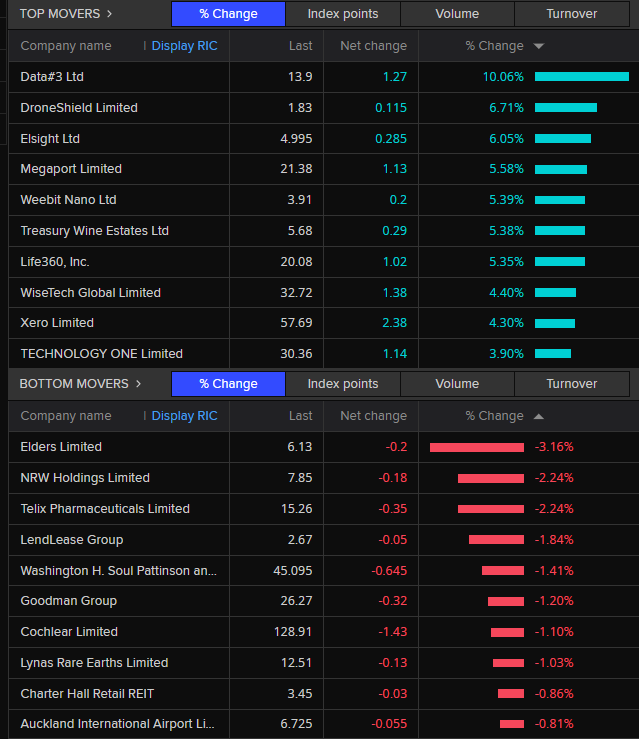
Leading the pack today is IT services company Data#3 Ltd, continuing to soar after upgrading its guidance for the first half of FY27.
DroneShield Ltd is also up close to 7%.
Meanwhile, Elders Ltd (-3%) and Telix Pharmaceuticals Ltd (-2.2%) are the major laggards at the open of trade.
ASX performance by sectors
The ASX is fractionally higher this morning, tracking the turnaround on Wall Street after US bond yields retreated from multi-decade highs.
The gains follow a rough day yesterday when the benchmark index fell by close to 2%.
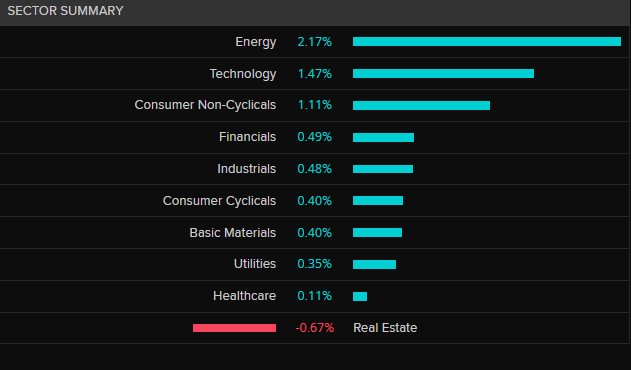
At opening, 10 of the 11 sectors are in the green, led by energy and technology.
ASX rises at the start of trade
The ASX 200 has started the day higher by rising 0.34% to 8,643 points in the first 5 minutes of trading.
The All Ordinaries have risen by 0.3% to 8,821 points.
I’ll have more shortly.
Businesses find workarounds to recoup surcharge fees banned by RBA
The RBA’s surcharge ban on debit and credit cards has officially started, and businesses say they’re raising prices to cover bank fees.
While the cap on interchange fees businesses pay to banks has been reduced, it hasn’t been slashed entirely, so small businesses with thin margins have no choice but to raise prices to cover them.
Charlie Sheppeard, ANZ’s executive general manager of strategy and operations at Xero, the small business accounting platform, says small businesses still have costs to pay.
“The card surcharge ban removes a visible cost for consumers, but it doesn’t remove the cost of accepting card payments for businesses. The question is where the cost goes,” Sheppeard says.
“Small businesses are navigating challenging conditions with the introduction of Payday Super requiring them to pay super every pay cycle, and economic pressures from inflation and increasing interest rates.”
The latest Xero Small Business Insights data shows sales in retail and hospitality grew only 3.4% and 2.1% year-on-year, respectively, in the June quarter.
“There is no one-size-fits-all answer, depending on their circumstances, that could mean adjusting prices, changing their payment mix or absorbing some of the cost,” Sheppeard says.
“Leaving those fees unchecked risks gradually eroding profitability.
“We’ll likely see different approaches emerge as businesses settle into the change.
“The surcharge may have disappeared from the receipt, but payment costs now need to become a much more visible part of businesses’ cashflow planning.”
Morningstar flags boom warning signs ahead of Firmus float
Morningstar senior market strategist Lochlan Halloway, in a note written on Thursday, says the proposed Firmus float is showing hallmarks of the boom phase of the classic boom-and-bust cycle.
“In Firmus, I see the hallmarks of the boom phase of Kindleberger’s cycle, if not outright euphoria. First, the wild increase in valuation in such a short period of time,” he says.
“Not bad for a start-up. That would be a 12-bagger in less than six months.
“Second, the debt. The neoclouds are heavily geared.”
Halloway says Firmus expects to carry about US$30 billion of debt, about six times its forecast US$5 billion of operating earnings in 2028.
“Borrowed money alone does not make a bubble, and plenty of infrastructure is sensibly funded with debt. But credit is the common thread running through essentially every boom-and-bust cycle,” he says.
“To be clear, I’m not joining those who have written Firmus off as all hype and no substance. Every business has a fair value, and we’ll have more to say once we’ve seen the prospectus.
“For investors, what matters is how that fair value compares to the float price. The distance will tell us a good deal about where we are in Kindleberger’s cycle.”
What CBA’s Matt Comyn thinks about interest rates
The Commonwealth Bank is Australia’s biggest bank and its second-biggest company.
One in three Australians are CommBank customers, giving it an enormous influence over the Australian economy.
Matt Comyn has been CBA’s chief executive since 2018 and has been named by the Australian Financial Review as the most powerful person in corporate Australia.
Now, with Australians watching closely for what happens to interest rates amid still-high cost-of-living pressures, Matt Comyn joins Alan Kohler on That’s Business to discuss rates, AI, productivity and the future of Australian banking.
You can catch the podcast below.
BCA agrees businesses need to ‘step up’ on productivity, but says settings must change
The Business Council of Australia has backed RBA Governor Michelle Bullock’s call for businesses to “step up” and help lift the nation’s weak productivity.
BCA chief executive Bran Black says business does need to invest more, but argues Australia’s tax, regulatory and industrial relations settings are making it more attractive to invest offshore.
“We agree, we want to see business step up and do more, but business is confronted with uncompetitive settings that make it more attractive to invest capital offshore,” he says.
He says stronger business investment is essential to turning that around, conceding:
“The simple point is we’re not seeing businesses invest enough.”
Black says without stronger investment, Australia will struggle to lift productivity, leaving less room for real wage growth and making it harder to bring inflation down.
You can hear more of that conversation below.
Loading…
ASX set to rise this morning
After a tough day for investors, with $60 billion wiped from the share market yesterday, futures are pointing to a positive start today.
On The Business with Alicia Barry yesterday, VanEck’s Jamie Hannah said the Australian market took its lead from Wall Street, where a late sell-off was driven by growing nervousness about rapidly rising bond yields.
You can watch the full interview below.
Loading…
Oil price jumps 5%
Oil prices are up by 5.3% as at 7.45am, trading at $103 US dollars a barrel.
The rise comes after a WSJ report that the US is sending a third aircraft carrier and up to 10,000 more troops to the Middle East as President Donald Trump considers resuming strikes on Iran after the US midterm elections.
The president told reporters he was considering his options.
“Now I have to make a decision. They’ll either sign a very fair deal or they won’t exist any longer,” he said.
It also comes as China has reportedly suspended fuel exports.
While crude oil continues to reach the market, diesel and other refined fuels remain in short supply following damage to refinery infrastructure in the Gulf and Russia.