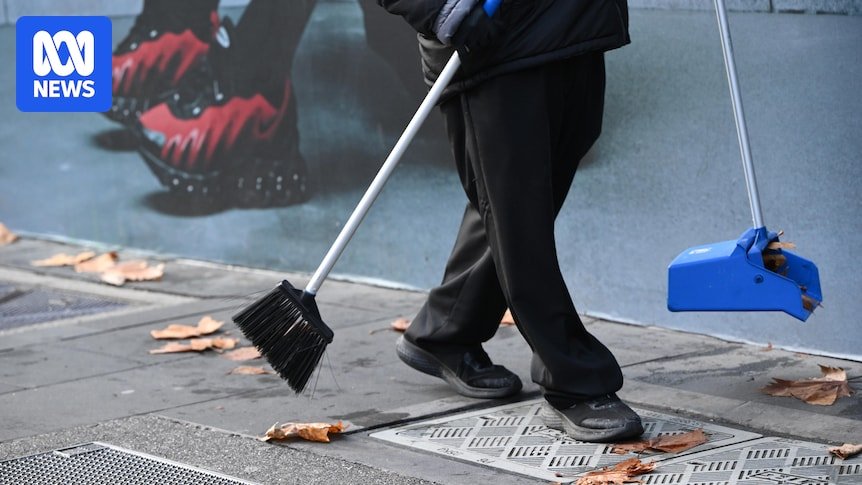
Millions of workers will get a 4.75 per cent pay rise after Fair Work raised modern award wages above the rate of inflation. The ASX200 slipped ground, as real estate and financial stocks weighed on the index.
Catch up on the day’s financial news and insights from our specialist business reporters on our blog.
Disclaimer: this blog is not intended as investment advice.
Tue 2 Jun 2026 at 4:33pm
Market snapshot
- ASX 200: -0.06% at 8,724 points (close)
- Australian dollar: +0.13% to 71.63 US cents
- Dow Jones: +0.1% to 51,078 points
- S&P 500: +0.3% to 7,599 points
- Nasdaq: +0.4% to 27,086 points
- FTSE: -0.7% to 10,338 points
- EuroStoxx: -0.8% to 621 points
- Spot gold: +1.15% to $US4,535/ounce
- Brent crude: -1.05% to $US93.98/barrel
- Iron ore: +0.3% to $US105.05/tonne
- Bitcoin: -1.47% to $US70,321
Prices current around 4:30pm AEST.
Live updates on the major ASX indices:
Tue 2 Jun 2026 at 5:07pm
Until tomorrow
That’s it for today. Thanks for joining us.
We’ll be back early tomorrow morning to catch up on developments on foreign markets overnight.
Tomorrow morning, at 11:30am AEST, the Bureau of Statistics will publish its March quarter GDP figures.
That will be big economic news, but remember – the GDP measurement is backwards-looking, so it will tell us how the economy was performing in January, February and March.
Until tomorrow, take care of yourselves.
Tue 2 Jun 2026 at 4:56pm
Best and worst performers
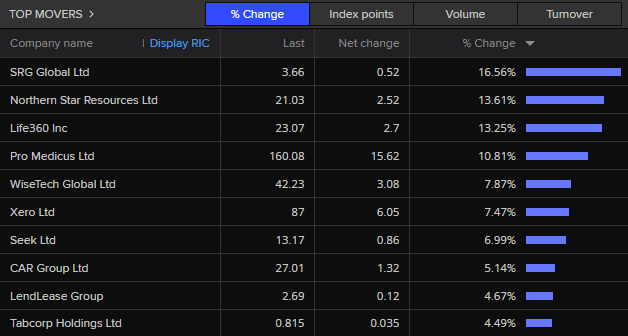
Among the best performing stocks on the ASX200 were SRG Global (up 52c, +16.56%, to $3.66), Northern Star Resources (up $2.52, +13.61%, to $3.66), and Life360 (up $2.70, +13.25%, to $23.07).
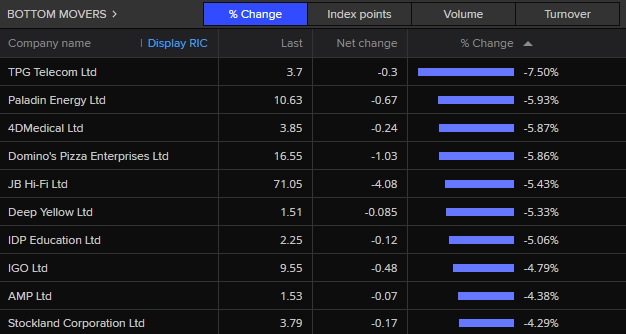
Among the worst performing stocks were TPG Telecom (down 30 cents, -7.50%, to $3.70), Paladin Energy (down 67 cents, -5.93%, to $10.63), and 4DMedical (down 24 cents, -5.87%, to $3.85).
Tue 2 Jun 2026 at 4:47pm
Sector summary
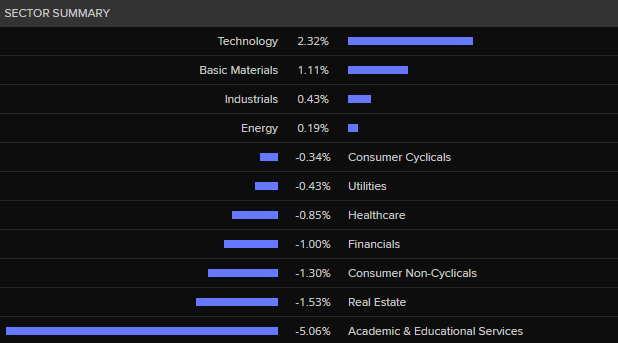
Only 4 sectors out of 11 gained ground on the ASX200 today.
They were: technology stocks (+2.32%), Basic Materials (1.11%), Industrial (+0.43%) and Energy (+0.19%)
Tue 2 Jun 2026 at 4:27pm
ASX closes slightly lower
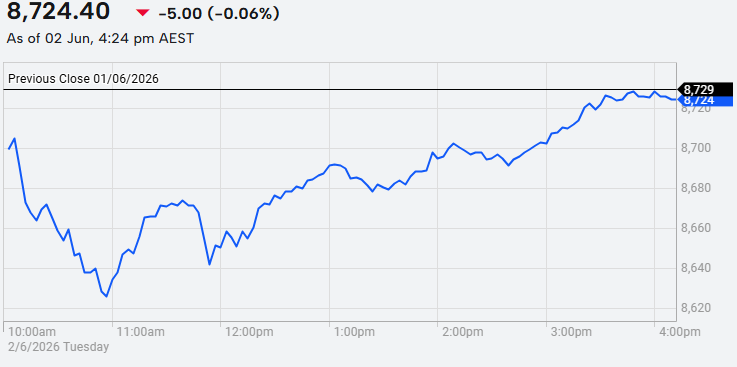
Trading has finished on Australia’s stock market for the day.
The S&P/ASX200 index has lost 5 points (-0.06%) to close on 8,724.4 points.
Tue 2 Jun 2026 at 4:19pm
Protections for whistleblowers under review
Whistleblowers who help uncover misconduct and wrongdoing in the tax and corporate sectors could face stronger protections under reforms being consulted on by the federal government.
Whistleblowing protection in corporate and financial services sectors was broadened and reformed into a single regime in the Corporations Act 2001 in 2019.
A new tax whistleblowing regime was also introduced into the Taxation Administration Act 1953 at the same time.
Assistant Treasurer Daniel Mulino says the review will investigate whether these laws are working as intended, identify any ongoing concerns, and, where appropriate, recommend further improvement.
“The terms of reference include consideration of whistleblowers’ access to justice, and the effectiveness of the regimes in incentivising whistleblowing and disincentivising misconduct,” he said.
“Corporate, financial and tax crime can be challenging to detect, and exposing wrongdoing often comes at great personal and financial risk.
“A strong whistleblowing regime mitigates those risks with legal protections, while also promoting fair and competitive markets by exposing businesses that may be gaining an unfair advantage.”
The closing date for submissions is July 29.
I have written about the need for protections to date failing those like Richard Boyle who blew the whistle on the ATO. I have also covered the wider issues regarding the lack of public service protections. The story was written before the cases against Boyle and others had legal outcomes, but the latter half focuses on how Australia once led the world in terms of strong legal protections for whistleblowers, but is now well behind. Read more here:
Tue 2 Jun 2026 at 4:04pm
Westpac economists flag possible economic contraction in June quarter
Tomorrow, the Bureau of Statistics will publish the March quarter GDP figures.
Westpac’s economic team says it thinks the data will show that Australia’s economy was slowing before the conflict in the Middle East, or the rate hikes in February, March and May, had really started to impact:
“The significant headwinds from the conflict will be more fully reflected in the second quarter of 2026, with the possibility of a quarterly contraction which would be the first quarterly decline since the GFC (excluding COVID),” they say.
They think the data will show that Australia’s economy expanded by just 0.3 per cent over January, February and March, and by 2.4 per cent in year-ended terms.
If that comes to pass, it will be the softest quarterly growth rate since the second quarter of 2024.
Tue 2 Jun 2026 at 3:38pm
Business Council of Australia says real wage increases should come from productivity gains
Bran Black, chief executive of the Business Council of Australia, has this to say about the Fair Work Commission’s wage decision:
“The BCA wants to see real wages increases.
“Productivity is the only way to sustainably deliver higher real wages over the long term. That must be the focus.
“Wage increases that are not backed by productivity gains don’t deliver higher living standards, they deliver higher prices.
“Businesses, particularly small businesses, are under real pressure and can’t pay for wage increases that are not backed by productivity growth.”
Tue 2 Jun 2026 at 3:27pm
🎙️ Big tech goes public
There’s a race happening on Wall Street, as AI giants rush to go public and collect the prize of passive funds.
Anthropic has made the latest move to file on the heels of SpaceX, which is already set to stage the largest public offering in stock market history.
And a huge uptake in home batteries here in Australia is reshaping the power industry. Could battery-generated power help the nation to combat inflation?
Carrington Clarke and chief business correspondent Ian Verender break it all down on ABC Business Daily.
Take a listen:
Tue 2 Jun 2026 at 3:18pm
Wage rise ‘another nail in the coffin’, mango growers say
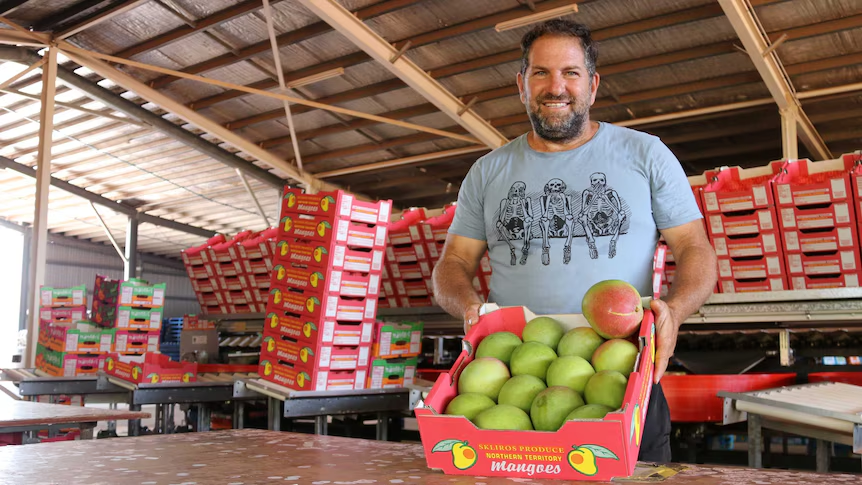
Rural reporter Matt Brann has spoken to Leo Skliros, the President of the Northern Territory Mango Industry Association.
Mr Skliros says the upcoming mango season is looking ‘scary’ for a lot of growers as input costs, and now wages, keep rising.
“These rises just make farms and a lot of businesses unprofitable,” he told ABC Rural.
“We’re seeing an accumulative effect with interest rates, fuel prices, fertiliser, insecticides — this (wage rise) is just another nail in the coffin.”
He said the mango industry relied heavily on seasonal workers to pick fruit and the increase to award wages on July 1 would be felt by farmers more than consumers.
“Mango prices are not increasing to offset these rising costs,” he said.
“We’re just not an industry that can pass the cost on, especially when consumers are tightening their belts.
“It’s just becoming less feasible to be in horticulture.”
Tue 2 Jun 2026 at 3:06pm
The pension increases twice a year
Do you know whether pensions and other government payments will also rise by one of the percentages mentioned?
– Norman
What about the aged pension? I’ll bet that doesn’t go up by 6%.
– Glenda Carroll
How about us on the pension. Why are we always neglected???
– Fred Sacroug
Will this include pensioners??
– JJ
The Fair Work Commission reviews minimum wages once a year.
Minimum wages are not indexed to inflation, so if the FWC does not keep minimum wages in line with inflation each year the minimum wage will lose its purchasing power over time.
As the FWC said today, most modern award-reliant employees are in the position that their wage rates, in real terms, are still lower than what they were in July 2021.
The Age Pension is different.
It is automatically adjusted to inflation* twice a year (every six months) to ensure that the real value of the pension does not deteriorate.
On March 20, over 2.5 million Age Pensioners received their latest fortnightly increase in their pension. The next increase will occur on September 20.
(*in fact, it’s even better than that (for pensioners). The government uses a combination of three economic measures to determine its regular and automatic pension increases: the consumer price index, the pensioner and beneficiary living cost index, and male total average weekly earnings).
Tue 2 Jun 2026 at 2:44pm
How many ongoing jobs do data centres create? There’s disagreement, even in business community
By National AI reporter Cameron Wilson
By National AI reporter Cameron Wilson
One of the selling points for building a data centre in your local area is the promise of local job creation. Jobs to build the data centres in the beginning, then jobs to run operations once it’s up and running.
But prominent investor AirTree Ventures co-founder Daniel Petre set a cat among the pigeons on a panel this morning when he suggested that the ongoing demand for jobs to run data centres is close to negligible.
“The idea that it’s going to be a massive employer is completely bullshit. There are two people and a canary who manage a data centre up once it’s up and running,” he said at the Australian Financial Review’s AI Summit.
Immediately after Petre’s appearance, Google‘s VP of global infrastructure Bikash Koley gave keynote address in which he argued that numbers of data centres employment understates the indirect benefits.
“For every job that we create in a data centre in its operational phase, there are additional jobs that are created because of the ecosystem that is created through this data centre, where it’s power generation, cooling, or supply chain,” he said.
Tech Council of Australia chair and Atlassian co-founder Scott Farquhar later tried to square the circle by acknowledging the limited ongoing jobs, but pointing out the sheer size of data centre construction demand.
“[The numbers of jobs created in Australia]’s lower in the operation phase, but the construction phase can run for the next 10 to 20 years,” he said.
Tue 2 Jun 2026 at 2:20pm
Europe in ‘outright recession’ should strait remain closed
Deutsche Bank has published its latest “World Outlook”.
It outlines, within the report, a scenario which would see Europe fall into a technical recession or 6 consecutive months of economic contraction, which typically coincides with rising unemployment.
Here’s an excerpt of the report:
“A [peace] deal in early June would create some optimism relative to our oil price view for Q3 but have limited impact relative to our broader macro baseline.”
“Conversely, a more extreme downside scenario that sees the Strait of Hormuz largely closed through Q3 [three months to September] would push Brent crude closer to $150 per barrel in Q3, turning the drag on US growth from marginal to material and pushing Europe into an outright recession.
“Our economists and strategists, though still largely constructive on the medium-term outlook, emphasize the non-linear risks and the broadening dispersion of economic fortunes.
“Expect continued volatility, as markets swing between narratives of technological triumph and stagflationary concerns.”
Tue 2 Jun 2026 at 2:05pm
James Boag to cease beer production in Tasmania
James Boag has announced it will stop producing beer in Tasmania at its iconic 145-year-old brewery later this year, affecting 42 local jobs.
The brewer said the decision came amid the “long-term decline in the national beer market” and high costs.
The brand will continue to be produced on the mainland at other breweries owned by parent company Lion Australia, and its Boag’s Brewhouse in Launceston will remain open.
Tue 2 Jun 2026 at 1:51pm
🎥ATO warns people claiming tax deductions to stop with ‘unusual’ claims
As millions of Australians begin lodging their tax returns, the Australian Taxation Office (ATO) warns people claiming deductions to stop with ‘unusual’ claims.
More than 10 million Australians have claimed about $31 billion worth of work-related expenses in their 2024-25 tax returns so far, many relating to working from home.
The average claim made by taxpayers was $3,100.
The tax office is using data matching, analytics and artificial intelligence to understand taxpayer behaviour and identify red flags.
Business reporter Nassim Khadem spoke with ATO assistant commissioner Anita Challen.
Loading…
Ms Challen said each year the agency got unusual claims that it had to reject.
“We have seen a claim for $17,000 of baby expenses, for tiny winter clothes, or medical expenses, all very important but not something that goes into your tax return,” Ms Challen said.
“We’ve also seen a taxpayer look to claim $20,000 that they gifted to a family member as a tax deduction — definitely a no-go zone in terms of putting that in your tax return.”
Read more:
Tue 2 Jun 2026 at 1:28pm
AMP pencils in two more RBA rate hikes following Fair Work decision
Superannuation giant AMP has for some time been what market participants call “dovish” on Reserve Bank monetary policy.
That is, it’s seen fewer RBA interest rate hikes than many other financial institutions, despite the ongoing Iran war and the upwards pressure it has put on oil and fuel prices, and therefore inflation.
Today, it’s changed its tune, based on the Fair Work Commission’s decision to raise the award wages for millions of workers by more than inflation.
“While it is understandable that the Fair Work Commission wants to avoid negative real wage growth for workers, and today’s decision is only expected to add less than 0.6 percentage points to annual wages growth next year, the risk is that wage pressures spill over into other parts of the private sector,” AMP economist My Bui said.
“We expect the wage price index to lift from 3.2% to 3.7% by the December quarter, supported by a still-resilient labour market.
“Wage pressures will add to already sticky services inflation, as businesses pass on higher labour and input costs, which have remained elevated amid rising goods prices.
“As a result, we are now forecasting another rate hike in November, taking the peak cash rate to 4.85% for this cycle.
“There is also a risk that the upcoming hike comes sooner, in June rather than August,” she said.
The Reserve Bank’s next interest rate decision is due June 16.
Tue 2 Jun 2026 at 1:24pm
ASX off its lows at lunchtime
The local share market remains well in the red but off its lows.
The ASX 200 is down 0.6% with 148 stocks losing ground.
The worst performing stocks of the session so far are:
- TPG Telecom -7.3%
- Paladin Energy -6.6%
- Ora Banda Mining -6.4%
- Domino’s Pizza -6.3%
- Deep Yellow -5.8%
And the best performers:
- SRG Global +15.3%
- Northern Star Resources +13.3%
- Life360 +8.4%
- Pro Medicus -6.4%
- Xero -5.2%
Tue 2 Jun 2026 at 1:04pm
Farm profits to dive by 70% as drought and costs bite
The lingering drought and soaring input costs mean there are tough times ahead for the nation’s farmers, according to the latest report from the Australian Bureau of Agricultural and Resource Economics and Sciences (ABARES).
Its June quarterly report shows that winter crop production across the nation is forecast to fall by 21%, as the value of agricultural exports shrinks by $7 billion.
ABARES executive director David Galeano said farmers would feel the impact.
“Due to cost pressures, [broadacre] farm-business profits will be down 70% on last year to about $65,000 per farm, and in parts of NSW those falls in profit will be even larger,” he said.
“That area of farms sown to crop in NSW looks like being down by a third.”
While rain is improving the situation in NSW, it came too late for many growers to plant a winter crop, and the forecast for winter is for drier-than-average conditions.
The crop in Queensland could be down as much as 35%.
“WA and SA did pretty well with rainfall late summer and early autumn and are looking much better in terms of crops like canola and wheat,” Mr Galeano said.
While production is down in some regions, costs have been rising across the board, and this is expected to reduce profits significantly.
Read more from the ABC Rural team:
Tue 2 Jun 2026 at 12:45pm
Labor welcomes Fair Work Commission’s wage increase decision
Treasurer Jim Chalmers and Workplace Relations Minister Amanda Rishworth have stepped up for a press conference following the Fair Work Commission’s (FWC) wage decision.
Australia’s minimum wage will increase by 5.97 per cent, and minimum award workers will get a 4.75 per cent pay boost, in the FWC’s annual wage review.
Rishworth says the federal government welcomes the wage increase, declaring it a “win for working Australians”.
“We thank the commission for the work that they’ve undertaken in balancing the multiple factors that they are required to consider,” Rishworth says.
Chalmers says the FWC’s wage increase is “sustainable” the government has called for and will help people address cost of living concerns.
“We see decent pay as part of the solution, not part of the problem and so we’re pleased to see those cost of living pressures recognised by the commission in this very welcome decision that they’ve taken today,” Chalmers says.
Read more political reaction on the politics live blog.
Tue 2 Jun 2026 at 12:30pm
Anthropic in the box position, at the moment
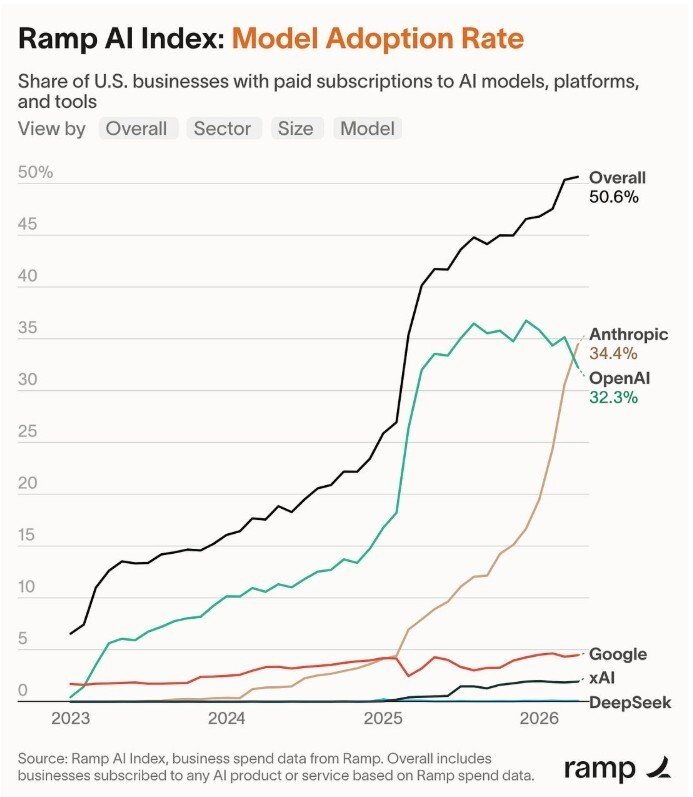
In my recent blog post about Josh Rowe’s analysis, I mentioned the business take-up of AI.
Here’s the data I referred to.
It doesn’t mean Anthropic has ‘won’ the AI race.
But its shift to selling years-ahead future capacity is a hint it has business where it wants it: as a key part of infrastructure, just like buildings, a water provider, an electricity provider.