Shares in stock exchange operator ASX fall as the regulator increases its capital requirements after damning inquiry findings.
The local share market opens its last full trading week of the year in the red, after a series of disappointing announcements from big tech stocks rattled Wall Street.
Follow the day’s financial news and insights from our specialist business reporters on our live blog.
Disclaimer: this blog is not intended as investment advice.
Key Events
Market snapshot
- ASX 200: -0.5% to 8,653 points (live values below)
- Australian dollar: -0.1% to 66.46 US cents
- Wall Street (Friday): S&P500 -1.1%, Dow -0.5%, Nasdaq -1.9%
- Europe (Friday): Dax -0.5%, FTSE -0.6%, Eurostoxx -0.6%
- Spot gold: flat at $US4,302/ounce
- Brent crude: +0.1% to $US 61.16/barrel
- Iron ore (Friday): -1.2% to $US103.00/tonne
- Bitcoin: -0.5% at $US88,065
Prices current around 10:20am AEDT
Live updates on the major ASX indices:
ASIC review piles pressure on ASX’s top boss
By Analysis by Ben Butler
By Analysis by Ben Butler
The corporate watchdog’s scathing assessment of the ASX’s lacklustre response to its rolling crisis will pile additional pressure on chief executive Helen Lofthouse.
Ms Lofthouse, who has been with the exchange for a decade and was made top dog in 2022, has already given up her short-term bonus this year in an effort to appease investors and market users angry at a series of bungles that have drawn the ire of regulators.
But according to an expert panel appointed by ASIC, the ASX continues to underestimate what it needs to do, is insular and defensive and has “deficiencies in culture and leadership”.
It’s important to note that this is the judgment of Ms Lofthouse’s peers among the top tier of Australian corporate life — the panel tasked with looking into the ASX is made up of senior banker Rob Whitfield, experienced non-executive director Christine Holman and former Reserve Bank deputy governor Guy Debelle.
The key question analyst Andrei Stadnik of Morgan Stanley asked Ms Lofthouse during a conference call on Monday morning was: given ASIC’s demand for stronger leadership, what’s going to be different?
“Transformational change is not easy,” Ms Lofthouse responded.
She said the ASX was “investing in leadership as a key lever of cultural and transformational change at all levels of the organisation” and pointed out that many of the problems she confronts have been there for years.
It is true that the roots of many of the exchange’s problems predate Ms Lofthouse’s tenure — most notably, the botched replacement of the vital system that clears share trades, CHESS, was the pet project of former CEO Elmer Funke Kupper, who left way back in 2016.
Mr Funke Kupper wanted to replace CHESS with a system based on the then-fashionable blockchain technology behind bitcoin and other cryptocurrencies. But, as Mr Stadnik pointed out, the current management team has been in place for three years.
And the key program the ASX hoped would fix its regulatory woes, Accelerate, was announced only in June. According to ASIC’s panel, this program is nowhere near ambitious enough and needs to be reset.
The regulators have given the ASX yet more time to come up with a plan to really fix its problems. Ms Lofthouse has until the end of February to give ASIC a plan. And until July to actually reset the Accelerate program.
Her fate may hinge on whether she can deliver.
ASX report ‘raises very serious issues’: Treasurer
Shares in ASX Limited are trading down today, after some damning interim findings from an inquiry commissioned by the corporate regulator, ASIC.
The stock exchange operator has issued a statement, confirming it has committed to the “strategic package of actions” ASIC has announced.
Treasurer Jim Chalmers has now just released a statement, welcoming this “agreement”.
“This is an agreement between ASIC and the ASX but from the government’s point of view, it’s very welcome.
“The report raises very serious issues and the ASX must now act urgently to fix them, consistent with the commitments it has given to the regulators.”
Key Event
The ASX 200 opens 0.7% lower, dragged down by the miners and supermarkets
The ASX 200 has opened 0.7% lower (at 10:45am AEDT), following a weak lead from Wall Street after tech stocks were hammered on Friday,
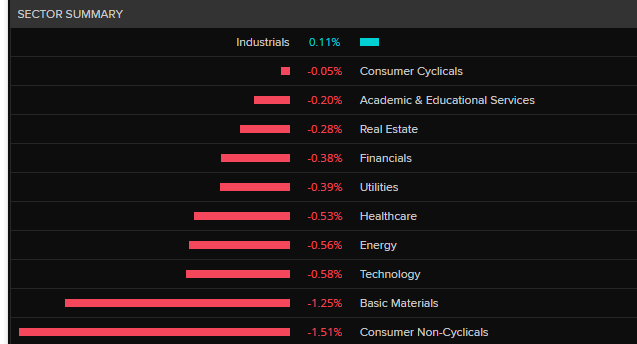
Most sectors are in the red but non-cyclical consumer and tech stocks, as well as the miners have been the hardest hit.
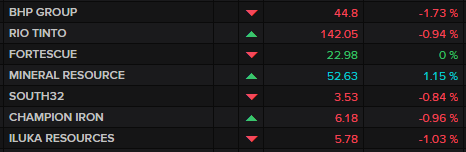
The big miners are down on lower iron ore and copper prices on Friday.
BHP and Rio Tinto have shed 1.7% and 0.9% respectively.
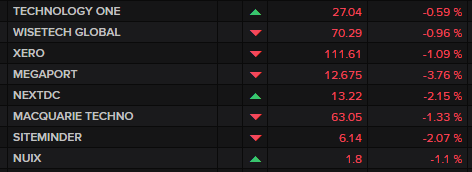
The tech sector is generally weaker, particularly data centre providers Megaport (-3.8%) and NextDC (-2.2%).
Retailers are mixed — non-cyclical outlets such as supermarkets are being sold off, while more discretionary retailers are doing better.
Woolworths is down more than 2% on news it had been hit with a class action over the alleged underpayment of staff.
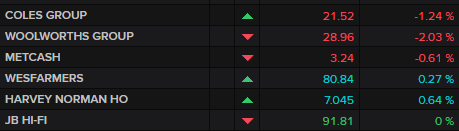
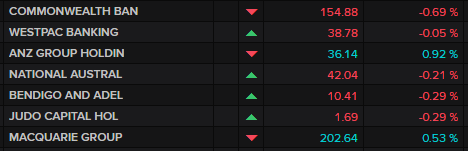
The banks are generally softer, although ANZ (+0.9%) and Macquarie (+0.5%) are bucking the trend.
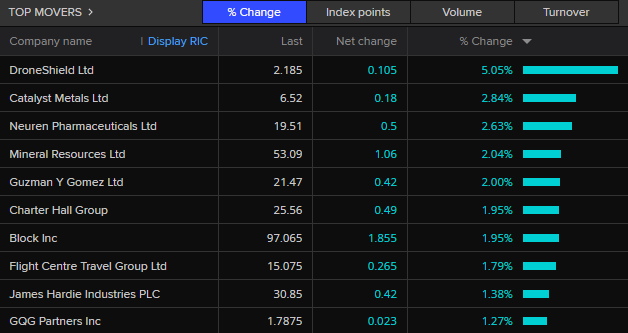
The top movers on the ASX 200 include DroneShield and gold miner Catalyst Metals.
Boutique global asset manager GQG is also doing well thanks to its underweight position in the big tech stocks.
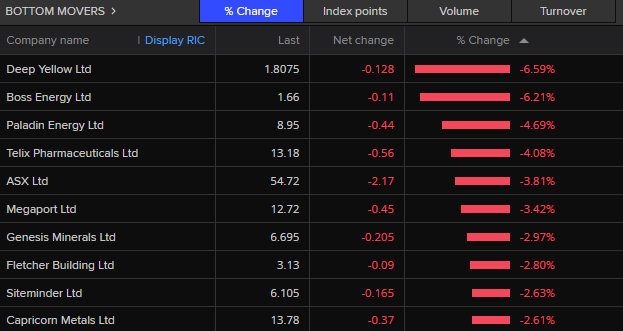
The ASX bottom movers include a host of uranium plays such as Deep Yellow (-6.6%), Boss Energy (-6.2%) and Paladin (-4.7%).
ASX Ltd has shed almost 4% after a damning report into its numerous inadequacies.
Key Event
Woolworths facing class action over alleged underpayments
Woolworths says it will defend itself against class action proceedings after allegations of staff underpayments in South Australia.
The supermarket giant announced the news on Monday, saying that legal action had been launched against it in Federal Court.
The company the allegations were brought by Shine Lawyers. They involved a Woolworths subsidiary and were based on South Australian state legislation repealed “some time ago” that deemed Sundays to be public holidays.
A previous proceeding was filed by another company, Dutton Law, related to staff underpayments.
Woolworths said it did not believe the legal action was market sensitive and declared it would defend the proceedings.
In September, in a separate case involving both Woolworths and Coles, Woolworths flagged potential additional costs of more than $500 million.
That was after the Federal Court handed down a judgement on the historical underpayments of employees at the two major supermarkets, affecting nearly 30,000 employees.
Reporting by Reuters
Key Event
ASX Ltd shares drop 3.5% after damning inquiry findings
Shares in ASX Limited have dropped at the open, down 3.5% so far after some damning interim findings from an inquiry commissioned by the corporate regulator.
The stock exchange operator has just issued a statement, confirming it has committed to the “strategic package of actions” ASIC announced earlier.
The firm’s capital requirements have been increased, reflecting an “elevated risk profile” identified by the inquiry.
The company has left its expense growth and capital expenditure guidance unchanged.
ASX managing director Helen Lofthouse described it as a “tough report”.
“It has placed ASX under a critical lens and the assessment from the Panel is that we must get better.
“We’re driving that process now and it is clear we will need to lift leadership at all levels to deliver.
“We are aligned with the Report on the need to transform and that has been the driving force behind our strategy, including our significant investment in technology modernisation.
“This reset gives us further impetus to bring about deep and lasting change.
“These actions should be a clear signal to the market that ASX is committed to delivering the transformation necessary for resilient and future-ready critical market infrastructure.”
ASX will address investors and analysts at 11am AEDT, so we’ll keep you updated on that.
Key Event
ASX opens lower
The local session is underway, for the final full trading week of the year (yes, we are that close — the next two weeks have a few public holidays and shortened sessions).
The ASX 200 is down by half a percent, as is the All Ords.
Super funds accused of delaying disability insurance claims
Some superannuation members are still experiencing delays and issues with total and permanent disability (TPD) insurance claims through their super funds.
Consumer advocates are calling for mandatory timeframes to be placed on claims handling processes, but the super industry says it could be problematic.
Assistant Treasurer Daniel Mulino said there had been areas where some funds had fallen short and the government was consulting on new standards to improve how funds engaged with their members.
He did not comment when asked by ABC News whether these standards would include specific timeframes for super funds to respond to insurance claims, but said the government wanted to ensure “funds put member interests at the heart of service delivery”.
You can read more from Nassim Khadem:
Key Event
What has led to the scrutiny on ASX Limited?
ASIC has released the interim findings of a review into stock exchange operator ASX this morning. It contains quite a lot of corporate jargon around strategic resets and transformation projects.
So what has led to the increased scrutiny on ASX?
There has been a litany of issue in recent years, but on that really got the regulators circling was a pre-Christmas outage last year, which left brokers unable to settle trades.
In March, the corporate regulator ASIC and the Reserve Bank issues a joint letter rebuking the exchange operator, describing “deep concerns”.
By June, ASIC had launched an investigation, citing “ongoing concerns over ASX’s ability to maintain stable, secure and resilient critical market infrastructure”.
“ASIC’s decision to initiate an Inquiry follows repeated and serious failures at ASX,” Mr Longo said in the announcement at the time.
There have been other incidents since — in August, an embarrassing bungle saw ASX assign a company announcement involving private equity firm TPG Capital to the unrelated listed telecom TPG.
And a fortnight ago, there was a technical glitch that left companies unable to publish announcements, leaving dozens of stocks in trading halts due to being unable to notify investors of price-sensitive developments.
You can read a recap of some of ASX’s woes from chief business correspondent Ian Verrender:
Key Event
Whitehaven Coal doubles reserves at Blackwater Mine
Whitehaven Coal has almost doubled its recoverable reserves from its Blackwater Mine in Queensland’s Bowen Basin.
In a statement to the ASX, Whitehaven upgraded the recoverable reserves at the mine from 191 million tonnes to 365 million tonnes.
Blackwater is one of the largest metallurgical coal mines in Queensland and is jointly owned by Whitehaven (70%), Nippon Steel (20%) and JFE Steel (10%).
Whitehaven and its partners bought Blackwater from the BHP- Mitsubishi Alliance (BMA) in 2023 in a deal valued at more than $4 billion.
Whitehaven CEO Paul Flynn says the reserves updates reflect the progress the company is making to integrate and advance the Queensland operations acquired from BMA.
“The uplift to the Resources and Reserves at Blackwater unlocks future mining areas and reinforces its position as a long-life asset and the strong potential for growth (at the mine),” Mr Flynn said.
Key Event
CBA hit with anti-money laundering fine in NZ
CBA’s New Zealand subsidiary, ASB, has been hit with an anti-money laundering action launched by the Reserve Bank of New Zealand.
The RBNZ says ASB has co-operated with it and has admitted liability for “all seven causes of action” in breaches of core requirements under the Anti-Money Laundering and Countering Terrorism Act.
The breaches date back to at least 2019.
The proceedings were launched in the NZ High Court.
The RBNZ says both parties have agreed to jointly recommend a penalty of $NZ6.73 million ($5.86 million), though the final determination is up to the court.
Key Event
Treasury Wine Estates in trading halt
The much-diminished Treasury Wine Estates (TWE) has placed itself in a trading halt pending an investor update on Wednesday, December 17.
Earlier this month, TWE wrote down the value of its North American business by almost $700 million, although that may not be the end of the impairments by the time the interim results are announced.
TWE’s share value has halved so far this year.
Key Event
ASX inquiry finds defensive culture, ‘lack of vision’, poor supervision
The ASIC inquiry into the ASX was announced in June.
Based on this morning’s statement from the regulator, it seems the findings could not be sat on.
ASIC said the inquiry “has identified shortcomings in ASX’s governance, capability, risk management and culture that required urgent attention and response”.
“Due to the urgency of the reset required, the insights of the Report were shared with ASIC, and ASIC engaged with ASX.”
These interim findings are based on around 140 stakeholder interviews, written submissions, a review of nearly 10,000 documents, focus groups with ASX staff and benchmarking with international entities, ASIC said.
Key findings include:
- ASX’s focus on short-term financial performance and shareholder returns has compromised its obligations to operate critical national market infrastructure
- ASX’s strategy lacks the vision necessary for the critical role it plays
- The organisation’s culture is defensive, which limits its ability to deliver meaningful change
- ASX’s governance structures do not ensure the independence of its Clearing and Settlement subsidiaries and their required levels of investment
- Existing supervisory practices have not achieved the desired outcomes.
Key Event
Urgent action needed to fix ASX, says corporate regulator
ASIC has released interim findings of its inquiry into stock exchange operator ASX — and says what was uncovered was so serious, immediate action is required.
The corporate regulator says ASX has committed to a “package of reforms” including an additional $150 million capital charge on the company, improving governance, changes to an existing transformation program and “a commitment to stronger leadership”.
ASIC chair Joe Longo said “urgent action was needed to set ASX on the right path”.
“ASX needs to embrace a new era of accountability, investment, and stewardship to increase confidence, and meet the expectations of the market and the Australian public.
“This package is a circuit-breaker.
“Many of the problems the report identifies took years to develop, and while there are some immediate actions that will be put in place, the key issues are going to take time and resources to resolve. There are no quick fixes or shortcuts.
“This reset is about addressing underlying issues, and laying the foundations for a resilient, world-class market operator.
“This should be a clear signal to the market that ASX are committed to delivering the transformation necessary for resilient and future-ready national market infrastructure.”
Russian oil revenues halved since last year: report
Reuters has an interesting piece about the Russian budget being under the pump (so to speak) from sharply declining oil revenues, which its Treasury bean counters failed to see coming.
While sanctions have made an impact, the big drivers have been a lower-than-expected oil price and a stronger than expected currency.
Reuters calculated that Russian state oil and gas revenue in December is likely to almost halve from a year earlier to 410 billion roubles ($US5.17 billion) as a result of lower crude prices and a stronger rouble.
It is a significant amount, given that oil and gas account for a quarter of federal budget proceeds in Russia, and those proceeds have been drained by heavy defence and security spending since Russia invaded Ukraine in February 2022.
Here’s more from the Reuters report:
For the entire year, the (oil and gas) revenue is set to fall by almost a quarter to 8.44 trillion roubles, below the Finance Ministry’s 8.65 trillion rouble forecast, according to calculations based on data from industry sources and official statistics on production, refining and supplies.
Russia reported its lowest monthly oil and gas revenue of 405 billion roubles in August 2020, when oil prices tumbled during the COVID-19 pandemic.
Sergei Konygin, a senior analyst at Moscow-based investment bank Sinara, said that the budget deficit of 1.6 trillion roubles expected in December will be covered by state bonds, but 2026 will be more difficult.
“Next year is a big challenge to the budget as it was formed under an optimistic scenario of oil at $59 (per barrel) and the rouble at 92 (per dollar),” he said.
The Russian oil price used for taxation purposes decreased in November by 16.4% from October to $44.87 a barrel while the rouble strengthened to 80.35 per dollar.
Konygin expects amendments to the budget next spring to make use of the National Wealth Fund to address the deficit under a lower assumed price of oil.
Ukraine and its Western backers have repeatedly said they want to curb Russian oil revenue to force the world’s second-largest oil exporter to end the war in Ukraine.
The Finance Ministry had initially expected 10.94 trillion roubles in oil and gas revenue this year but made a downward revision in October to account for global oil prices that have been driven lower by concern over a supply glut.
With Reuters
This week — MYEFO and consumer confidence
Australia:
Tue: MYEFO, Westpac/MI consumer sentiment (Dec), ANZ/Roy Morgan consumer confidence (weekly), PMIs (Dec)
Thu: Finance & wealth (Q3)
Fri: Private sector credit (Nov)
International:
Mon: CN — Retail sales, industrial production, FAI (Nov), Residential property sales (YTD)
US — NAHB housing index (Dec)
Tue: US — Payrolls/unemployment (Nov), Retail sales (Oct), PMIs
Thu: UK — BoE rates decision
US — CPI (Nov)
Fri: EU — ECB rates decision
JN — BoJ rates decision
The data flow slows to a trickle locally this week, with the Westpac-Melbourne Institute consumer sentiment survey (Tuesday) one of the few significant releases in the diary.
Westpac described November’s 13% surge as “extraordinary and somewhat surprising,” and the first net positive (optimistic) result for the best part of four years.
The December survey was taken as the RBA confirmed that “a rate cut was not on the table” and that the Board was focused on the upside risks to inflation.
“The degree to which this could weigh on sentiment will be of great interest in the run-up to holiday high season for retail,” Westpac says.
Federal Treasury is expected to release its Mid-Year Economic and Fiscal Outlook (MYEFO) on Tuesday, but that is yet to be confirmed.
The MYEFO statement will update the federal government’s spending and fiscal position since the March budget.
The budget initially forecast a deficit of $42 billion, but given a pickup in nominal GDP and stronger-than-forecast iron ore prices, CBA’s economics team says don’t be surprised if the deficit comes in at a narrower $32 billion.
Offshore, the US statisticians continue to play catch-up after the protracted Federal Government shutdown.
The long-awaited and finally updated non-farm payroll data (Tuesday) is expected to show jobs grew by around 100,000 in November, with unemployment holding at 4.4%.
US core Consumer Price Inflation (Thursday) is expected to have risen 0.2% in November, or 3.0% over the year.
There will be a flurry of central bank activity with the Bank of England expected to cut (Thursday), the European Central Bank hold (Friday), and the Bank of Japan hike (Friday).
Key Event
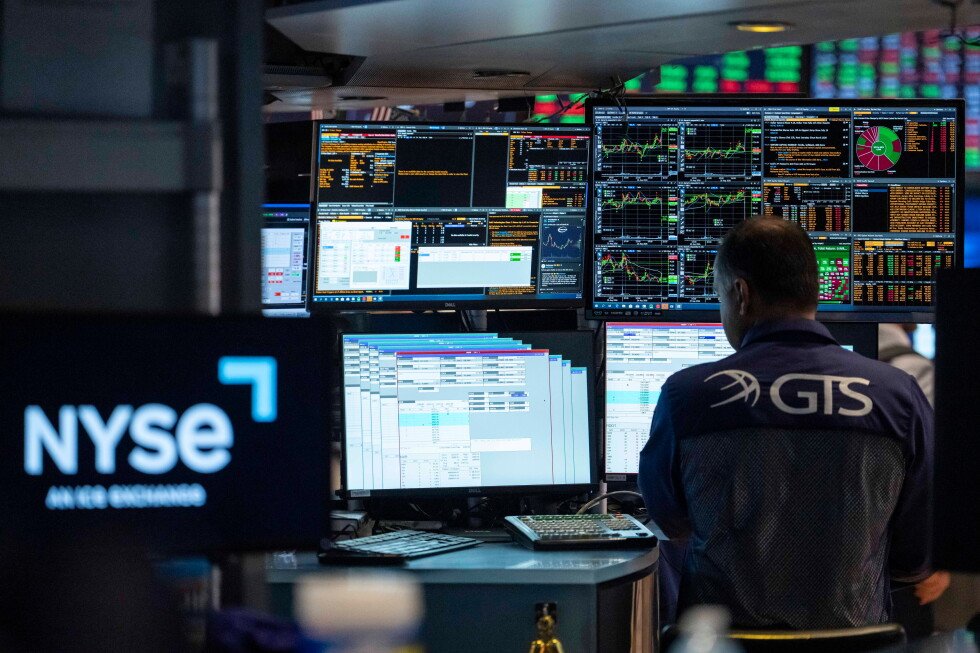
Wall Street stumbles on tech sell-off, ASX set to fall
It wasn’t one of those champagne-popping, record-topping ends to the week on Wall Street.
The bubbles went flat as traders spent the day executing sell orders on tech stocks, which soured the sentiment across the board.
The S&P 500 closed 1.1% lower while the blue-chip Dow fell 0.5%.
The tech-centric Nasdaq tumbled 1.9%. The technology sector within the S&P 500 lost 2.9% as AI punters decided to take some profits off the table in double-jig time.
The cloud-computing company Oracle, which had prompted the tech wobble earlier in the week with a disturbing mix of weak earnings forecasts and massive spending commitments, dropped another 4.5% on top of Thursday’s 11% capitulation.
Chipmaker Broadcom closed 11% lower after issuing a warning about its margins, and AI leader Nvidia shed another 3.3%.
Granite Wealth Management Managing Director Bruce Zaro told Reuters that “continued disappointment and uncertainty over the AI trade and technology trade” pressured the market.
“I would have thought this choppiness would have ended by now,” he said.
“We’re in a really, really good seasonal period. Typically, mid-December through the last trading days of the year is traditionally the Santa Claus rally period.”
European stocks also closed lower with the broad Eurostoxx 600 shedding 0.6%, while the global MSCI was also down 0.6%.
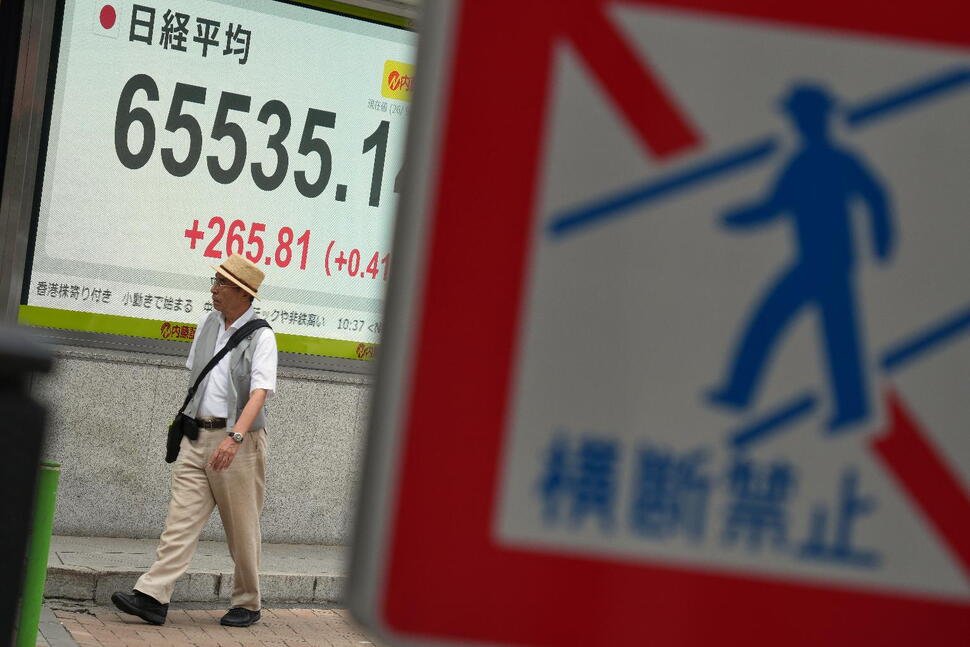
Over the week, the S&P 500 fell 0.5%, while the ASX was one of the better performers, picking up 0.7%, matching the effort of the Nikkei.
However, if futures markets are anything to go by, the ASX will give up a fair chunk of last week’s gains, pricing in a 0.6% loss on opening.
US Treasury yields rose in line with the global vibe that most central banks were nearing the end of their current easing cycle.
The US dollar was generally stronger, although the Aussie dollar largely held its ground against the greenback. It notched its third successive week of gains and hit its highest weekly close in almost fourteen months.
On commodity markets, oil prices slipped due to ongoing worries about oversupply building into next year.
The global benchmark Brent crude fell 1.5% to be down almost 4% over the week.
Gold pushed above $US4,300 an ounce, while silver slipped on profit taking and copper eased 3% after almost hitting $US12,000/tonne and a new record high.
Overnight, Bitcoin again dived back under $US90,000.
Good morning
Good morning, and welcome to another day on the ABC markets and finance blog.
Stephen Letts from ABC business team limbering up for a blow-by-blow coverage of the day’s events, where every post is hopefully a winner, but none should be construed as financial advice.
In short, it looks like the local market will start the week heading south after Wall Street’s key indices closed sharply lower on Friday.
Futures trading is pointing to the ASX drop of around 0.6%.
Up ahead, we’ll get the monthly update on China’s retail sales, industrial production and infrastructure/property investment, as well as a reading on home prices.
As always, the game’s afoot, so let’s get blogging.
Loading
Market snapshot
- ASX 200 futures: -0.6% to 8,659 points
- Australian dollar: -0.1% to 66.43 US cents
- Wall Street (Friday): S&P500 -1.1%, Dow -0.5%, Nasdaq -1.9%
- Europe (Friday): Dax -0.5%, FTSE -0.6%, Eurostoxx -0.6%
- Spot gold (Friday): +0.5% to $US4,302/ounce
- Brent crude (Friday): -1.5% to $US 61.12/barrel
- Iron ore (Friday): -1.2% to $US103.00/tonne
- Bitcoin: -1.7% at $US88,600
Prices current around 7:15am AEDT