Key Points
-
Vanguard research from June projects that U.S. value stocks and international developed-market stocks might outperform in the future era of AI-driven productivity.
-
The Vanguard Small-Cap Value ETF has delivered a roughly 27% return in the past year.
-
The Vanguard International Dividend Appreciation ETF offers a high dividend yield from a mix of financially strong global companies.
Who will be the biggest winners of the artificial intelligence (AI) boom? Some investors believe the AI hyperscalers will win by building AI tools, while other investors are betting on AI pick-and-shovel companies building AI infrastructure and data centers. But what if there were a third choice?
New research from Vanguard is bullish on AI, but not necessarily AI stocks. The investment company’s June outlook projects that the biggest future gains of AI won’t go to the major tech players currently building it. Instead, Vanguard says the best returns from artificial intelligence might go to U.S. value stocks and international stocks in developed markets outside the U.S. That’s because these companies could be in the best position to use AI to make more money and boost productivity and efficiency.
Where to invest $1,000 right now? Our analyst team just revealed what they believe are the 10 best stocks to buy right now, when you join Stock Advisor. See the stocks »

Image source: Getty Images.
Vanguard’s research doesn’t recommend any particular stocks or exchange-traded funds (ETFs). But let’s look at two Vanguard ETFs that could fit the investment strategy of buying into the future of AI, but not only AI stocks.
Vanguard Small-Cap Value ETF (VBR): 835 stocks, 22 years of 9.6% annualized returns
The Vanguard Small-Cap Value ETF(NYSEMKT: VBR) offers a diversified portfolio of small-cap stocks that might be poised to grow from AI productivity gains. This fund delivered a 15.9% return through the first half of the year and 27.1% over the past year, outperforming the S&P 500 index. It charges a low expense ratio of 0.05%.
The fund holds a portfolio of 835 small-cap stocks with a well-diversified sector mix. Because it’s a value stock ETF, it’s not heavily weighted toward tech companies. The fund’s top five sectors are industrials (21.5%), financials (18.1%), consumer discretionary (13.9%), technology (9.6%), and real estate (9.5%).
One note of caution: Value stocks haven’t often beaten the rest of the market in the long run. The Vanguard Small-Cap Value ETF was established in January 2004, and during the past 22 years, it has delivered average annual returns of 9.6%. The S&P 500 index has delivered much stronger returns over that 22-year time frame:
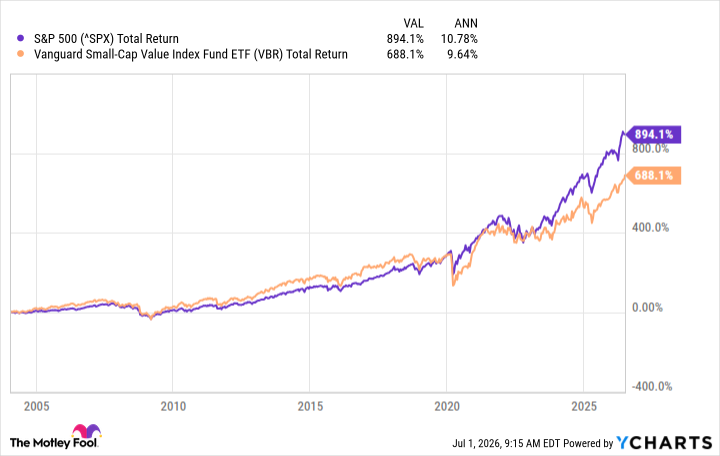
But past performance doesn’t guarantee future results. If you believe that smaller, undervalued companies might be more likely to benefit most from the future of AI, this ETF could fit the bill.
Vanguard International Dividend Appreciation ETF (VIGI): 343 stocks, 10 years of 8.4% annualized returns
The Vanguard International Dividend Appreciation ETF(NASDAQ: VIGI) holds a mix of 343 international stocks with a track record of paying higher dividends year over year. The fund pays a trailing 12-month dividend yield of 2.12% at recent prices, which is competitive with some of the best dividend ETFs. It charges a low expense ratio of 0.07%.
This fund was established in February 2016, and from inception through June 30, it delivered average annual total returns of 8.4%, underperforming the S&P 500. It’s also underperformed the S&P 500 over the past five years.
Most of the ETF’s portfolio is in developed markets, with only 5.1% of the fund’s assets in emerging markets. The top five countries represented are Japan (30.9% of the fund), Canada (23%), Switzerland (14.4%), Germany (5.5%), and the United Kingdom (5.6%).
The fund’s top stock holdings are mostly international banks from Canada and Japan, with two major Swiss companies that are well-known names in pharmaceuticals and consumer staples:
- Royal Bank of Canada (NYSE: RY): 4.5% of the fund
- Mitsubishi UFJ Financial Group (NYSE: MUFG): 3.9%
- Nestlé (OTC: NSRGY): 3.8%
- Novartis (NYSE: NVS): 3.55%
- Toronto-Dominion Bank (NYSE: TD): 3.4%
This international stock ETF has underperformed the broader U.S. stock market in the past. But it could be a good buy for the future if you believe in Vanguard’s thesis that some of the biggest gains from AI could go to international stocks in developed markets like Canada, Japan, and Western Europe.
The Vanguard International Dividend Appreciation ETF holds a mix of well-established, solidly profitable companies that pay strong dividends, like major banks and pharmaceutical giants. If these companies can use AI in the future to improve their profitability, that could be good news for this ETF’s shareholders.
Should you buy stock in Vanguard Small-Cap Value ETF right now?
Before you buy stock in Vanguard Small-Cap Value ETF, consider this:
The Motley Fool Stock Advisor analyst team just identified what they believe are the 10 best stocks for investors to buy now… and Vanguard Small-Cap Value ETF wasn’t one of them. The 10 stocks that made the cut could produce monster returns in the coming years.
Consider when Netflix made this list on December 17, 2004… if you invested $1,000 at the time of our recommendation, you’d have $418,761!* Or when Nvidia made this list on April 15, 2005… if you invested $1,000 at the time of our recommendation, you’d have $1,195,804!*
Now, it’s worth noting Stock Advisor’s total average return is 918% — a market-crushing outperformance compared to 208% for the S&P 500. Don’t miss the latest top 10 list, available with Stock Advisor, and join an investing community built by individual investors for individual investors.
*Stock Advisor returns as of July 4, 2026.
Ben Gran has no position in any of the stocks mentioned. The Motley Fool recommends Nestlé. The Motley Fool has a disclosure policy.
This article contains syndicated content. We have not reviewed, approved, or endorsed the content, and may receive compensation for placement of the content on this site. For more information please view the Barchart Disclosure Policy here.