By Kim Deok-hyun
SEOUL, May 31 (Yonhap) — With President Lee Jae Myung set to mark one year in office this week, his government has put top priority on efforts to revive economic growth and reinvigorate the capital market, which has received a boost with the local bourse pulling off a world-leading rally.
Still, the economy is facing multiple external challenges, including high energy prices triggered by the tense standoff in the Middle East and uncertainties surrounding Washington’s mercurial tariff policy.
In particular, the unpredictability over how the U.S.-Israeli war with Iran will end is having ripple effects on the global economy as a whole as well as impacting conditions facing South Korea.
“Oil supply disruptions have sharply driven up gasoline and diesel prices. Shortages of such raw materials as naphtha and urea are posing a threat to a wide range of people’s livelihoods, including the production of plastic bags and other everyday products as well as fertilizers,” Lee said in a budget speech in early April.
“Above all, we must steel ourselves for stronger, more thorough responses since this situation may not end soon,” the chief executive said, adding, “A state of emergency requires extraordinary measures, indeed.”
Last week, the Bank of Korea (BOK) held its key rate unchanged at 2.5 percent, but hinted a return to a hawkish monetary policy to curb inflationary pressure and prevent the Korean currency’s further weakness against the U.S. dollar.
Buoyed by strong exports of semiconductors and government spending, the BOK raised its economic growth outlook.
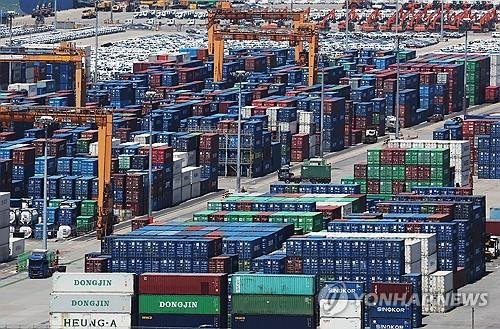
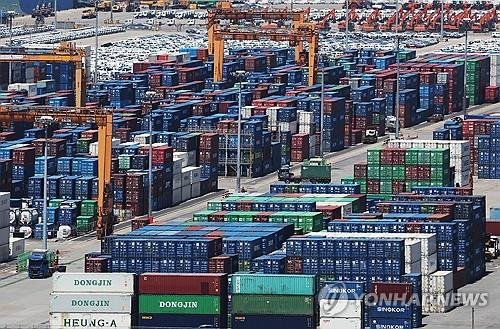
Containers are stacked at a port in Pyeongtaek, around 60 kilometers south of Seoul, in this file photo taken May 8, 2026. (Yonhap)
“The Korean economy is projected to expand by 2.6 percent this year — well above the February forecast of 2.0 percent — driven by robust semiconductor exports, while government measures, including the supplementary budget, partially offset the Middle East-driven supply shock,” the BOK said in a statement.
Reflecting a sharp rise in petroleum prices and its repercussions on other items, however, the BOK also increased its inflation forecast to 2.7 percent this year, compared with its February outlook of 2.2 percent.
“The global economy is expected to slow, as the commodity supply disruption stemming from the Middle East gradually weighs on activity, despite robust AI-related investment,” the BOK elaborated.
Currently, transit through the Strait of Hormuz, a key shipping route for oil, fertilizer and other commodities, was at some 10 percent of pre-war levels, according to the BOK.
Full normalization of transit through the strait is expected to take “considerable time, given potential mine clearance requirements, transit safety concerns and insurance constraints,” it said.
The nation’s industrial output fell 0.6 percent on month in April, with retail sales and facility investment also declining due to economic uncertainties stemming from the war in the Middle East.
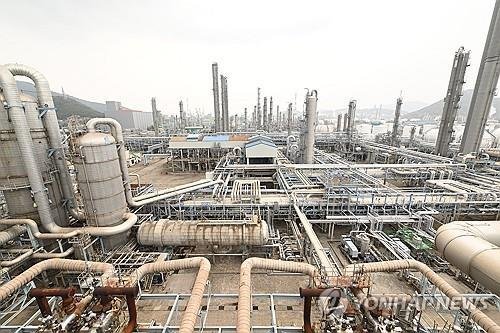
Naphtha processing facilities in the Yeosu National Industrial Complex in Yeosu, South Jeolla Province, are in operation, in this file photo from April 1, 2026. (Yonhap)
Signs of a switch toward tighter monetary policy could hurt market sentiment, but solid exports of semiconductors have underpinned stocks.
Fueled by artificial intelligence (AI) optimism and the government’s campaign to enhance shareholder returns, the benchmark Korea Composite Stock Price Index (KOSPI) hit 8,000 points this month.
It marked an unprecedented rally for the KOSPI, which had been trading at some 2,680 points a year ago, although some analysts have warned of a potential bubble.
The KOSPI broke above the 3,000 mark on June 20, 2025, and surpassed 4,000 points in October last year.
On Jan. 22, it hit 5,000 points in intraday trading, and touched 6,000 points on Feb. 25 and 7,000 points on May 6.
Besides the upbeat growth forecast and surging stock market, the Lee administration in March, implemented the so-called yellow envelope act, which is designed to guarantee bargaining rights for indirectly employed and subcontracted workers and prohibit companies from filing damage claims against unionized workers.
While labor groups welcomed the new law, business organizations voiced concerns about widening disputes between labor and management. Some critics have even warned that the law may embolden union workers to engage in hard-line tactics to get what they want, and if this leads to long-drawn standoffs, it can negatively impact the economy down the line.
On the prickly issue of soaring real estate prices and the pressing need to take remedial actions, the president and policymaker have made clear this is a top priority that the government is moving to bring under control.
Apartment prices in Seoul rose 0.28 percent in the second week of May, up 0.13 percentage point from a week ago, according to the Korea Real Estate Board.
It marked the highest weekly gain since the fourth week of January, when the government announced its stance over the planned end of a temporary exemption from heavy capital gains taxes for multiple homeowners.
As part of broader efforts to stabilize the housing market, the government has said it will supply some 90,000 rental housing units for young people in the greater Seoul area by 2027.
Whether such measures coupled with concerted efforts to limit borrowing will have the desired effect only time will tell, but many experts have pointed out that this matter is something that the government needs to resolve as soon as possible if it wants to avoid the criticisms that have weakened many administrations in the past.
(END)