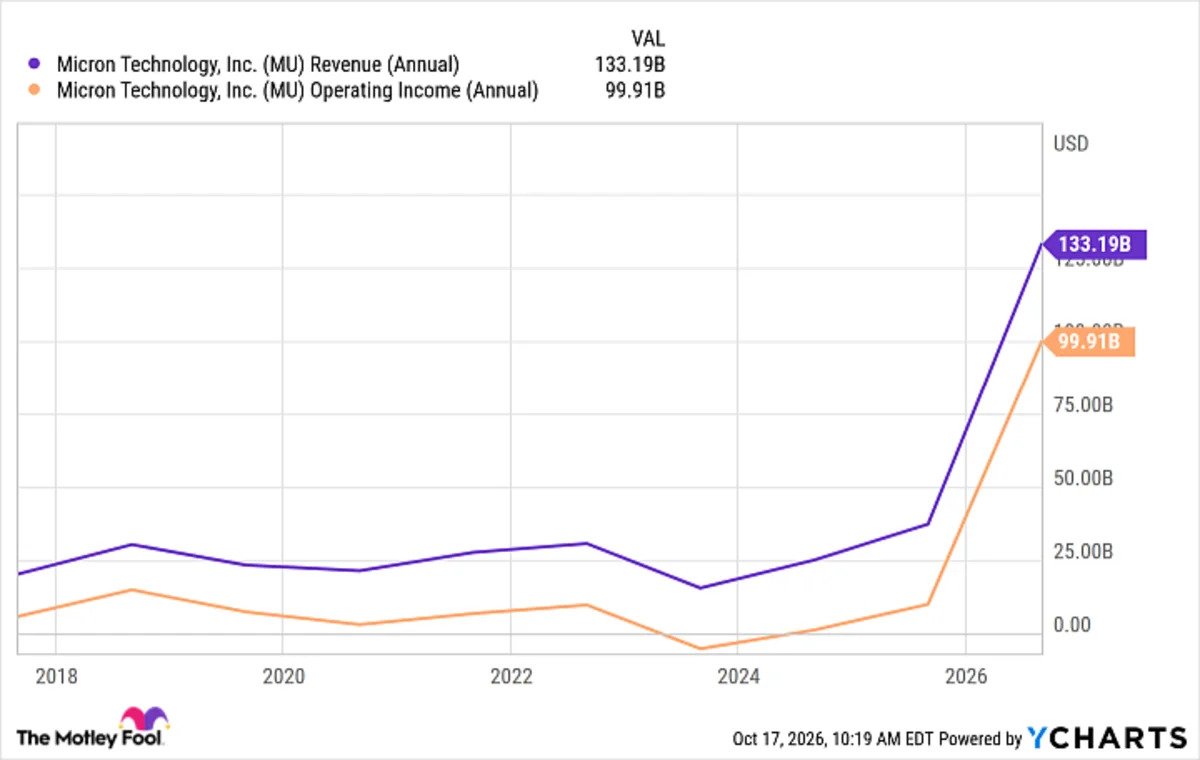
Micron (NASDAQ: MU) has been one of the market’s hottest stocks over the past year, with the ongoing artificial intelligence (AI) boom driving investors toward companies that make memory and storage devices. The stock was up 334% over the past 12 months and up 208% for the year through market close on Oct. 16.
There’s no doubt it’s been a good ride for Micron investors, but what might the next few years look like for the stock?
Missed Nvidia in 2009? This Rare Signal Is Flashing Again. In 2009, a “Double Down” signal flashed for a little-known chipmaker called Nvidia. For the first time in years, that same “Total Conviction” signal is flashing for a company 1/100th the size of Nvidia. Continue »
Micron is riding an AI high
Training AI models requires tons of data processing, and all that data must be stored in ways that allow processors to access it rapidly, which is why memory and storage devices have become some of the most important components in data centers.
With demand for memory chips skyrocketing and supplies limited, shortages are plaguing the whole space, and Micron and its peers have been able to flex their pricing power. From fiscal 2025 to fiscal 2026 (which ended Sept. 3), Micron’s operating income (profit from core operations) rose from $9.77 billion to $99.34 billion, its gross margin jumped from 39.8% to 80.7%, and its operating margin jumped from 26.1% to 74.6%.

MU Revenue (Annual) data by YCharts.
The memory chip industry has always been cyclical, so current conditions won’t prevail permanently, but right now, the company is definitely riding high.
At the moment, all the memory-chip makers are working on new fabrication lines to expand their production capacity. When supply catches up (and it will), prices will inevitably cool, but that doesn’t diminish the stock’s long-term appeal. The shortage is expected to last at least through 2027, though some have projected it to persist into 2030 because of the compute demands expected from agentic AI.
Regardless, right now, money is pouring into Micron and its peers from the ongoing data center and AI infrastructure build-out.
Could investors triple their investment by 2030?
At the time of this writing, Micron is trading at 7.5 times its sales, slightly above the 6.5 P/S ratio it has averaged over the past three years.
MU PS Ratio data by YCharts.
In its fiscal 2027, Micron’s revenue is projected to be $318 billion, up 139% from the $133.2 billion it made in fiscal 2026. I don’t expect that growth rate to continue to 2030, but let’s assume it grows by 30% in fiscal 2028 and 25% in fiscal 2029. That would put its revenue at around $517 billion in fiscal 2030.