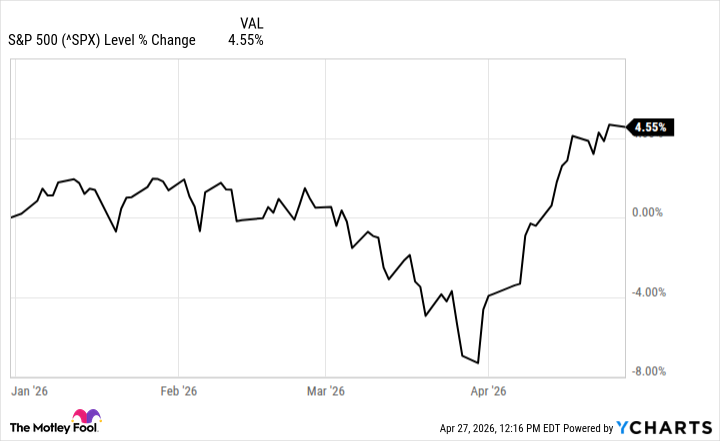
The war in Iran is one of the biggest stories thus far in 2026. How it plays out will undoubtedly impact global markets and how well the S&P 500 (^GSPC +0.14%) does this year. Right now, the broad index is up over 4% as investors don’t appear overly concerned, as U.S. President Donald Trump often talks about the conflict coming to an end and being open to peace talks.
While the S&P 500 may surge even higher this year, there may be challenges ahead for the markets, even if the war in Iran ends. What I predict will have a much more significant impact on the markets this year is what happens with the Fed and its current chair, Jerome Powell. That could determine whether the markets tank or reach new highs in the coming months.

Image source: Getty Images.
Criminal probe dropped, but uncertainty remains
Powell’s term as Fed chair is set to end on May 15, but there’s been uncertainty as to whether he will stay on or not. The Department of Justice recently dropped its controversial investigation into Powell, which should pave the way for Trump’s nominee, Kevin Warsh, to be confirmed.
But there’s still the lingering question of whether Powell will stay on as governor or leave the Fed entirely. Previously, he stated he would stay on due to the DOJ investigation, but with a criminal probe no longer ongoing, that could mean he may depart, which has been the norm for outgoing chairs in the past. Trump has previously threatened to fire Powell if he doesn’t leave. If that were to happen, the fallout on the stock market could be significant, as it would call into question the Fed’s independence.
What should investors do?
How the uncertainty at the Fed plays out could have a significant impact on the markets. If things go smoothly, the S&P 500 may continue to reach new heights. But if that doesn’t happen and there’s ongoing conflict between Trump and Powell, the markets may tumble yet again.
While it’s impossible to know for sure what will happen, there are multiple things investors can do to minimize risk. This includes reducing positions in highly expensive stocks that may be vulnerable to sell-offs and instead looking at safer investments, including dividend stocks, which can help add stability and diversify your portfolio in the process.
There’s no guaranteed, surefire way to completely eliminate risk, but you can be less vulnerable to the market’s swings by focusing on low-volatility stocks.
David Jagielski, CPA has no position in any of the stocks mentioned. The Motley Fool has no position in any of the stocks mentioned. The Motley Fool has a disclosure policy.