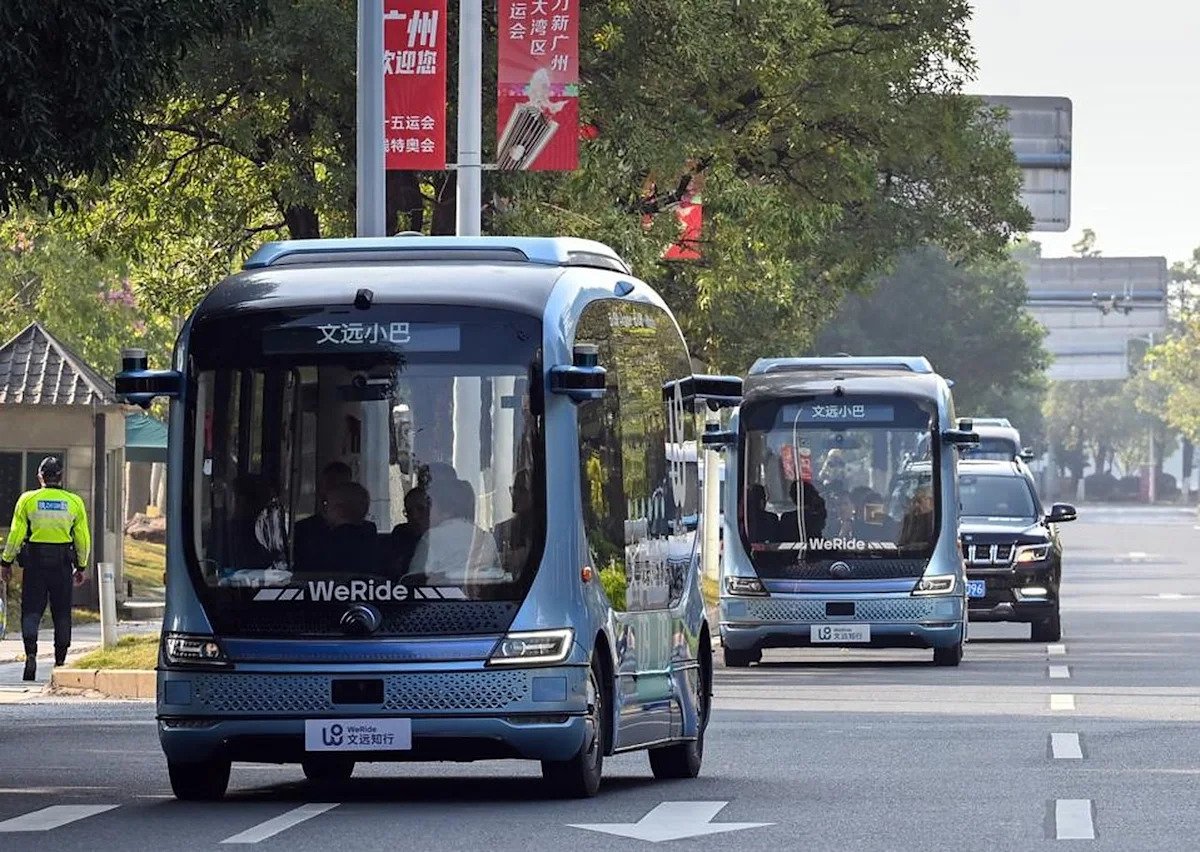
Shares in WeRide Inc., one of China’s largest autonomous driving companies, plunged by nearly 8.6% in Nasdaq trading on Friday to an all-time closing low of $2.985 after the company said its loss in the third quarter widened slightly from a year earlier despite a big increase in revenue.
Revenue in the three months ending on Sept. 30 rose by 88 percent to the equivalent of $48 million, or 321 million yuan, buoyed by gains in overseas business. International revenue increased by 171% from a year earlier to $21.9 million. Robotaxi revenue climbed 204% year-on-year to more than 100 million yuan. The company also saw increased demand for its real-time, physical-world data for AI infrastructure businesses, WeRide said.
WeRide’s quarterly loss of 310 million yuan, or $46.2 million, however was slightly worse than 307 million yuan a year earlier. For the first nine months of the year, WeRide lost $164 million, little changed from a year earlier.
WeRide went public on the Nasdaq in October 2024 at $15.50 per American depository share, raising more than $400 million when combined with a stock placement. Its current stock price of $2.985 leaves its IPO investors deep underwater. The company’s shares have also traded at the Hong Kong Stock Exchange after November 2025.
“This quarter showed that our global strategy is working. Overseas markets now generate nearly half of our total revenue and more than 90% of our Robotaxi revenue,” WeRide CEO Tony Han said in a statement. “WeRide is now Uber’s largest autonomous vehicle partner outside the United States by driverless fleet size. In China, our Guangzhou Robotaxi operations achieved positive unit economics, demonstrating that Robotaxi can be a sustainable business.”
“Robotaxi is our core business and the fastest path to commercializing Physical AI. The technology and closed-loop data we have built on real roads now power three mutually reinforcing businesses: Robotaxi, L2++/L3 solutions, and AI Infrastructure, which extends these capabilities to foundation models, embodied AI and robotics,” he said. “As an infrastructure builder for Physical AI, we are just getting started.”
Investors include Zhengzhou Yutong Group, a supplier of electric buses, Qiming Venture Partners, a Shanghai-headquartered investment company, and Alliance Ventures, whose partners include Renault, Nissan Motor and Mitsubishi Motors. Other global players in the autonomous driving business include Waymo and Tesla of the U.S. and China’s Baidu and Pony.ai.
Headquartered in the southern Chinese city of Guangzhou, WeRide was formed in 2017. Han worked as an associate professor of the electrical and computer engineering department at the University of Missouri from 2007 to 2017. He was the chief scientist of the autonomous driving unit at Chinese search heavyweight Baidu Inc. from 2014 to 2017. Han holds a bachelor’s degree in electrical and computer engineering from Beijing Jiaotong University, a master’s degree in electrical engineering from the University of Rhode Island, and a Ph.D. in electrical and computer engineering from the University of Illinois Urbana-Champaign.
Chinese Brands’ Global Push Opens Doors For Big U.S. Advertising Firm
China’s Miniso Retail Billionaire Ye Guofu Aims For The World
This article was originally published on Forbes.com