I love the stock market. I love it in a thoroughly mercenary way because it provides the most honest snapshot of public sentiment that no mass poll or sophisticated focus group can match. Last week, the stock market spoke with absolute honesty about what it thinks of the economy. Perhaps this week it will reveal what it thinks of President Vladimir Putin as well.
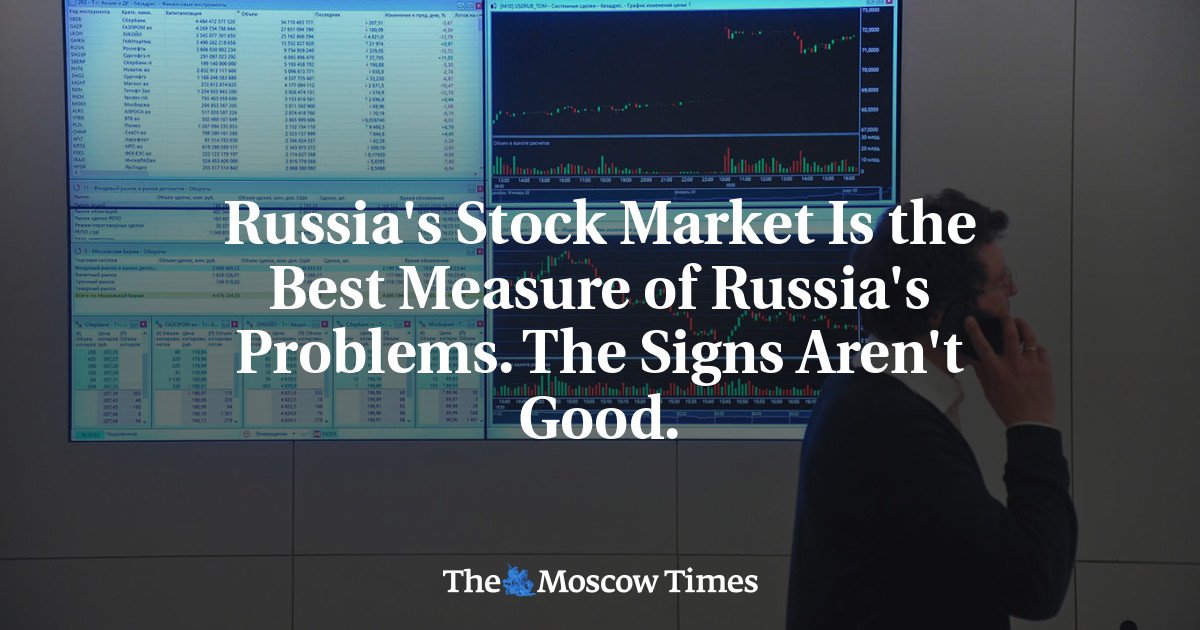
The most common joke I saw in traders’ chats on Friday was “A rare long will live to see the middle of the session.” Those longs, who buy stocks in the expectation that they will rise, have been suffering for 16 weeks. But last Friday brought a genuine collapse. After all, the MOEX index had never lost 5% in a single day before.
The stock market is the most honest and fastest public-opinion poll because it takes place in real time and aggregates the views of many thousands of participants. Some are extraordinarily smart and well informed; others are naïve and susceptible to manipulation. But all of them are risking their own money, which makes them exceptionally candid and their actions maximally visible.
Yes, this market, like any society, can be wrong. It can be self-deluded and even become the victim of manipulation. But it is also quick to return to reality precisely because errors and delusions must be paid for out of one’s own pocket. It is a cynical market not held back by moral qualms. That is why the MOEX index rose quite happily when Russian missiles were turning Ukrainian cities into dust and the Iranian regime was attacking tankers and hanging protesters.
So what happened? The answer is simple: traders lost hope.
First of all, they lost faith that listed companies’ shares and bonds would produce profits.
Why? Because industrial output, which seemed to have begun recovering, is now falling again, largely thanks to oil companies benefiting from higher oil prices after the Strait of Hormuz was closed.
Extractive industries fell 2.7% in May after growth in March when it became clear that high oil prices could not be maintained.
Oil refining was down 13.5%, while metallurgy was down 12.8% — both historic records.
Manufacturing output, which includes the defense sector, has increased but only modestly. It appears that its capacities have reached their ceiling.
There is no point even discussing retail and services, whose stocks are not popular anyway. Developers are on the brink of bankruptcy and investors have long been fleeing their shares.
As output falls, so does investors’ hope that companies will make profits. No profits mean no dividends for shareholders, which were the only thing that made Russian stocks attractive.. Unlike sweet-talking ministers and propagandists, investors have absolutely no faith in any technological breakthrough by domestic industry. Neither, for that matter, do the companies themselves. That is why they pay out lavish dividends of up to 50% of their profits, turning their owners into real, not merely paper, billionaires.
The second disappointment was the Central Bank’s policy of cutting its key interest rate only symbolically. There were also Central Bank Governor Elvira Nabiullina’s remarks that, in conditions where budget spending — spending on the war, naturally — is no longer restrained or controlled, it is impossible to speak of sensible monetary policy or forecasting. The only thing left is to rein in the runaway horses of the budget through high interest rates.
Military spending, naturally, does not care about interest rates, while the rest of the business sector will wither away.
Some might say that at least inflation will not be allowed to run wild. No, even that hope is probably gone, which investors understand will hit profits. The Russian army will, of course, not be left without fuel as Russian refineries go up in smoke, unless the increasingly unrestrained drones take out the fuel tankers and frontline storage sites too. The civilian sector will have to live on what it is given, which is already so little that trucks carrying everything from food to construction materials are refusing to travel farther than 100-150 kilometers, as they are not sure they will be able to refuel at all or refuel enough to get back.
Problems with garbage collection, the delivery of goods and public transportation have already begun. From there, the train will roll on without stopping. Even if the fuel shortage can be resolved by autumn, the logistical chaos will not be untangled quickly.
So far, the government and local authorities have been managing the crisis in a way that makes one wish they had done nothing at all: rationing fuel sales, sending the National Guard to stand watch at gas stations and zealously hunting down speculators. Our officials and politicians do not know how to work in a market economy, only how to return to Soviet-style controls. So by the time they realize it is easier to let prices rise, they will already have risen so far that Germany’s 2.50 euros ($2.85) per liter of gasoline will seem cheap.
Haulage companies have already warned that their prices will rise by at least 10%. Naturally, price increases will spread all along the supply chain. That means the Central Bank will not merely refrain from cutting rates faster — it may well raise them again.
To see why the stock market has so little faith in the Kremlin, I recommend you watch an interview Putin gave on June 28 to one of his favorite reporters, Pavel Zubin.
Calls for Putin to do something had gathered steam in the preceding days amid dramatic Ukrainian drone attacks and a viral video where an especially extreme pro-war crank demanded a meeting with Putin “to open his eyes to the situation at the front.”
But the thing that pushed Putin’s hand was Belarusian President Alexander Lukashenko. Following Ukrainian President Volodymyr Zelensky’s ultimatum, threatening to use military force to destroy Belarusian relay stations that Russia uses to coordinate drone attacks. Lukashenko not only complied but also rebuked the Russian ambassador in Minsk — telling him, in effect, not to drag Belarus into the war. He then flew at great speed to Putin’s lavish residence in Valdai, an extraordinary turn of events as he very rarely hosts guests there.
But while Lukashenko was sitting in Valdai, a rumor spread like wildfire that he had brought peace proposals from Zelensky, speculation that the Ukrainian president encouraged.
Putin decisively dispelled any hope for an end ot the war in his interview. I strongly recommend reading it in full, or better yet, watching it.
The overall tone of the interview was: everything is fine. Things are going better than ever. There are fuel difficulties, but they are temporary. New air-defense systems will soon protect everything; the country’s fuel reserves are large; damaged sites are being quickly restored. “Everything is functioning steadily, with a large margin of safety.”
This is so far removed from reality that one can only marvel at the audacity — or ignorance of reality — of the people informing Putin. Of course, since Soviet times, the authorities have known how to turn the most catastrophic events into reports of success. But leaders usually understood the falsification — and engaged in it themselves — so it could separate the wheat from the chaff and rein in a subordinate who had lied too extravagantly. When the leadership lost its capacity for critical thought, however, the result was what happened in June 1941, when Stalin believed not intelligence reports but the reports of his subordinates and the flattering words of Nazi commanders.
That is exactly why I suggest watching Putin’s interview. It is clear that he genuinely believes what he is saying — especially when he turns to the war, which plainly interests him more than some troubles at gas stations.
Lukashenko is not the only person who understands that Putin has retreated from reality into a world drawn for him by the sycophantic reports from generals and officials. Pro-war bloggers understood too, making their channels a pleasure to read. Their content is indistinguishable from that of so-called foreign agents, extremists and terrorists, except in their more colorful language.
Did investors understand? Judging by their online chats, they did.
But the MOEX index rose on Monday by over 2%. That’s nothing compared with the previous crash, but it’s still an increase. Perhaps that shows relief.
The stock market has one peculiarity. It is a little slow. Not from stupidity, but because the whales — large pools of capital concentrated in discreet investment firms — control such a large share of the Russian market that they can turn the index in the direction they want, albeit not for long. The same thing happened after the Central Bank’s shock meeting: MOEX rose at first, followed by a crash the next day.
The reason is simple: when the whales take short positions, they want to sell shares at a higher price. So when an event is unexpected and not predicted through insider information, prices are pumped up through market manipulation and public relations support from analysts and bloggers kept on their payroll. That prices then fall even faster and more deeply works only to the advantage of short sellers. Indeed, many analysts wrote yesterday about how cheap the Russian market was and how important it was not to miss the chance to buy stocks.
Yes, the most honest warned that the rise would not last. But what would make a gambling speculator abandon the hope of making a quick profit?
I don’t know what will happen the day after I wrote this on June 28. But I can say with confidence that the Russian market’s fall will continue. If not today, then tomorrow. At most, within a week. Put simply, investors may be slow, but they are not fools. The situation already smells of kerosene in the most literal sense, making the problem even to the least perceptive people.
My advice is to watch the Russian stock market. It provides an excellent view — especially on weekly charts — of what people really think about the situation in the country and its irremovable helmsman.
The views expressed in opinion pieces do not necessarily reflect the position of The Moscow Times.
A Message from The Moscow Times:
Dear readers,
We are facing unprecedented challenges. Russia’s Prosecutor General’s Office has designated The Moscow Times as an “undesirable” organization, criminalizing our work and putting our staff at risk of prosecution. This follows our earlier unjust labeling as a “foreign agent.”
These actions are direct attempts to silence independent journalism in Russia. The authorities claim our work “discredits the decisions of the Russian leadership.” We see things differently: we strive to provide accurate, unbiased reporting on Russia.
We, the journalists of The Moscow Times, refuse to be silenced. But to continue our work, we need your help.
Your support, no matter how small, makes a world of difference. If you can, please support us monthly starting from just $2. It’s quick to set up, and every contribution makes a significant impact.
By supporting The Moscow Times, you’re defending open, independent journalism in the face of repression. Thank you for standing with us.
Continue

Not ready to support today?
Remind me later.