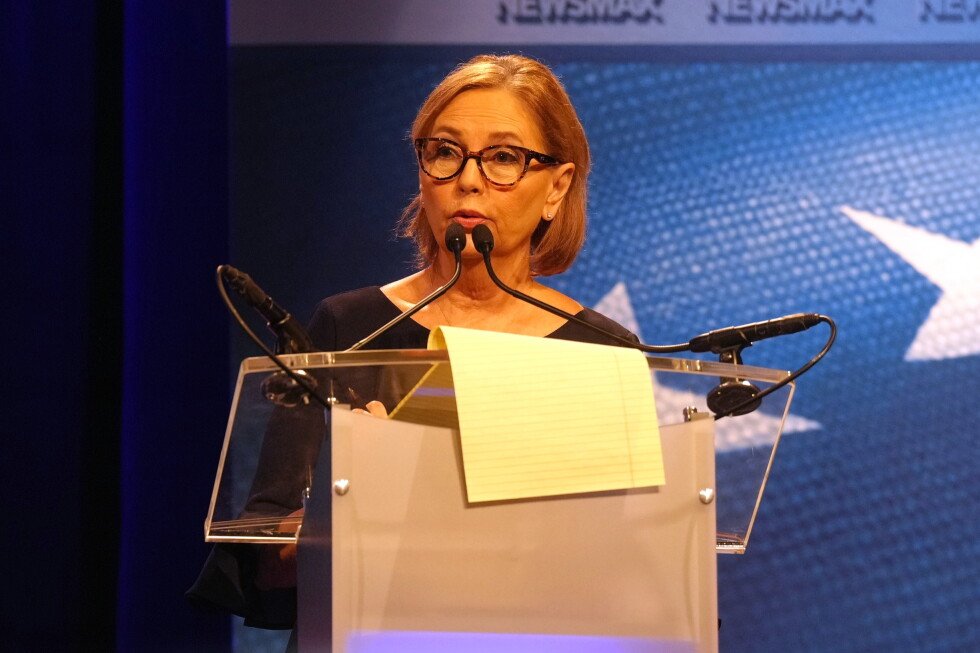
COLUMBIA, S.C. (AP) — Sen. Darline Graham stumbled in a Tuesday night debate over an elementary question about foreign policy, a signature issue of her late brother. It was a high-profile misstep a week before she faces a runoff election in her bid to hold onto the South Carolina seat to which she was appointed last month.
Graham, a political novice, was asked whether the U.S. has a national security interest in Taiwan and the South China Sea — a longstanding contention of both Democratic and Republican administrations. She struggled to answer before admitting “national security is not my thing.”
“I’m not that informed on national security,” she added.
Her rival in next week’s runoff for the GOP nomination, Rep. Ralph Norman, suggested the answer showed Graham was unqualified for the role.
“By her choice, she’s running for the United States Senate. It’s a six-year term,” Norman said. “You need to get fully versed in what issues you’re going to be dealing with. This isn’t a get training on the job, you can’t do that.”
It was a moment that drew a stark contrast to Graham’s brother, Lindsey, who died unexpectedly on July 11. It also gave Norman, an established conservative politician, a fresh avenue of attack as he tries to overcome President Donald Trump’s endorsement of Graham in her first campaign. The Republican president is set to visit South Carolina on Friday to campaign for her.
During his decades in the Senate, Lindsey Graham was known for his foreign policy involvement, making countless foreign trips, sometimes as part of a group of U.S. lawmakers meeting with international leaders and observing contentious areas firsthand.
There were multiple trips to Taiwan, including in 2022, when he led a delegation for a two-day visit that included meetings with Taiwanese President Tsai Ing-wen and the island’s defense minister.
Darline Graham had been asked, “Are Taiwan and the South China Sea national security issues for the United States and if so, why or how?”
Graham avoided a direct response, and instead mentioned her brother’s wealth of experience and her desire to lead differently.
“My brother was in the Air Force for 33 years, so I will do everything I can to support the military,” said Graham, who often read from a legal pad on which she had notes, its pages draped over the front of her lectern. “My dad was in the Army. I’m not a polished politician up here; national security is not my thing, not my area of expertise, but I do support the military.”
Candidates were not allowed to bring notes into the debate, but Graham spent several minutes before the broadcast began copiously writing on her legal pad. Norman wrote down a few things but not as extensively.
As interim senator, Graham is surrounded by many of her brother’s Capitol Hill staff, many of whom worked with him for years on issues foreign and domestic. She’s repeatedly thanked them for getting her up to speed on legislative issues and has pointed to her several weeks on the job as a productive time in which she’s gotten legislation passed, including a Russia sanctions bill named for her brother.
In the wake of her brother’s death, Graham has been asked multiple times about how she would either further or shift away from his intense focus on national security, an attitude that was at the essence of his Senate portfolio.
Asked after the debate by reporters if she wanted another crack at her answer to moderators’ question, she doubled down, saying she was more focused on South Carolinians’ everyday concerns.
“They’re worried about their pocketbooks more than they’re worried about the South China Sea, quite honestly,” Graham said. “So that’s going to be my biggest focus.”
Graham added that she had spoken multiple times during the debate about the overall national security threat posed by China.
“I realize national security is very important,” Graham said. “I probably said 10 times up there tonight how bad China is, how they’re a national threat to us.”
Taiwan has often been a flashpoint for aggression from China and international efforts to support its right to self-rule. The U.S. maintains a policy of strategic ambiguity over whether it would defend Taiwan militarily if the mainland invaded, but has committed to bolstering the island’s defense for generations.
Claimed by China as part of its territory, Taiwan sits along a South China Sea global trade route, virtually all of which China claims despite a 2016 arbitration ruling based on the 1982 U.N. Convention on the Law of the Sea that invalidated Beijing’s expansive claims.
During a visit to Manila this week, Adm. Frank Bradley, commander of the U.S. Special Operations Command, said that American special operations forces are ready to step up warfighting-readiness exercises with counterparts in the Philippines and other countries in Asia to further strengthen a security alliance and help deter a major conflict in the region.
___
Meg Kinnard can be reached at http://x.com/MegKinnardAP.