James E. Thorne, chief market strategist at Wellington-Altus Private Wealth, believes the S&P 500 can nearly double by 2031, driven by stellar earnings from an AI-powered economy.
- In a post on X, Thorne said his S&P 500 target is 14,000 by 2031, implying about 1.8x growth from the current 7,500 level.
- Future market returns would largely depend on valuation, Thorne said, while outlining multiple scenarios to justify his target.
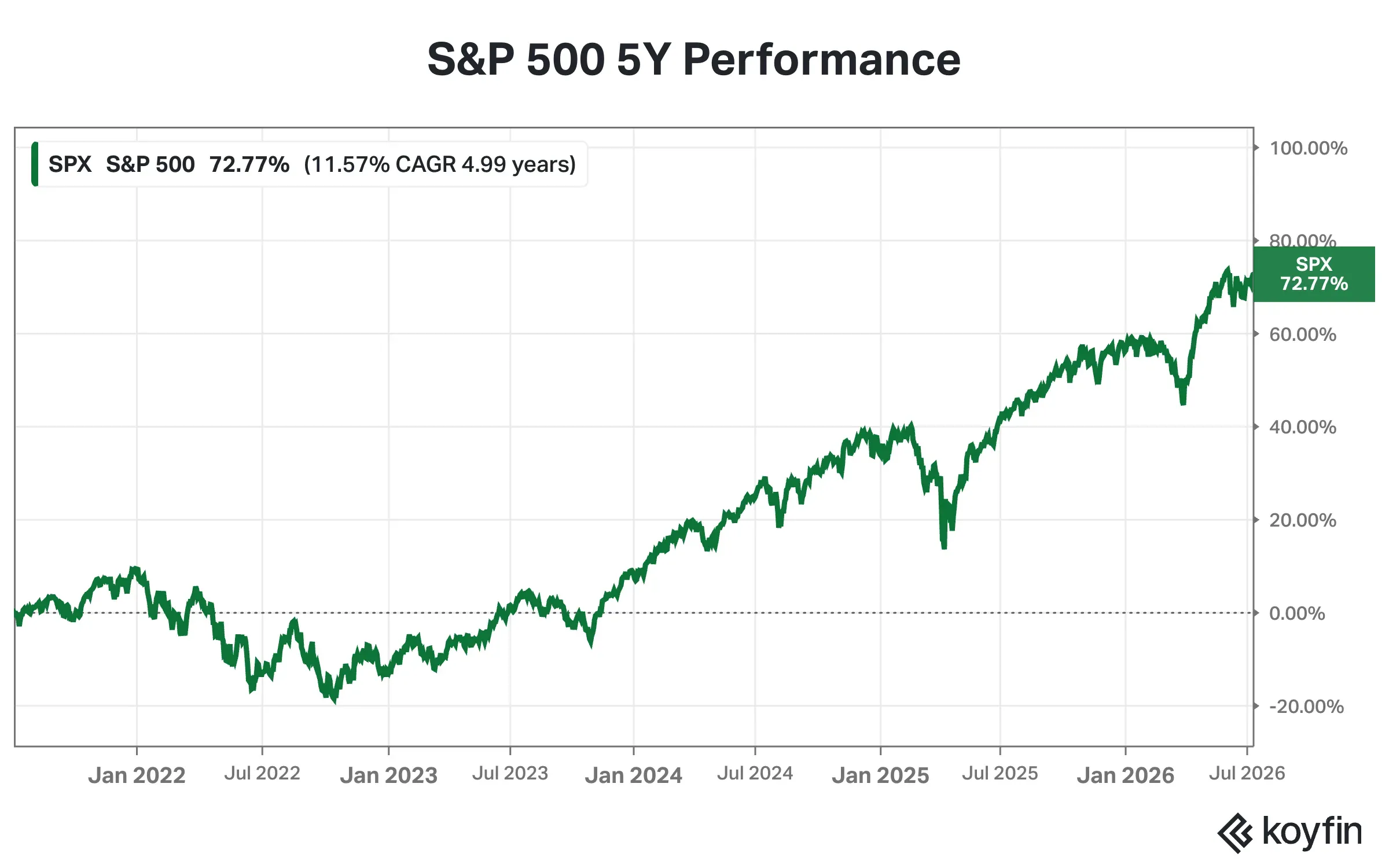
- The S&P 500 has returned about 73% in the last 5 years.
The S&P 500 can nearly double from current levels in the next five years, driven by “an AI capex super‑cycle, full expensing and a deliberate rebuild of productive capacity,” according to James E. Thorne, chief market strategist at Wellington-Altus Private Wealth.
In a post on X, Thorne said his S&P 500 target is 14,000 by 2031, implying about 1.8x growth from the current 7,500 level. “Yes, you’re not bullish enough,” he said, arguing that markets are only beginning to grasp the earnings power that could emerge from an AI-powered economy.
For context, the S&P 500 has returned about 73% in the last 5 years.
The Run-Hot Thesis
According to the strategist, the U.S. is heading towards an economic environment that differs from the one that followed the global financial crisis of 2008.
“Markets are finally asking the right question: what kind of earnings and multiples can a Trump‑era, AI‑powered ‘run‑hot’ regime actually support, and how does that differ from the post‑GFC world of secular stagnation and permanent caution. The answer looks less like a replay of the 2010s and more like a modernized version of the late 1980s and 1990s, when growth, productivity and valuation rose together,” he said.
Thorne added that for long-term betters who are not day trading, “the run‑hot thesis is a framework for compounding real earnings and productivity over years, not for trading the next headline.”
Thorne envisions that U.S. President Donald Trump “runs the economy hot,” while nominal gross domestic product grows at about 7% a year, compared with about 5% at the end of 2025, based on IMF data.
This is based on the assumption that earnings will grow to around $400 in 2027 and to $600 to $650 by 2031, implying annual growth of 10.5% to 14%. That would lead to the “S&P 500 earnings (to) grow at roughly 1.5–2 times that pace, powered by an AI capex super‑cycle, full expensing and a deliberate rebuild of productive capacity,” he said.
The Case For S&P 500 At 14,000 By 2031
Future market returns would largely depend on valuation, as per Thorne. In his base-case scenario, where earnings climb to about $600 per share and a forward multiple of roughly 22x, would result in the S&P 500 would land in the low-to-mid 13,000 range.
A stronger outcome, he imagines, would lead investors to view the AI-driven productivity gains as a lasting structural shift, supporting a 25x multiple and lifting the index to between 15,000 and 16,000.
His highly bullish environment scenario envisions valuations approaching 30x earnings, pushing the S&P 500 into the 18,000-19,500 range. With dividend reinvestment, total returns would balloon further, Thorne said.
What’s The Alternative?
“The alternative, a world that only delivers 10,000 by 2031, is simply the old regime in disguise: slower nominal GDP, middling earnings and flat multiples,” the strategist said.
However, he noted that he believes that this assumption is wrong. “In an AI‑driven, supply‑side American system, investors either price a genuine repricing of productive capacity, or they mis‑price a decade of higher output before it happens,” he added.
Meanwhile, on Stocktwits, retail sentiment around the SPDR S&P 500 ETF (SPY), which tracks the S&P 500 index, was ‘bullish’ at the time of writing. The Vanguard S&P 500 ETF (VOO) and the iShares Core S&P 500 ETF (IVV) were also trending in the ‘bullish’ territory.
The S&P 500 has gained about 11% so far this year. Meanwhile, the Dow Jones Industrial Average has gained nearly 9% in the same time, and the tech-heavy Nasdaq Composite has been the best-performing among the benchmark indexes, gaining more than 13%.
Retail sentiment around the SPDR Dow Jones Industrial Average ETF Trust (DIA) and the Invesco QQQ Trust (QQQ) was ‘extremely bullish’ and ‘neutral’ respectively at the time of writing.
For updates and corrections, email newsroom[at]stocktwits[dot]com.

Subscribe to Chart Art
Get the daily crypto email you’ll actually love to read. It’s value-packed, data-driven, and seasoned with wit.