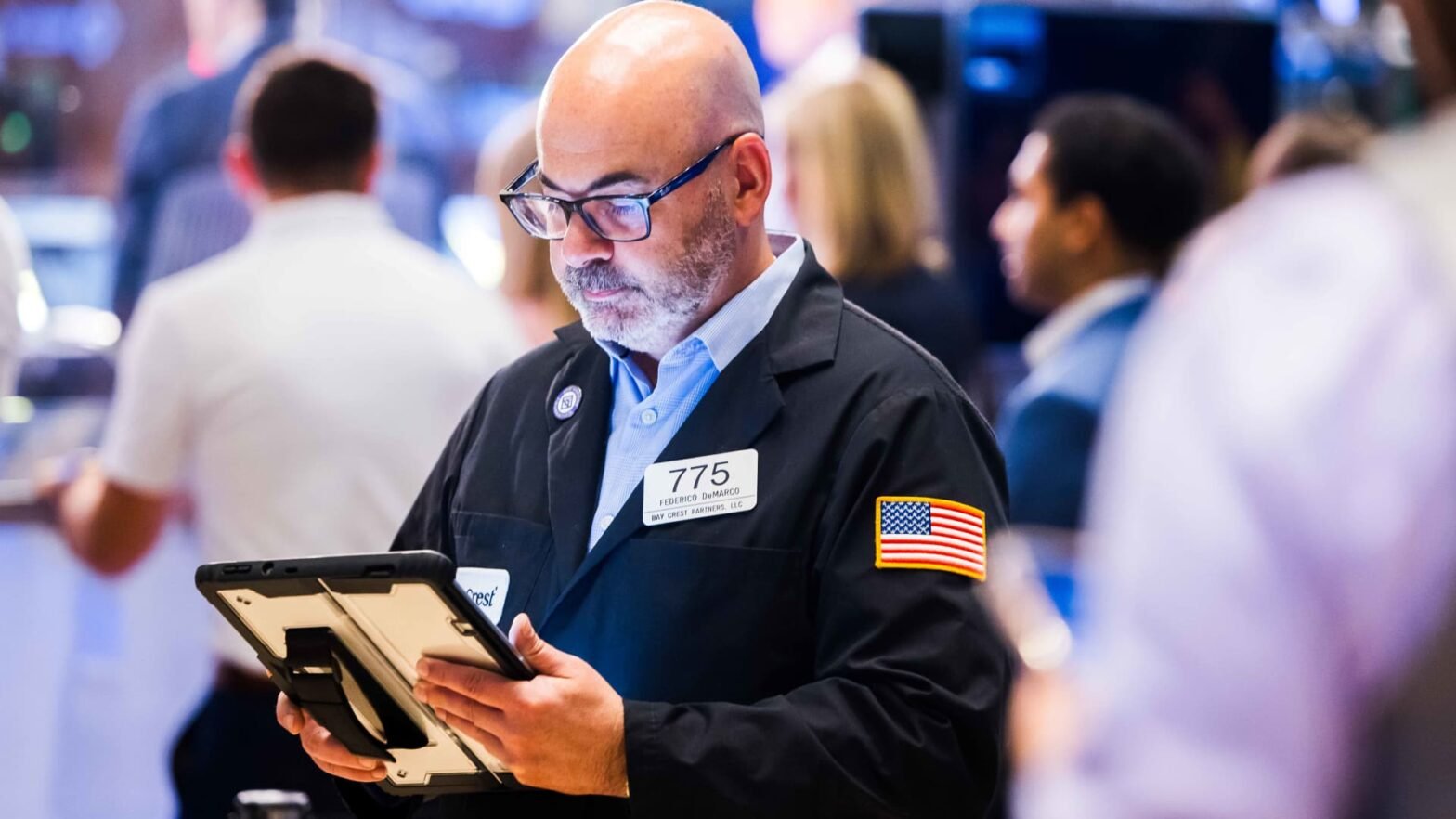
Traders work at the New York Stock Exchange on June 26, 2026.
NYSE
U.S. stock futures traded near the flatline on Wednesday night, while Asia markets traded mostly lower Thursday, tracking losses on Wall Street.
Dow Jones Industrial Average futures lost 53 points, or 0.1%. S&P 500 futures slipped about 0.1%, while Nasdaq-100 futures dropped 0.1%.
South Korea’s Kospi led losses in Asia, falling 5.36% at the open, prompting the Korean Exchange to temporarily halt trading for five minutes to curb volatility. The small-cap Kosdaq dropped 3.55%.
Japan’s Nikkei 225 declined 0.70%, while the Topix inched up 0.13%. Australia’s benchmark S&P/ASX 200 was down 0.59%.
The moves come after the major U.S. averages ended Wednesday’s session lower, with the Dow erasing a 423.46-point jump that brought it to record highs to close just below the flatline. The S&P 500 and Nasdaq Composite slid 0.2% and 0.7%, respectively, as investors pared positions in chipmakers.
The VanEck Semiconductor ETF (SMH) lost 5.4%, with Micron Technology and Sandisk dropping more than 10% each. And while the sector decline weighed on the broader market, Ned Davis Research strategist Rob Anderson thinks the rotation out of semiconductors is healthy.
“One of the characteristics of the bull market has been rotation. The attribute has been on full display in 2026,” he wrote. “A passing of the baton to a non-commodity cyclical sector would be further evidence that the stock market is entering the second half of the year in a position of strength and that the bull market can continue deep into the second half of the year.”
Wall Street is also looking ahead to the June jobs report. Economists polled by Dow Jones expect the economy added 115,000 jobs last month.
South Korea inflation hits highest level in more than 2 years, bolstering case for rate hike
South Korea’s inflation rate in June hit 3.2%, its highest level since December 2023.
The reading was in line with expectations from Reuters-pollled economists and was also the fourth straight month of accelerating inflation.
The reading strengthens the case for a rate hike by the Bank of Korea, which will have its next meeting on July 16.
— Lim Hui Jie
South Korea’s Kospi tumbles more than 5% at the open, triggering trading halt
Asia-Pacific markets traded mostly lower early Thursday, with South Korea’s Kospi leading losses.
The Kospi dropped 5.36% at the open, prompting the Korean Exchange to temporarily halt trading for five minutes to curb volatility. The small-cap Kosdaq dropped 3.55%.
Japan’s Nikkei 225 declined 0.70%, while the Topix inched up 0.13%.
Australia’s benchmark S&P/ASX 200 was down 0.59%.
—Justina Lee
Asia-Pacific markets set to open broadly lower, tracking U.S. stocks
Asia-Pacific markets were set to open mostly lower on Thursday, tracking losses on Wall Street as investors took profits in semiconductor stocks.
Japan’s Nikkei 225 was poised to decline, with the Chicago futures contract at 69,750 and its Osaka counterpart last trading at 69,610, compared with the index’s previous close of 70,474.96.
Hong Kong’s Hang Seng index was set to open higher after returning from a public holiday. Futures traded at 22,990, compared with the index’s last close of 22,881.02.
In Australia, futures last traded at 8,687, while the S&P/ASX 200 closed at 8,722.90.
Developments in the Middle East remain in focus, after President Donald Trump said the talks between the U.S. and Iran in Qatar were progressing well.
“As far as things are going, the denuclearization of Iran is moving along well,” Trump told reporters. “They’ve had very good meetings and we’ll see.”
— Justina Lee
‘Mag7’ declines are a healthy pullback, says Wells Fargo
The declines in the “Magnificent Seven” should be treated as a buying opportunity, according to Darrell Cronk, president for Wells Fargo Investment Institute.
“I’d characterize the recent pullback as a healthy reset, not a structural break—but it’s exposing some important shifts in how the market is thinking about Big Tech. AI is moving from excitement to scrutiny. A shift from build at any cost to prove the ROI narrative. We remain favorable on the sector despite the recent pullback but would be more selective.”
— Fred Imbert
Treasury Department unveils Trump Account investment options
U.S. won’t renew USMCA
The Trump administration has decided not to renew its trilateral trade pact with Canada and Mexico, instead opting to conduct annual reviews of the treaty that President Donald Trump once called “the best agreement we’ve ever made.”
The widely anticipated decision on the United States-Mexico-Canada Agreement, known as USMCA, was revealed Wednesday, the deadline for the three North American trade partners to determine whether they would renew their agreement for another 16-year term.
— Kevin Breuninger
Stock futures open near the flatline
U.S. stock futures traded near the flatline on Wednesday evening.
Futures tied to the Dow Industrials were down 79 points, or 0.2%. S&P 500 futures were off 0.1%, as were Nasdaq 100 futures.
— Fred Imbert