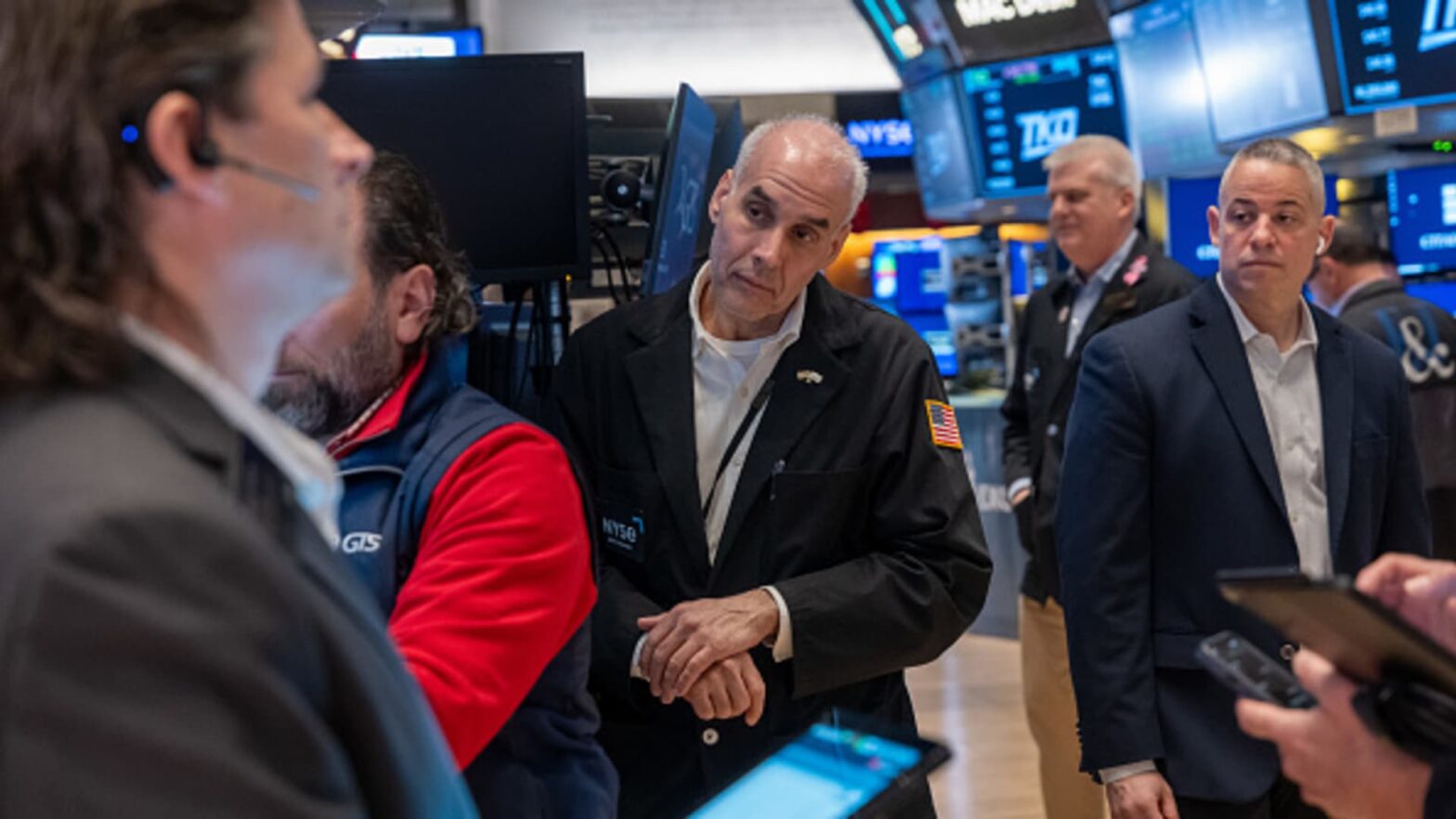
Traders work on the floor of the New York Stock Exchange (NYSE) in New York City.
Spencer Platt | Getty Images
Stock futures were lower on Monday evening as investors continued to monitor the conflict between Israel and Iran.
Futures tied to the Dow Jones Industrial Average slipped 85 points, or 0.2%. S&P 500 futures slipped 0.2%, while Nasdaq 100 futures dipped nearly 0.3%.
The three major averages ended Monday’s regular trading on a positive note, with the 30-stock Dow adding more than 300 points. The S&P 500 posted a roughly 0.9% advance, while the Nasdaq Composite jumped 1.5%.
Investor sentiment was aided by cooling oil prices, with Brent crude and West Texas Intermediate crude futures settling more than 1% lower. It was a turnaround from the sharp rally in oil prices on Friday following Israel’s airstrikes against Iran.
Though the attacks went into a fourth day on Monday, Iran reportedly asked several nations, including Saudi Arabia and Qatar, to urge U.S. President Donald Trump to put pressure on Israel for a ceasefire, a Middle East diplomat with knowledge of the matter told NBC News. The diplomat said the ceasefire would be in exchange for Iran’s flexibility on nuclear talks.
On Monday evening, Trump said in a Truth Social post that “everyone should immediately evacuate Tehran.” U.S. stock futures turned slightly lower afterward, and West Texas Intermediate crude futures added 1% in overnight trading.
“[Israel’s] main short-term objective is to neutralize the Iranian nuclear threat. Longer term, the more difficult goal is to effect regime change, though it is not clear whether that will be achievable,” said Jeff Buchbinder, chief equity strategist at LPL Financial.
He added that while every conflict is different, an analysis of 25 geopolitical shocks dating back to the Pearl Harbor attack in 1941 showed that stocks have been resilient in these scenarios. Total drawdowns around these events have averaged 4.6% over an average of roughly 19 days, Buchbinder said.
“Recoveries to pre-event levels have taken longer, averaging 40 days, but we’re still talking about an interruption of only a few weeks to a couple months typically,” the strategist said.
On the economic front Tuesday, investors will watch for May’s retail sales data. The main event this week will be the Federal Reserve’s rate policy decision, which is due Wednesday afternoon. Fed funds futures trading data suggests a near certainty that central bank policymakers will hold rates at their current target range of 4.25% to 4.50%, according to the CME FedWatch tool.
It’s too early to dismiss the impact of tariffs, says Northwestern Mutual Wealth Management
Investors may be underestimating the potential ramifications of President Donald Trump’s tariffs, says Northwestern Mutual Wealth Management.
“While it is possible that the impact of tariffs will be less than previously feared and that the weakness in the soft data will fail to translate into weaker hard data, we believe it is too early to dismiss the risks that exist from a combination of proposed tariffs and an economy that was already in the late stages of a growth cycle at the beginning of the year,” wrote chief investment officer Brent Schutte.
“While the ultimate level of tariffs applied on imports to the U.S. may be lower than originally proposed, we don’t believe the administration is willing to abandon its view that they are a cornerstone of its efforts to reorder the global economy and the role of the U.S. in it,” he added. “The president and his advisors believe tariffs will bring back manufacturing to the U.S., help working class voters and, importantly, generate revenue to offset the costs of its so-called Big Beautiful Bill that reduces taxes.”
— Brian Evans
Stock futures are little changed
Stock futures were little changed on Monday, as investors kept an eye on tensions between Israel and Iran.
Futures tied to the Dow Jones Industrial Average gained 18 points, or 0.04%. S&P 500 futures gained 0.01%, while Nasdaq 100 futures pulled back 0.01%.
— Brian Evans