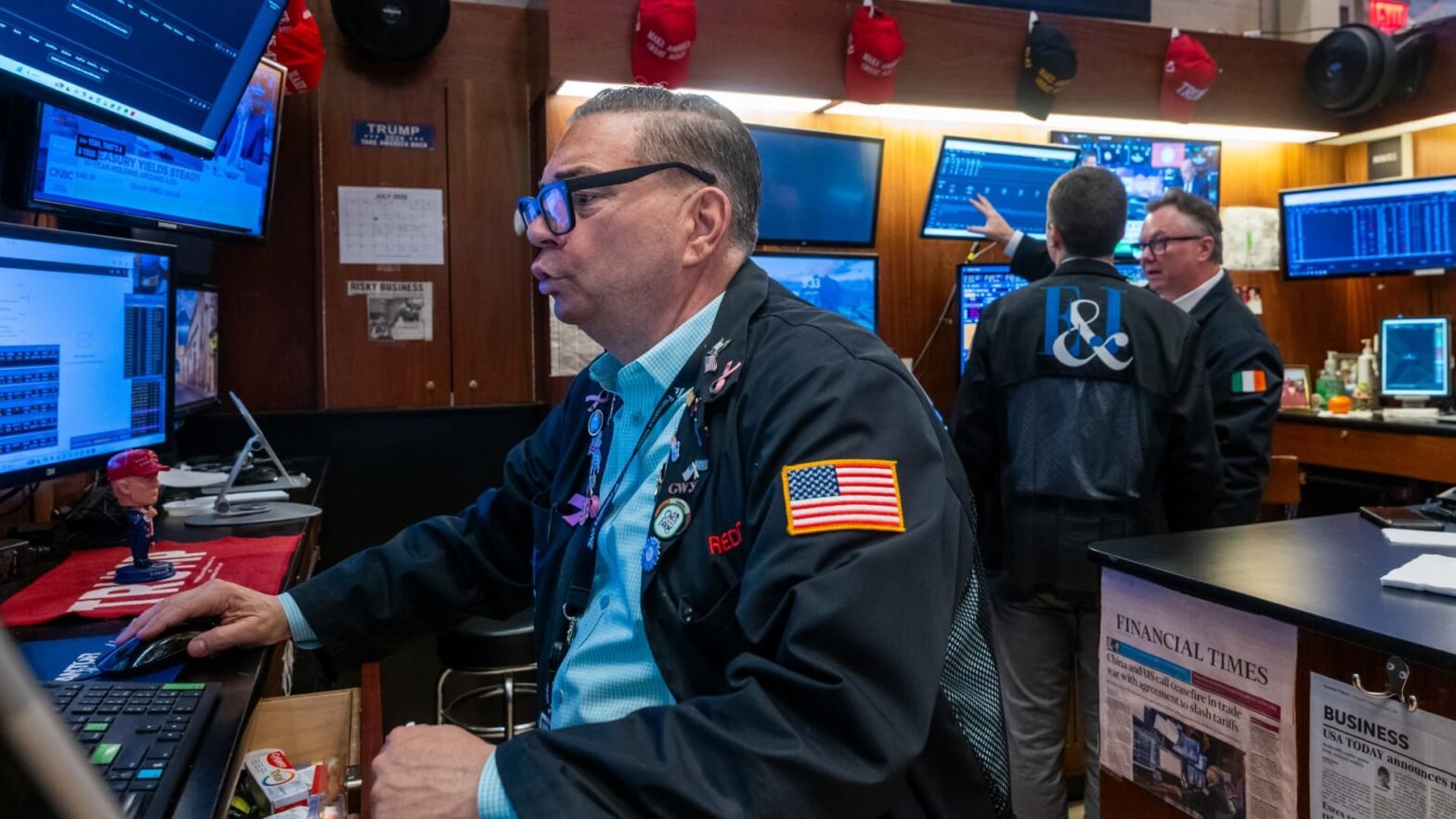
Traders work on the floor of the New York Stock Exchange (NYSE) on July 21, 2026 in New York City.
Spencer Platt | Getty Images
Stock futures were little changed in overnight trading Tuesday as investors looked ahead to another busy day of corporate earnings, with several major technology and industrial companies set to report.
Futures tied to the Dow Jones Industrial Average dipped just 16 points. S&P 500 futures and Nasdaq-100 futures were both flat.
In Asia, South Korea’s Kospi led gains in the region, advancing over 5% while the Kosdaq rose 2%. Japan’s Nikkei 225 added 0.34%, while the Topix was little changed. Australia’s benchmark S&P/ASX 200 was up 0.12%. Hong Kong’s Hang Seng Index was down 0.66%, while the CSI 300 rose 0.15%.
The major U.S. averages snapped a three-session losing streak on Tuesday, supported by better-than-expected earnings from blue-chip companies including 3M and General Motors, which helped ease concerns about the health of corporate America. Chipmakers also fueled the rally, with the VanEck Semiconductor ETF (SMH) climbing 4% as investors rotated back into artificial intelligence-related names.
Investors remain focused on whether strong demand for AI infrastructure and software will continue to justify elevated valuations across the technology sector as earnings season accelerates.
“Q2 earnings season is ramping up, but with most hyperscalers yet to report, the market is still waiting for the definitive read on how AI investment is being monetized and translated into future capital spending,” said Julia Hermann, global market strategist at New York Life Investment Management.
Earnings take center stage again on Wednesday, with reports due from ServiceNow, International Business Machines, Tesla, Texas Instruments, Alphabet and AT&T. Investors will be watching closely for updates on AI spending, cloud demand, corporate technology budgets and the outlook for the second half of the year.
Meanwhile, oil extended its recent rally as escalating tensions in the Middle East raised concerns about potential supply disruptions. Brent crude climbed 2% to settle at $91.01 a barrel, while U.S. West Texas Intermediate gained 2% to $84.91.
Japanese finance minister says ready for ‘decisive action’ as yen hits four-decade low
The Japanese yen on Wednesday weakened to a four-decade low of 163.15 per dollar, with Finance Minister Satsuki Katayama saying that the country was ready to take “decisive action” on forex, if needed, Reuters reported.
“Intervention risks are basically a reality every day,” said Dominic Schnider, head Commodities and APAC Forex at UBS. He told CNBC’s “Squawk Box Asia” that Japan’s authorities are likely to remain on alert over excessive yen weakness, but argued strong action from the Bank of Japan would be needed to stabilize the currency.
Schnider added that a 25-basis-point rate increase “will not change the big scheme of things,” and highlighted that the BOJ needs to signal that “savers are going to get better real rates,” a move he said could help the yen “easily stabilize.”
—Lee Ying Shan
Japan exports and imports grow at fastest pace since November 2022, beating estimates
Japan exports in June grew at their fastest pace since November 2022, rising 19.3% from a year earlier, powered by shipments of semiconductor equipment and a weak yen.
Exports growth beat expectations of an 18.6% rise from economists polled by Reuters, and was higher than the 16.8% seen in May.
Shipments to Asia rose 22.7%, most notably seeing a 46.4% jump in exports to Taiwan compared to the same period last year. Exports to China, Japan’s largest trading partner, increased 17.6%, while shipments to the U.S. climbed 13% year on year.
Read the full story here.
—Lim Hui Jie
Asia-Pacific stocks open higher; Kospi jumps 5%
Asia-Pacific markets opened in the green on Wednesday. South Korea’s Kospi led gains in the region, advancing over 5% while the Kosdaq rose 2%.
Japan’s Nikkei 225 added 0.34%, and the Topix was little changed.
Australia’s benchmark S&P/ASX 200 was up 0.12%.
— Lee Ying Shan
Asia-Pacific markets set to open subdued as investors assess U.S. strikes on Iran, ceasefire efforts
Asia-Pacific markets were set for a mixed open on Wednesday as investors monitored the latest U.S. strikes on Iran and renewed diplomatic efforts to secure a ceasefire, with the Middle East conflict continuing to cloud the outlook for energy markets.
Japan’s benchmark Nikkei 225 was set to open higher, with the futures contract in Chicago at 67,145 against the index’s last close of 66,232.19.
Futures for Hong Kong’s Hang Seng index last traded at 24,978, lower compared to the index’s last close of 25,132.29. Futures for Australia’s benchmark S&P/ASX 200 were last at 8,763 compared to the indexes close of 8,793.3.
— Lee Ying Shan
Pegasystems shares fall 12% after disappointing results
Pegasystems shares tumbled about 12% in extended trading after the software company reported second-quarter results that fell short of Wall Street expectations.
Adjusted earnings came in at 35 cents per share, below the 43 cents analysts had projected, according to FactSet. Pegasystems said rapid and “unprecedented” changes in the artificial-intelligence market prompted some customers to delay purchasing decisions.
— Yun Li
Super Micro Computer shares pop 17% after solid preliminary results
Super Micro Computer shares surged about 17% in extended trading after the server maker reported preliminary fourth-quarter results that featured much stronger profitability than investors had expected, offsetting revenue that came in near the low end of its guidance, according to FactSet.
The company said gross margins are expected to be between 15% and 17%, well above its prior forecast of 8.2% to 8.4%, citing a more favorable mix of customers and products, according to FactSet.
Super Micro also said its backlog climbed to a record level at the end of fiscal 2026 after receiving more than $60 billion of new orders during the quarter, providing a strong indication that demand for its AI-optimized servers remains robust and is expected to support revenue growth over the coming quarters.
— Yun Li
Jamie Dimon says he wouldn’t buy stocks or Treasurys at current prices
JPMorgan Chase CEO Jamie Dimon said investors are underestimating geopolitical and fiscal risks that could eventually rattle markets. He said he wouldn’t be a buyer of either equities or long-dated U.S. Treasurys at current prices.
“I do think those risks are probably bigger than other people think,” Dimon said, pointing to wars in Ukraine and the Middle East, tensions between the U.S. and China, and rising military spending in a time of mounting government deficits.
— Hugh Son