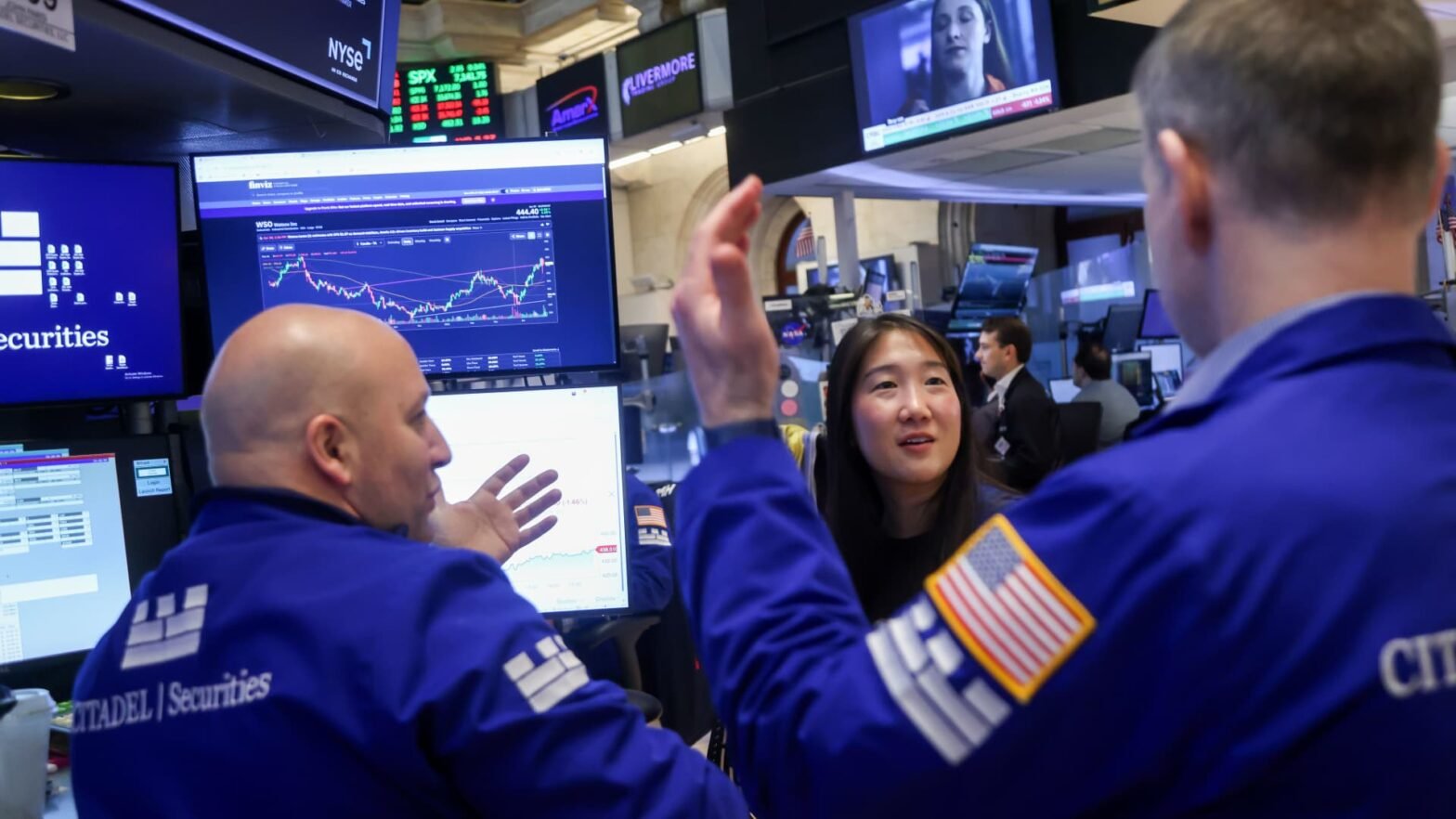
Traders work on the floor of the New York Stock Exchange (NYSE) during Pershing Square Capital Management LP’s initial public offering (IPO) in New York, US, on Wednesday, April 29, 2026.
Michael Nagle | Bloomberg | Getty Images
Stock futures climbed early Tuesday, reclaiming losses in the previous session, as investors look through the latest developments in the Iran war to focus on corporate earnings updates.
Futures tied to the Dow Jones Industrial Average added 0.35%, while S&P 500 futures and Nasdaq 100 futures rose 0.5% and 1.12%, respectively.
In regular trading, the Dow dropped 307.16 points, or 0.59%, weighed down by a 2% in decline in Apple shares. The broad market S&P 500 fell 0.19%, and the tech-heavy Nasdaq Composite lost 0.05%.
Central Command has carried out its 10 consecutive night of strikes on Iran since President Donald Trump declared the ceasefire “over,” while Tehran’s forces have struck U.S. military assets across the Middle East and its Houthi allies have declared a maritime embargo against Saudi Arabia.
But oil prices have edged lower in early trade as traders monitored a renewed diplomatic push towards mediation efforts between the U.S. and Iran. Reports suggest mediators are proposing a 10-day ceasefire between the two adversaries. West Texas Intermediate crude futures were down 0.88% at $82.50 a barrel, while international benchmark Brent was almost 1% lower at $88.34.
Oil had traded higher during Monday’s session after President Donald Trump said in a Truth Social post that Tehran will pay for the deaths of three U.S. service members. The climb in energy prices pulled the major averages lower on the day, even as semiconductor stocks clawed back some of last week’s steep losses. The VanEck Semiconductor ETF (SMH) posted a modest gain, aided by Micron Technology and Advanced Micro Devices.
“It looks to be a quiet week ahead for stock investors that could be dominated by technicals and geopolitical headlines,” said Callie Cox, chief market strategist at Ritholtz Wealth Management. “Sleepy summer weeks aren’t the time to draw conclusions about the world around us, but they could shake up market leadership going into a busy end of the summer.”
“Earnings are continuing to flow in, but they may provide more support than a catalyst to send stock prices higher given lofty expectations,” she added. “Yields are knocking at the door of recent highs across the world, giving investors a tough choice between growth and income. This stock market is under a lot of pressure after an impressive three-month rally.”
As companies issue their latest earnings results this week, traders will be hunting for details on artificial intelligence spending. They’ll also be listening on earnings calls for confirmation that executives aren’t becoming more cautious about the second half of the year. Big names set to report later this week include Alphabet, IBM and Tesla.
General Motors and 3M are slated to report Tuesday morning, while quarterly results from Chubb are due after the closing bell.
European markets opened the session in broadly positive territory, with the Stoxx 600 up 0.10%, as most major bourses traded higher, while regional sectors were mixed.
Asia-Pacific markets closed in the green. Japan’s Nikkei 225 added over 3% to 66,232.19, while the Topix rose 2.44% to 4,014.95. South Korea’s Kospi advanced 3.56% to 6,747.95 while the Kosdaq edged up 0.49% to 753.34. Australia’s benchmark S&P/ASX 200 was little changed at 8,793.3.
Mainland China’s CSI 300 was up over 3% at 4,739.23, while Hong Kong’s Hang Seng index rose 0.25% in the last hour of trade.
European equities open Tuesday’s session higher
The pan-European Stoxx 600 advanced 0.14% shortly after 8:10 a.m. in London (3:10 E.T.).
Most major bourses on the continent notched early gains, with the Italian FTSE MIB rising 0.55%, Germany’s DAX up 0.19%, and the French CAC 40 adding 0.15%. The U.K.’s FTSE 100 was down 0.31%.
Regional sectors were mixed, with technology stocks and mining names both up about 1.2%, while media companies tumbled 0.9%.
—Hugh Leask
Asia-Pacific markets close in the green
Asia-Pacific markets closed in the green. Japan’s Nikkei 225 added over 3% to 66,232.19, while the Topix rose 2.44% to 4,014.95. South Korea’s Kospi advanced 3.56% to 6,747.95 while the Kosdaq edged up 0.49% to 753.34.
Australia’s benchmark S&P/ASX 200 was little changed at 8,793.3.
Mainland China’s CSI 300 was up over 3% at 4,739.23, while Hong Kong’s Hang Seng index rose 0.25% in the last hour of trade.
—Lee Ying Shan
European markets set for mixed open
European stock markets are set to start Tuesday’s session in mixed territory.
London, the FTSE 100 was seen 0.56% lower ahead of the opening bell, dragged lower by the presence of several energy majors on the U.K. index as oil prices headed lower.
France’s CAC 40 was set to open 0.17% lower in Paris, while Germany’s DAX was flat ahead of the market open in Frankfurt. The Italian FTSE MIB was in positive territory, up 0.26% in Milan.
Futures tied to the Stoxx 50 were seen 0.1% higher.
— Hugh Leask
New UK PM Andy Burnham kicks off premiership by cutting electricity bills

New U.K. finance minister Healey a ‘safe pair of hands’ amid fiscal pressure
Britain’s former defense secretary John Healey leaves 10 Downing Street in London July 20, 2026 as cabinet appointments are being made after Andy Burnham became Britain’s new Prime Minister.
Henry Nicholls | Afp | Getty Images
The U.K.’s new finance minister John Healey faces a formidable fiscal challenge as Prime Minister Andy Burnham looks to reshape Britain’s economic model.
Healey — who was previously the U.K.’s defense minister, having previously held a junior role at the Treasury — replaces Rachel Reeves as Chancellor, in a surprise move by Burnham. Home Secretary Shabana Mahmood had earlier been widely expected to be handed the role, but will remain in her current post.
“Healey is widely regarded as a safe pair of hands who is likely to deliver on Burnham’s agenda rather than pursue an agenda of his own,” said Harry Woolman, global capital markets analyst at Validus Risk Management.
New Prime Minister Burnham took office on Monday, promising a “new economic model” for Britain, with a 10-year plan involving the reindustrialization of the country, and a more collaborative approach to politics. He is expected to outline further policy measures aimed at easing the U.K.’s cost-of-living burden, and how these will be funded, in a speech later Tuesday.
“This will no doubt be high on the new Chancellor’s agenda for the foreseeable future,” Woolman said.
However, Sanjay Raja, chief U.K. economist at Deutsche Bank, said the U.K.’s new Chancellor faces a tighter fiscal backdrop, with the looming Autumn Budget now set to be one of the important domestic policy events for markets this year.
“Headroom appears limited, with earlier buffers partly eroded by higher rates, a softer macro-outlook and renewed geopolitical risks,” Raja said. “Energy prices have eased from their peaks, but renewed upward pressure remains a key risk.”
— Hugh Leask
Treasury yields edge lower; analysts see room for rally despite geopolitical risks
U.S. Treasury yields edged lower across the curve on Tuesday. The benchmark 10-year Treasury yield slipped 0.6 basis point to 4.592%, while the two-year yield fell 1.1 basis points to 4.204%. The 30-year bond yield eased 0.3 basis point to 5.115%. Bond yields move inversely to prices.
BMO Capital Markets said the Treasury market has remained relatively steady despite the latest escalation in the Middle East, as signs of possible mediation tempered the initial jump in oil prices. With little U.S. economic data due this week, however, strategists warned that government bonds could remain vulnerable to abrupt moves in energy prices and developments in the Iran conflict.
“The degree to which nominal yields can decline will be tempered by the market’s ongoing focus on the energy sector and geopolitical tensions,” the BMO strategists said, adding that July and August inflation reports would be needed before investors could conclude that energy-driven inflation pressures had peaked.
—Lee Ying Shan
Oil prices ease as mediation hopes offset fresh Middle East tensions
Oil prices edged lower on Tuesday as investors balanced reports that the U.S. and Iran could be exploring mediation efforts against fresh military exchanges and new threats from Yemen’s Houthis to impose a naval blockade on Saudi Arabia.
U.S. crude futures for August delivery fell 0.3% to $82.98 per barrel, while international Brent crude futures for September delivery declined 0.56% to $88.72 per barrel.
“While the Houthis have not yet clarified how the blockade would be enforced, their previous campaign against commercial vessels demonstrates both the capability and willingness to disrupt Red Sea shipping,” Rystad Energy senior vice president Jorge Leon wrote in a note published Tuesday.
—Lee Ying Shan
China stocks slip, but Deutsche Bank sees structural tailwinds supporting second-half gains
Mainland China’s CSI 300 was down 0.18%, while Hong Kong’s Hang Seng index declined 0.18% in the first hour of trading.
Deutsche Bank chief investment officer for emerging markets Jacky Tang told CNBC he remains constructive on Chinese equities in the second half of the year, citing a combination of artificial intelligence, energy security investment, state-owned enterprise reforms and export-oriented companies as key tailwinds.
“We actually identified a few structural drivers to push the Chinese financial market in the second half of the year,” he said, adding, “We think that China in the second half will continue to do well.”
Year-to-date, the Hang Seng Index is down around 1.8% while the CSI 300 is about 0.3% lower, data from LSEG showed.
—Lee Ying Shan
Asia-Pacific markets open mixed
Asia-Pacific markets opened mixed on Tuesday.
Japan’s Nikkei 225 added 0.8%, while the Topix rose 0.86%. South Korea’s Kospi advanced 0.1% while the Kosdaq declined 0.72%.
Australia’s benchmark S&P/ASX 200 was down 0.58%.
— Lee Ying Shan
Asia markets set for mixed open as investors weigh Middle East tensions, fresh U.S. tariffs on Canada
Asia-Pacific markets were set for a mixed open on Tuesday as investors weighed rising geopolitical tensions in the Middle East, fresh U.S. tariffs on Canadian imports and higher oil prices.
Japan’s benchmark Nikkei 225 was set to open higher, with the futures contract in Chicago at 64,965 against the index’s last close of 64,141.12.
Futures for Hong Kong’s Hang Seng index last traded at 25,099 compared to the index’s last close of 25,143.05.
Futures for Australia’s benchmark S&P/ASX 200 were last at 8,717 compared to its close of 8,791.3.
U.S. President Donald Trump vowed Iran would face consequences following the deaths of three American service members, while Yemen’s Houthi militants announced a maritime embargo on Saudi Arabia, raising fresh concerns over energy supplies.
Separately, the Trump administration unveiled an additional 50% tariff on a range of Canadian imports, accusing Ottawa of unfair trade practices across several U.S. industries.
Trump signed three proclamations imposing the higher duties on Canadian motor vehicles, alcohol and dairy products, with administration officials saying the measures were intended to address what Washington views as discriminatory treatment of U.S. exports.
— Lee Ying Shan
Stock futures open flat
U.S. equity futures were little changed to begin trading on Monday night. Futures tied to the Dow Jones Industrial Average ticked up 12 points, or 0.02%. S&P 500 futures and Nasdaq 100 futures were down by 0.05% and 0.01%, respectively.
— Tanaya Macheel