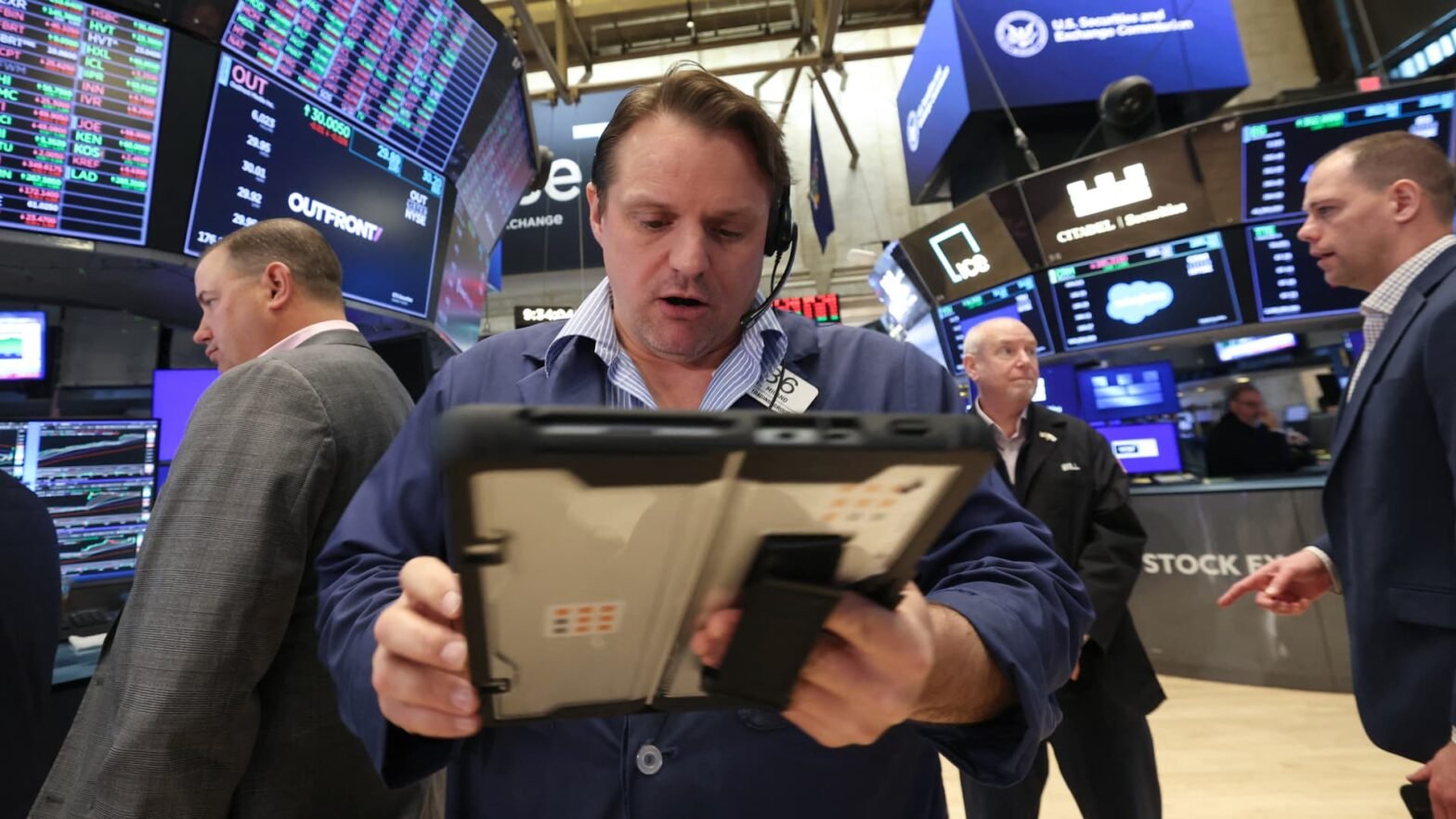
Traders work on the floor of the New York Stock Exchange (NYSE) at the opening bell in New York, on April 20, 2026.
Timothy A. Clary | AFP | Getty Images
U.S. stock futures rose on Tuesday night after President Donald Trump extended the U.S. ceasefire in Iran.
S&P 500 futures and Nasdaq 100 futures both added 0.4%. Futures tied to the Dow Jones Industrial Average rose by 186 points, or 0.4%.
All three major averages had settled lower as investors grew concerned that the U.S. and Iran would not be able to reach a peace deal by Wednesday, when the tenuous ceasefire between the two nations was set to expire. The S&P 500 shed 0.63%, while the Nasdaq Composite fell 0.59%. The Dow Jones Industrial Average lost 293 points, or 0.59%.
However, shortly after the market closed, Trump extended the two-week U.S. ceasefire, saying it was warranted due to Tehran’s “seriously fractured” government.
“Based on the fact that the Government of Iran is seriously fractured, not unexpectedly so and, upon the request of Field Marshal Asim Munir, and Prime Minister Shehbaz Sharif, of Pakistan, we have been asked to hold our Attack on the Country of Iran until such time as their leaders and representatives can come up with a unified proposal,” the president said in a Truth Social post.
He continued: “I have therefore directed our Military to continue the Blockade and, in all other respects, remain ready and able, and will therefore extend the Ceasefire until such time as their proposal is submitted, and discussions are concluded, one way or the other.”
But the timeline remains dicey, after a lack of commitment from Tehran resulted in a pause in Vice President JD Vance‘s trip to join peace talks, according to reports from The New York Times and Axios, which cited U.S. officials with knowledge of the situation. Iranian state media reported on Wednesday that negotiators from Tehran said they wouldn’t appear as talks with the U.S. were a “waste of time.”
Last week, the S&P 500 erased all of its losses since the beginning of the war as hopes of de-escalation rose. Both the broad market benchmark and Nasdaq Composite notched multiple all-time and closing highs, with the S&P closing above the 7,100 level for the first time ever.
Despite ongoing geopolitical uncertainty, Stephanie Aliaga, global market strategist at JPMorgan Asset Management, expects the rally to continue, buoyed by the AI boom and rising productivity.
“We’re clearly not in the coast is clear when it comes to this conflict in the Middle East, but markets are forward looking, and the reality is we are still on a de-escalatory path,” Aliaga said on CNBC’s “Closing Bell: Overtime” on Tuesday night. “We don’t know the details and the timing exactly yet — and I think that remains a risk for markets, especially a market that had so swiftly moved to price in essentially, coast is clear. So there is some choppiness. But ultimately these are bumps along the road to a market that is on an upward trajectory.”
AT&T, Boeing, Boston Scientific, GE Vernova, CME Group and Moody’s are just a handful of the stocks reporting earnings before Wednesday’s opening bell.
Stocks making the biggest moves after hours: Adobe, United Airlines and more
These are the stocks moving the most in extended hours trading:
- Adobe — Shares rose more than 2% after the tech company’s board approved a $25 billion stock repurchase program through April 2030.
- United Airlines — Shares rose less than1% even after the airline posted disappointing guidance for its current quarter and full year as rising fuel prices pressure its outlook.
- Capital One Financial Group — The stock shed more than 2% after the bank posted first-quarter earnings of $4.42 per share, excluding items, and revenue of $15.23 billion.
Read the full list of stocks moving here.
— Lisa Kailai Han