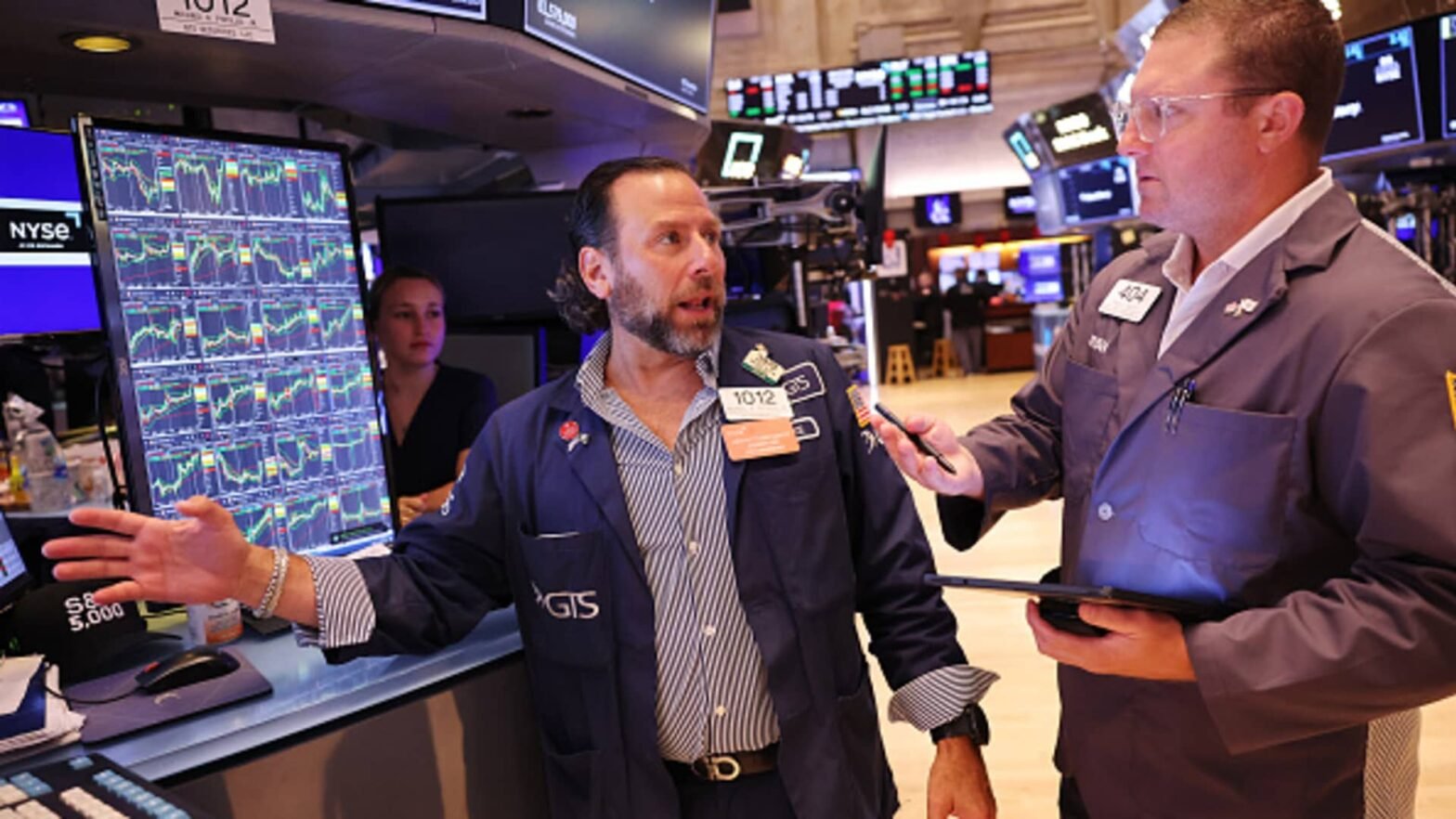
Traders work on the floor of the New York Stock Exchange during morning trading on July 31, 2024 in New York City.
Michael M. Santiago | Getty Images News | Getty Images
U.S. stock futures slid on Thursday night as traders considered fresh results from Amazon and Intel. Investors also looked ahead to July’s payrolls report.
Futures tied to the S&P 500 fell 0.5%. Dow Jones Industrial Average futures lost 143 points, or 0.4%, and Nasdaq 100 futures dropped 0.8%.
In after-hours trading, Intel cratered about 20% after announcing weak guidance and layoffs. Amazon slid 5% after missing the Street’s estimates on second-quarter revenue and issuing a disappointing forecast. Apple shares inched higher after a top- and bottom-line beat in the fiscal third quarter.
In the regular session, the major averages fell sharping growing fears of a potential recession. The blue-chip Dow dropped nearly 500 points, or 1.2%. The broad market index slid nearly 1.4%, while the tech-heavy Nasdaq Composite tumbled 2.3%.
The sell-off on Thursday indicates that the market is now “wondering if the Fed is too late in transitioning monetary policy,” said Quincy Krosby, chief global strategist at LPL Financial.
The recent rally in small-cap stocks may also come under threat as investors become more nervous on the broader economic outlook, added Arnim Holzer, global macro strategist at EAB Investment Group. Indeed, the Russell 2000 lost 3% on Thursday, posting its worst session since February.
“Increased market volatility is justified, with potential tech sector disappointments posing a risk to the overall market,” Holzer said.
The three major averages are heading into Friday with weekly losses. The S&P 500 is off 0.2% through Thursday’s close, while the Dow is down 0.6%. The Nasdaq is toting a 0.9% decline week to date. Even the small-cap Russell 2000 hasn’t been spared from the recent tumult, down about 3.3% in the period and on pace for its worst weekly performance since January.
Friday brings a fresh set of data — and a new catalyst for stocks: July’s nonfarm payrolls. Economists polled by Dow Jones are calling for growth of 185,000 jobs, down from June’s gain of 206,000. The unemployment rate, which is especially important as traders search for signs of an impending recession, is expected to hold steady at 4.1%.
Factory orders are also on deck Friday morning.
On the earnings front, energy giants Chevron and Exxon Mobil will be announcing their quarterly results Friday before the market open.
Utilities lead the way in otherwise ugly week
It’s been a rough week for stocks, with the S&P 500 on pace for a decline of 0.2%, but the utilities have been holding up well against the storm.
Seven of the 11 S&P 500 sectors are on track to end the week in positive territory, with utilities leading the pack. Utilities, once a sleepy corner of the stock market, are up 4.15% for the week. They also held their ground as investors panicked over recession risk on Thursday; the sector wrangled a 1.85% gain even as the major averages tumbled.
Utility stocks leading the way for the week include Vistra, on pace for a pop of nearly 7%, and Southern Company, up about 6.6% for the period.
—Darla Mercado, Chris Hayes
Stocks making the biggest moves after hours
Check out the companies making headlines in extended trading:
Intel — The chip stock sank 17%. Intel said it would suspend its dividend in the fiscal fourth quarter, and it announced plans to lay off 15% of its workforce. The news coincided with worse-than-expected quarterly results. Intel also shared disappointing guidance for the current quarter.
Amazon — Shares of the e-commerce giant dropped 5% in extended trading. The company reported weaker-than-expected revenue for the second quarter and issued a disappointing forecast for the third quarter. Revenue in its cloud division increased 19% in the second quarter, beating analysts’ estimates, however.
Apple — Shares of the iPhone maker inched higher, as the company beat analysts’ estimates on the top and bottom lines. Apple reported fiscal third-quarter earnings of $1.40 per share while analysts polled by LSEG called for $1.35 per share. Revenue clocked in at $85.78 billion, also surpassing the Street’s estimates.
The full list can be found here.
— Hakyung Kim