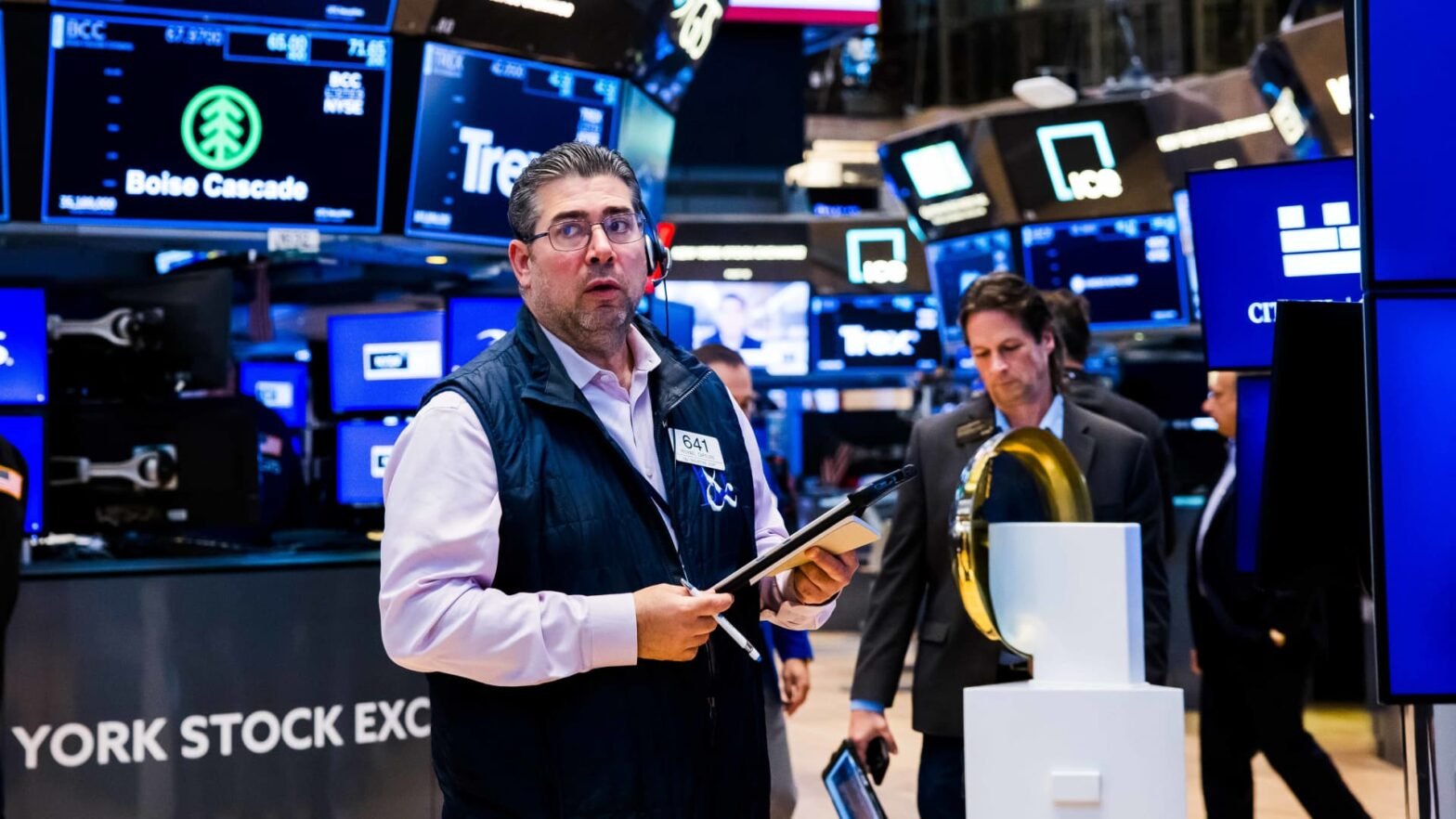
Traders work at the New York Stock Exchange on June 9, 2026.
NYSE
U.S. stock futures slipped on Tuesday night after the U.S. launched “self-defense strikes” against Iran, in retaliation for the downing of a helicopter a day earlier.
S&P 500 futures and Nasdaq 100 futures both shed 0.3%. Futures tied to the Dow Jones Industrial Average fell by 161 points, or 0.3%.
Asian markets open lower Wednesday, with South Korea’s Kospi leading the declines, down over 2%. Japan’s Nikkei 225 dropped 0.71%, while Australia’s benchmark S&P/ASX 200 was marginally lower.
Oil prices ticked higher after the strike, and West Texas Intermediate crude futures were last up roughly 1%, trading around $89 a barrel.
Tensions in the Middle East ramped up again on Tuesday evening, after U.S. forces launched strikes against Iran “in response to yesterday’s downing of a U.S. Army Apache helicopter,” U.S. Central Command said. President Donald Trump had earlier accused Iran of shooting down the helicopter, which he said was patrolling over the Strait of Hormuz.
Iran has not directly claimed responsibility for shooting down the helicopter. However, this latest development threatens the fragile ceasefire between the U.S. and Iran, and could hinder progress toward a peace deal.
In regular trading Tuesday, chip stocks sold off again, dragging the S&P 500 and Nasdaq Composite lower by 0.26% and 0.97%, respectively. On the other hand, the blue-chip Dow rose 86.10 points, or 0.17%.
Tuesday’s rout was an extension of last week’s pullback, which followed a rally driven by artificial intelligence.
“If we’re talking about the substance of what we’ve seen over the past few weeks, it’s really been concentrated in that memory, semiconductor area that’s lifted the market. It’s been the real force behind everything, and really it’s run so hard that it feels very toppy at this moment,” said Marta Norton, chief investment strategist for Empower Investments, on CNBC’s “Closing Bell: Overtime” on Tuesday afternoon.
“So, does this mean that there’s some sort of fundamental deterioration?” she added. “I’m not so sure about that, but certainly there seems to be stretched sentiment that we’re getting some sort of correction too.”
May’s consumer price index reading will be released at 8:30 a.m. ET on Wednesday morning. The Dow Jones consensus predicts the index will show inflation running at a 4.2% annual rate and an expected monthly gain of 0.5%. This would mark the first time the consumer price index, or CPI, has crossed the 4% threshold since May 2023. It would also be the highest reading since April of that year.
Chewy reports earnings before Wednesday’s opening bell.
— CNBC’s Jeff Cox and Kevin Breuninger contributed reporting.
Japan’s wholesale inflation jumps 6.3% in May on higher energy prices
Japan on Wednesday reported a sharp spike in producer price inflation that topped analysts’ estimates on the back of soaring energy prices.
Wholesale inflation rose 6.3% year on year, government data showed, compared with Reuters-polled analysts estimates of 5.5%.
Producer price inflation rose 0.9% on a month-on-month basis, also exceeding analysts’ estimates of 0.5%.
Energy prices accounted for 0.21% of the rise in inflation, data showed.
Nikkei 225, Japan’s benchmark index, was down over 1%, while yield on 10-year government bond was up 3 basis points to 2.695%. Yen was trading flat at 160.36 against the greenback.
— Vinay Dwivedi
South Korea’s Kospi leads declines, down over 2%, as Asia markets open lower
Asia-Pacific markets opened lower Wednesday as Mideast tensions dent investor sentiment.
Japan’s Nikkei 225 dropped 0.71%, while the Topix slipped 0.30%.
South Korea’s Kospi declined 2.31%, and the small-cap Kosdaq was down 0.67%. Australia’s benchmark S&P/ASX 200 was marginally lower.
Hong Kong Hang Seng index futures were at 24,441, lower than the index’s last close of 24,565.90.
—Justina Lee
Asia markets set to open lower as fresh Middle East tensions test fragile ceasefire
Asia-Pacific markets were set to open broadly lower Wednesday on rising tensions in the Middle East after U.S. forces launched strikes against Iran, putting into spotlight a fragile ceasefire between Washington and Iran.
Japan’s Nikkei 225 was poised to decline, with the Chicago futures contract at 64,210 and its Osaka counterpart last trading at 64,440, compared with the index’s previous close of 65,416.63.
Hong Kong Hang Seng index futures were at 24,441, lower than the index’s last close of 24,565.90.
Futures for Australia’s S&P/ASX 200 last traded at 8,624, while the index closed at 8,604.20 on Tuesday.
The U.S. Central Command said that its had conducted strikes against Iran “in response to yesterday’s downing of a U.S. Army Apache helicopter.” Earlier, President Donald Trump accused Iran of shooting down the helicopter, saying that it was patrolling over the Strait of Hormuz.
—Justina Lee
Cracker Barrel gains 7% in Tuesday’s extended trading session
Shares of Cracker Barrel gained 7% on Tuesday evening, after the Southern country-themed restaurant chain lifted its full-year revenue and adjusted EBITDA guidance.

CBRL 5D chart
Cracker Barrel also posted a beat on both the top and bottom lines for its fiscal third quarter.
In its last quarter, the company reported adjusted earnings of 29 cents per share on $797.4 million in revenue. Analysts polled by FactSet had expected a loss of 48 cents per share and revenue of $776.7 million.
— Lisa Kailai Han
U.S. forces launch ‘self-defense strikes’ against Iran
On Tuesday evening, U.S. forces launched “self-defense strikes” against Iran “in response to yesterday’s downing of a U.S. Army Apache helicopter,” U.S. Central Command said.
Centcom added in an X post that these strikes are “a proportional response to unjustified Iranian aggression.”
President Donald Trump had said earlier Tuesday that the U.S. would respond to Iran downing the helicopter, which was patrolling over the Strait of Hormuz. Iran has not directly claimed responsibility for shooting down the helicopter.
The president added in a Truth Social post that the two pilots involved in the attack “are safe and uninjured.”
— Kevin Breuninger, Lisa Kailai Han and Darla Mercado
Stock futures tick lower after U.S. forces launch strikes
Stock futures slipped on Tuesday night, after U.S. forces launched strikes against Iran.
Shortly after 6 p.m. ET, futures tied to all three major averages shed around 0.2%.
— Lisa Kailai Han