Year to date, the S&P 500 (^GSPC +0.62%) has added 13%, and the Nasdaq Composite (^IXIC +1.30%) has added 14%. Strong corporate financial results and economic resilience, fueled by large investments in artificial intelligence, have been the driving forces behind those double-digit returns.
However, investors just got bad news from the Federal Reserve. Three officials voted to increase interest rates when the Federal Open Market Committee (FOMC) met in July, and history suggests a new hiking cycle could sink the stock market.
Here are the important details.

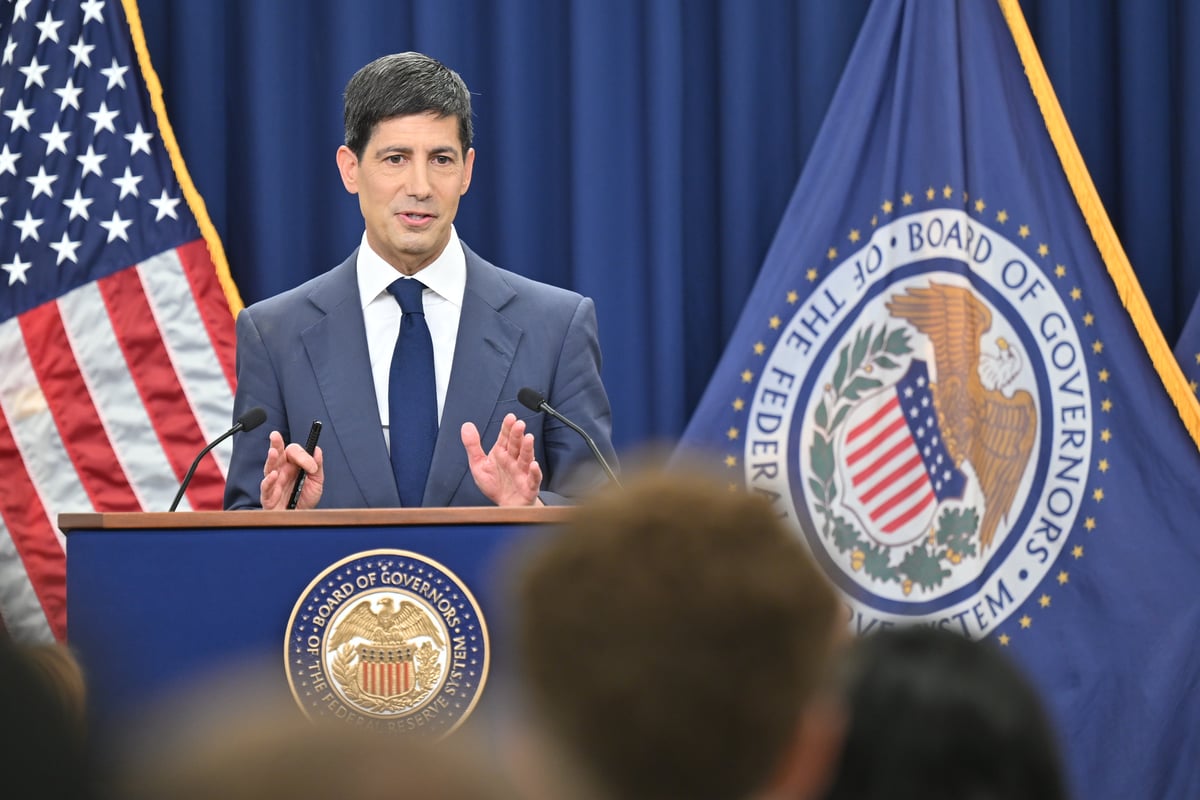
Fed Chair Kevin Warsh speaks at the FOMC press conference in June. Image source: Official Federal Reserve Photo.
Inflation has now exceeded the Federal Reserve’s 2% target for five years
The Federal Reserve operates under a dual mandate whereby its monetary policy decisions are supposed to promote price stability and maximum employment. Price stability does not mean no inflation, but rather 2% inflation, as measured by the PCE (Personal Consumption Expenditures) price index.
PCE inflation accelerated to 4.1% in May as the Iran conflict disrupted oil supplies moving through the Strait of Hormuz, a critical chokepoint in the Persian Gulf. That was the highest reading in three years. PCE inflation cooled slightly to 3.7% in June as geopolitical tensions eased, but projections point to similar readings for July and August, meaning inflation is sticky.
So what? PCE inflation has exceeded the Federal Reserve’s 2% target in every month since February 2021, meaning the FOMC has failed to achieve price stability for over five years. To that end, three FOMC officials (out of 12 voting members) wanted to raise interest rates in July. For context, zero FOMC officials wanted to raise rates in June.
Higher interest rates are typically a headwind for the stock market. Not only do higher rates make bonds more attractive, which can pull money away from equities, but they also slow corporate earnings growth by raising borrowing costs. The mechanism is simple: High rates directly raise interest expense and indirectly suppress spending.
If the Fed raises interest rates, history says a stock market correction will follow
The Federal Reserve has initiated five tightening (rate-hiking) cycles during the last three decades. After the first hike in each cycle, the S&P 500 and Nasdaq Composite fell by an average of 10% and 12%, respectively, at some point during the next three months. The chart below contains specific details.
|
First Rate Hike in Cycle |
S&P 500 Max Drawdown |
Nasdaq Composite Max Drawdown |
|---|---|---|
|
March 1997 |
(7%) |
(4%) |
|
June 1999 |
(8%) |
(7%) |
|
June 2004 |
(7%) |
(14%) |
|
December 2015 |
(10%) |
(15%) |
|
March 2022 |
(17%) |
(22%) |
|
Average |
(10%) |
(12%) |
Data source: Federal Reserve, YCharts. The chart shows the maximum drop in the S&P 500 and Nasdaq Composite during the three-month period following the first interest rate hike in a tightening cycle.
As shown in the chart, the S&P 500 and Nasdaq Composite have dropped by an average of 10% and 12%, respectively, during the three months following the first rate hike in a tightening cycle. That means both major stock market indexes have generally slipped into correction territory under those circumstances.
Going forward, inflationary pressure from tariffs and the Iran war make it unlikely that PCE inflation will return to target without central bank intervention. So, traders expect the Fed to raise rates by a quarter percentage point in September 2026, followed by a second quarter-point hike in March 2027, according to CME Group‘s FedWatch tool.
The FOMC’s most recent projections corroborate that outlook. In June, nine of 18 FOMC participants said they anticipated at least one quarter-point rate hike during the remaining months of 2026, and six participants said they anticipated at least two quarter-point hikes this year. That is a dramatic change from March, when zero participants signaled rate hikes.
So what? The Fed last modified its monetary policy when it cut interest rates in December 2025. If the next change is a rate hike, it would mark the beginning of a new tightening cycle. And history says a new tightening cycle could tip the S&P 500 and Nasdaq Composite into a correction. So, investors should be prepared for a drawdown.