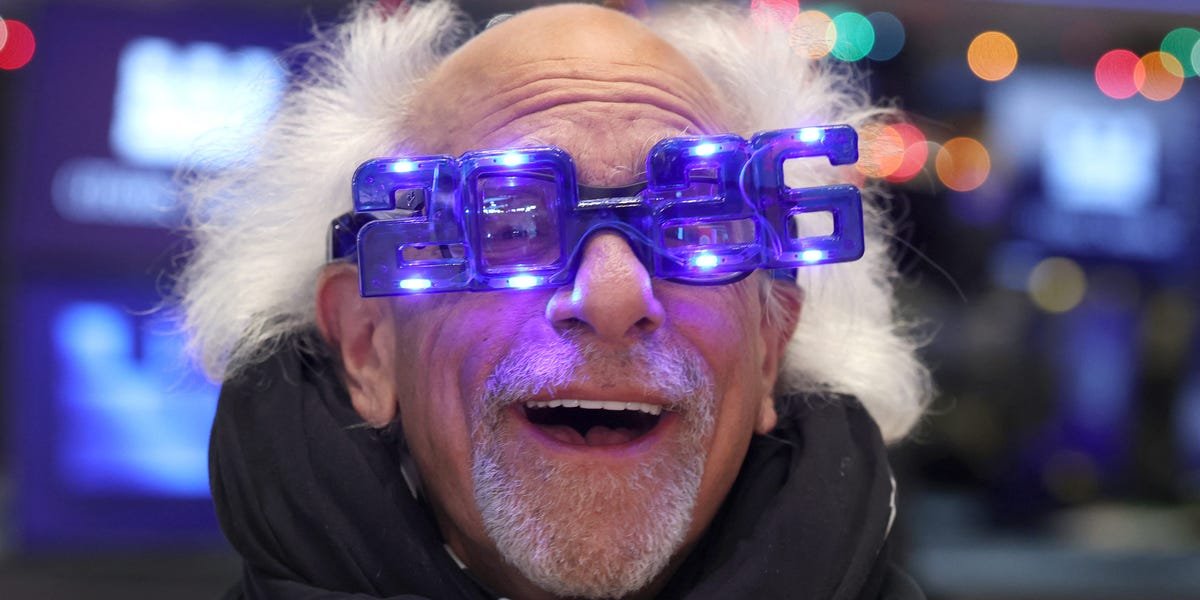
The most recognizable man on the floor of the New York Stock exchange has lived through his share of market calamities, and he’s got some thoughts on what’s going on with the investors’ latest craze.
Peter Tuchman is the face of the stock exchange. He’s often said to be one of the most photographed traders on the NYSE’s trading floor, having grown his celebrity over the decades with his animated facial expressions and distinct shock of gray hair. His look has earned him a nickname: the Einstein of Wall Street.
Tuchman is also one of the longest-standing traders at the exchange, with his tenure reaching 41 years at the end of March. As a forensic broker, he’s executed stock orders and analyzed every market crash since Black Monday in 1987, when the S&P 500 tanked 20% in a single session.

Spencer Platt/Getty Images
Tuchman says he remembers Black Monday clearly. That morning, as the trading floor descended into bedlam, he pulled out stacks of paper that were being printed out from the exchange’s stock ticker machine — all of them sell orders — and scrambled to fill them.
“I just remember chaos and fear and screaming, a lot of screaming,” he told Business Insider this week.
With concern about an AI bubble brewing in markets, Tuchman said he isn’t worried about another catastrophe. In an interview at the NYSE, he outlined three key differences between today’s market and past peaks — and said he saw a strong case for investors to buy in, even with stocks near record highs.
“I see an incredibly strong market and I see a market that is set for great things.”
Here’ what he’s watching.
1. Valuations don’t look as extreme compared to the dot-com peak.
The market’s top AI stocks are trading at a better valuation today compared to stocks that embodied the peak of the dot-com bubble.
For instance, Nvidia, the most valuable company in the world by market cap, is trading at a forward price-to-earnings ratio of 24.8. Compare that to tech giants of the early 2000s, like Cisco, which traded at over 100 times forward earnings at its peak.
2. Balance sheets look healthier.
Many companies that embodied the internet frenzy weren’t profitable. Pets.com, one of the most infamous dot-com era flops, fetched a market cap of around $400 million at its peak, but recorded a net loss of $94 million on $28 million in revenue when it dissolved in November 2000.
Big tech earnings, by comparison, are still on the up, with stellar profit growth fueling much of the stock rally in recent years. The S&P 500 is on track to post 50% year-over-year earnings growth for the quarter, the highest growth rate in five years, according to FactSet.
“They’re making a lot of money,” Tuchman said of AI firms today. “And so I think there’s a lot more structure and foundation to the market.
3. The market has a stable pool of retail cash
Retail investors have played a huge role in propping up the market since many piled into stocks in the early days of the pandemic. That support is unlikely to disappear anytime soon, Tuchman said, pointing to how the vast majority of stocks are held by top earners in the US — investors who are less likely to cash out in the event of a market downturn.
87% of all stocks and mutual fund shares in the US are owned by the top 10% of Americans by wealth, according to the most recently available Fed data.
Retail investors have also had plenty of opportunities to cash out in recent years, such as during the 2025 tariffs-fueled sell-off, but many have ultimately ended up back in the market anyway. A recent JPMorgan analysis found that retail investors purchased $270 billion in stocks over the first half of 2026, suggesting the impulse to buy the dip remains strong.
“The market is almost too big to fail in my opinion,” Tuchman added.
Advice from a market veteran
Michael M. Santiago/Getty Images
Tuchman has a lot of advice for traders navigating today’s market. He began mentoring traders when many retail investors piled into the market during the pandemic, pulling wisdom from his long career on the trading floor.
Over the years, he’s identified three common mistakes traders make:
- Not having a set trading strategy. Too many investors are riding off FOMO and hype, meaning they rarely have a set plan when they put money in the market, he said.
- Not using stop losses, which automatically exit a position once a loss reaches a pre-set threshold.
- They overtrade and revenge trade, or make trades with the hopes of recouping losses. Oftentimes, those behaviors end up putting an investor deeper into the red.
“Don’t try and pick the best time or wait for the next crash,” he said of his best advice for traders at the moment. “If you’re waiting around for the home run, you’re going to lose money.”
Read next
Jennifer Sor is a senior reporter at Business Insider. She covers financial markets and the economy, with a focus on retail investing, job trends, and the pursuit of wealth. She regularly speaks to famed forecasters and top investors in markets, and her work has been featured in outlets such as Forbes, Bloomberg Opinion’s “Money Stuff,” and SiriusXM Business Radio. She also appears regularly on television and radio to speak about markets and the US economy.Prior to her time at Business Insider, Jennifer covered tech and business news at the San Francisco Chronicle and Los Angeles Business Journal. She graduated from the University of California, Santa Barbara with a bachelor’s degree in economics and English.Have an interesting story to share? Please reach out to her at jsor@businessinsider.com or @jennreports.81 on the encrypted messaging app Signal.