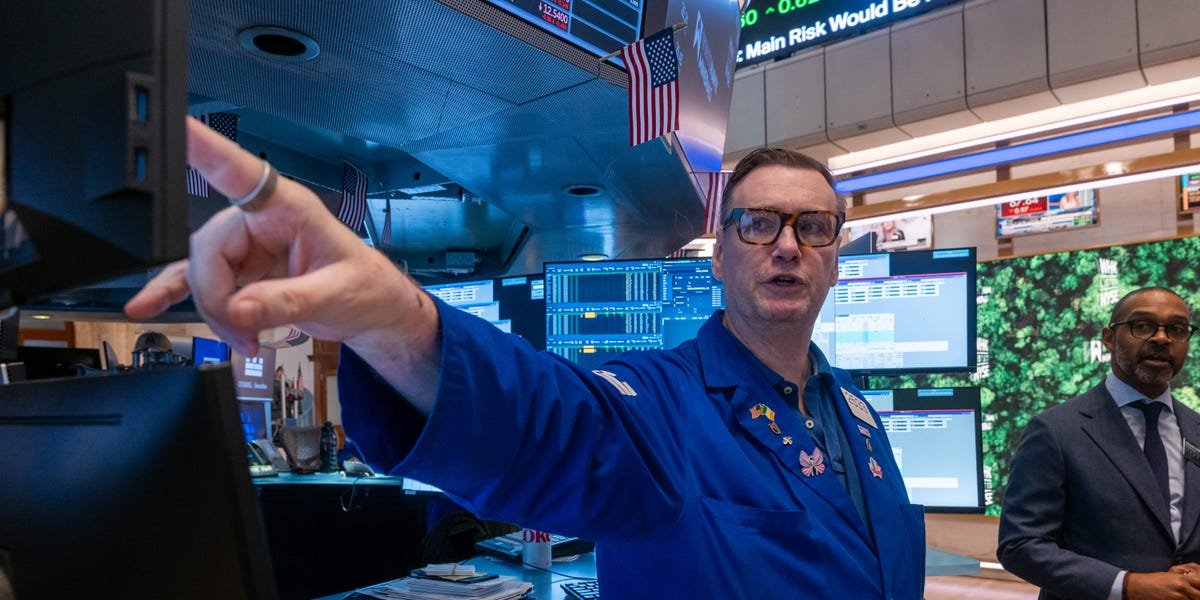
Spencer Platt/Getty Images
The AI-driven stock market’s growth has fueled comparisons to the dot-com era crash of 2000. Jim Paulsen isn’t worried, mostly because of the way the market is currently split.
The former chief investment strategist of The Leuthold Group hasn’t been shy about discussing potential cracks he sees in the market. But as he recently laid out in a post on his Substack, he sees the divide between “old era” and “new era” stocks shielding it from the type of risk it saw during the late 90s.
“New” basically refers to tech, while “old” encapsulates the other nine sectors in the S&P 500.
“The performance bifurcation between new and old era stocks has probably never been as extreme as it is today,” he wrote. “However, a lower correlation between new and old era stock prices compared to their relationship during the 1990s may be keeping overall contemporary stock market risk much lower than it was during the latter stages of the dotcom run.”
He added: “Today, because old era stocks provide a much larger stabilizing force than they did in the 1990s, investors are incented to diversify more broadly than they did during the 1990s,” he noted.
Paulsen is far from the only investing pro so analyze how the current AI boom stacks up against the dot-com bust. Goldman Sachs analysts recently said that while stock market breadth is at its lowest level since 2000, it doesn’t yet rival the depths of the pre-crisis era.
“Boring ‘old era stocks’ may ultimately substantially mitigate the investment carnage to the overall stock market once the music finally stops for new era stocks,” Paulsen added.
Read next
Samuel O’Brient is an experienced financial markets and business journalist who has written extensively on a wide range of topics involving economics, technology and public policy. At Business Insider, he covers important macro and micro economic stories, including takes from leading economists and hedge fund managers, breaking IPOs, corporate bankruptcies, meme stocks and short-selling. He also writes on other markets such as crypto, oil and real estate.He has interviewed many of the market’s most influential voices, ranging from top economists such as Mark Zandi and Richard Thalerto prominent investors including Danny Moses, Andrew Left, Anthony Scaramucci, Louis Navellier and Grant Cardone.Programs such as LiveNOW from Fox and Taking Stock have had Samuel on to discuss stock market developments. His reporting has been cited by The New York Times DealBook, Bloomberg Radio, Forbes, Entrepreneur and TheFutureParty.Samuel began at InvestorPlace, covering investing, retail trading and macro economic trends. Prior to joining Business Insider, he served as a technology markets reporter at TheStreet. He is a graduate of Sarah Lawrence College and Trinity College Dublin.Samuel’s work has appeared in publications such as TipRanks, EV and Observer. When he isn’t chasing down stories, he can often be found browsing book and record shops. To reach Samuel, email him at sobrient@insider.com or connect with him on LinkedIn. He is also on Signal as Samuel Clemens. Popular Articles: A Nobel economist has a warning for meme stock tradersThe business school dropout who kicked off the Beyond Meat rally wants you to know he’s not Roaring Kitty 2.0A top economist who thinks we’re on the brink of a recession says he’s eyeing these 3 warning signsTrump’s 401(k) executive order marks big changes for retirement savings — and possibly puts your money at riskWhy hedge fund icon Ray Dalio says you shouldn’t invest in real estate in this economyAI bullishness is soaring, but pros see a major opportunity brewing in an overlooked corner of the market

Follow Following
Every time publishes a story, you’ll get an alert straight to your inbox!
Look out for an alert in your inbox the next time publishes a story!
Every time a new story is published, you’ll get an alert straight to your inbox!
Look out for an alert in your inbox the next time a new story is published!
By clicking “Sign up”, you agree to receive emails from Business Insider. In addition, you accept Insider’s Terms of Service and Privacy Policy.