Latest Updates
(VERDAD)
A significant shift in the trading relationship between stocks and bonds has gotten under way. Similar situations in the past have boosted returns for investors who owned both, according to an analysis from Verdad.
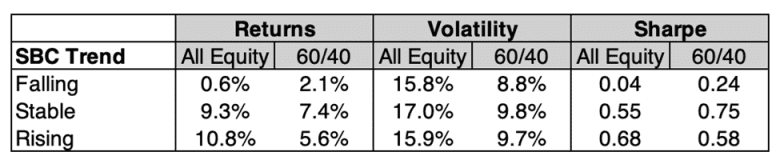
Lionel Smoler-Schatz, a Verdad analyst, dug into how model portfolios with different mixes of assets performed when the correlation between stock and bond performance was in flux.
He found that when the correlation between stocks and bonds was falling, portfolios with substantial allocations to both tended to outperform. Specifically, during a falling scenario, returns for a portfolio featuring 60% stocks and 40% bonds surpassed portfolios with 100% exposure to stocks on both an absolute and risk-adjusted basis.
The Dow Jones Industrial Average remains lower, dragged down by Boeing and Salesforce shares, while the S&P 500 and Nasdaq edged into positive territory.
The Dow was off 109 points, or 0.3%
The S&P 500 was up 2 points, or less than 0.1%
The Nasdaq Composite gains 26 points, or 0.1%
The commodities sector has rallied in September, with natural gas, sugar, coffee, and silver among the biggest gainers.
A boost in the economic outlook following the U.S. Federal Reserve’s decision to cut interest rates and China’s stimulus plans helped to feed broad gains in the sector, with the Bloomberg Commodity Index trading 4.4% higher month to date in Monday dealings.
Signs of tightness in supplies of natural gas, as well as growing power needs tied to the rise in artificial intelligence have contributed to gains for the fuel. The front-month November natural-gas futures contract was trading Monday nearly 38% higher for the month on the New York Mercantile Exchange.
Silver, meanwhile, rose to a 12-year high on Thursday, and was up 7.6% for the month on Comex as of Monday, lifted in part by China’s plans to boost its economy.
Sugar and coffee prices also traded sharply higher on the ICE Futures U.S. exchange, with sugar on track for a monthly rise of 15% and coffee up 9.3%. The rally for both commodities is tied to weather in Brazil, which is undergoing what has been called one of its worst droughts in decades, said Darin Newsom, senior market analyst at Barchart.
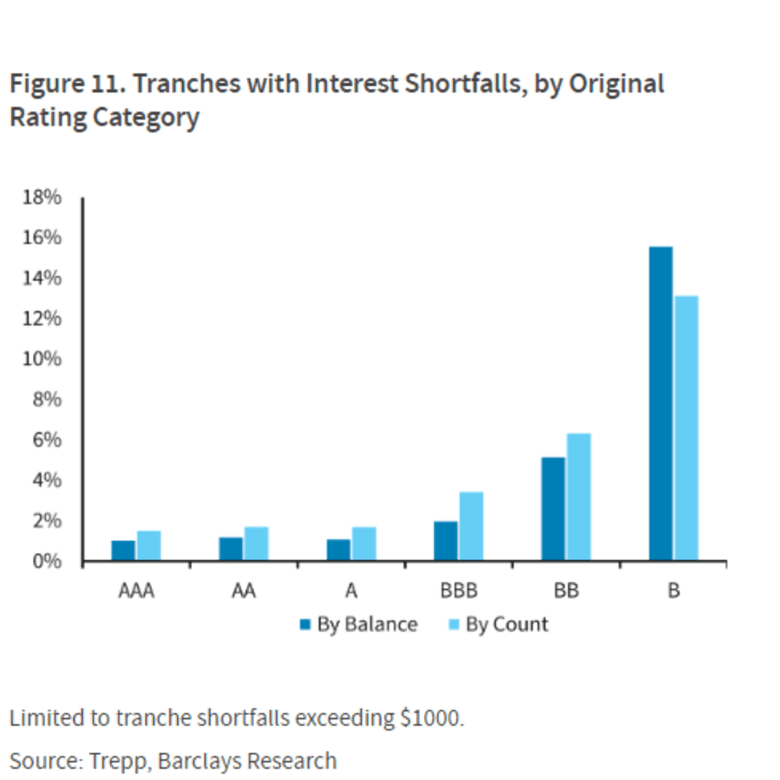
September saw more interest shortfalls for investors in bonds tied to troubled commercial real estate, according to Lea Overby’s research team at Barclays. (Trepp, Barclays Research)
With values of problem commercial real estate still dropping, another batch of top AAA-rated property bonds in September failed to provide expected interest to investors, according to Barclays analysts led by Lea Overby.
The tally of total AAA bonds with interest shortfalls has now reached eight when looking across single-asset, single-borrower bond deals. Those were sold to investors years ago in a lower rate backdrop.
While that makes up less than 2% of the sector, shortfalls have been climbing, especially for riskier “junk-rated” bonds, as fresh property appraisals come in lower and borrowers continue to struggle to refinance older loans.
“We still urge caution when looking to seasoned paper, as the performance of many assets is quite weak and the risk of extensive losses is high,” Overby’s team wrote in a Monday client note.
General Motors Corp.’s stock and Ford Motor Co.’s stock dropped Monday after Jeep owner Stellantis NV warned it’s facing tighter profit margins due to increased competition from Chinese automakers and lower wholesale shipments.
Stellantis’s stock STLA was down nearly 14% after it said it now expects adjusted 2025 operating margin of 5.5% to 7%, well below its previous estimate of a double-digit operating margin.
The stock dropped to below $14 a share for the first time in about two years.
Ford’s stock F fell 2%, while General Motors shares GM moved lower by 3.1%.
So much for the September gloom. Defying its record as the worst month for stocks, September gains for both the Dow Jones Industrial Average — up 1.7% — and the S&P 500 — up 1.5% — are on track to be the strongest since 2019, according to Dow Jones Market Data.
The Nasdaq Composite, up 2.2%, is on track for its best September since 2013.
JPMorgan Chase offers less potential upside as interest rates come down than Bank of America, Citi or Goldman, according to Morgan Stanley analyst Betsy Graseck.
Morgan Stanley downgraded JPMorgan to equal-weight from overweight.
She also reiterated overweight ratings for Bank of America Corp., Citigroup, and Wells Fargo & Co. and upgraded U.S. Bancorp to overweight from equal-weight.
Friday’s nonfarm payrolls report for September has the potential to put another big rate cut from the Federal Reserve on the table, if it comes in below expectations, according to Enrique Diaz-Alvarez, chief economist at London-based global financial services firm Ebury.
The median estimate of economists polled by The Wall Street Journal is for a gain of 144,000 jobs in September. “This Friday’s payrolls report should once again be consistent with a labor market that is generating modest job growth, but remains near full employment,” Diaz-Alvarez wrote in an email. A miss, however, “could cause markets to brace for the possibility of a second straight 50bp rate cut from the FOMC at its next meeting in early November.”
As of Monday morning, fed-funds futures traders were pricing in a 40.6% chance of a 50-basis-point cut in November, according to the CME FedWatch Tool.
The “roaring” 2020s have already emerged, with the question now being whether the scenario will be sustained, according to Jason Draho, head of asset allocation for the Americas at UBS Global Wealth Management.
“With the mid-point of the 2020s only three months away, and the final stage of the post-pandemic normalization underway with the start of Fed rate cuts, it’s no longer too soon nor too optimistic to suggest that the U.S. will experience a Roaring ‘20s economy,” Draho said in a note Monday. “The way things have been trending, it’s quite possible that by early 2025 only the most pessimistic investors will need rose-colored glasses to see a clear path to a Roaring ‘20s outcome.”
UBS views the “Roaring ‘20s” as a macro regime with sustained gross domestic product growth of 2.5% or higher, inflation in the range of 2%-3%, a federal-funds rate of around 3.5% and the yield on the 10-year Treasury note at around 4%, according to the note.
“The fundamental case for the scenario is based on a capex boom and surging AI investment, enabled by abundantly available capital, which results in faster productivity growth,” Draho said.
The 10-year Treasury yield was trading around 3.76% on Monday morning Eastern time, FactSet data show, at last check.
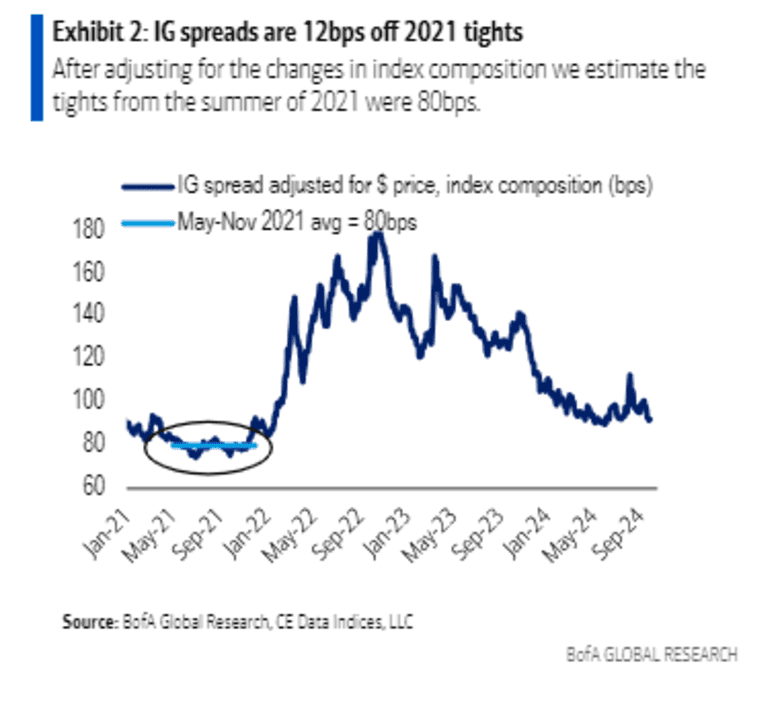
A major artery for financing Fortune 500 companies is signaling extremely low recession risks (BofA Global)
Recession risks appear extremely low when looking at at two major forces at play for S&P 500 companies.
But rather than demand more compensation to finance the borrowing spree, investors have been snapping up new investment-grade bonds at some of the lowest spread levels since the global financial crisis.
Spreads were last pegged at about 92 basis points above Treasurys, only 4 basis points off the lows of 2024 set in May, according to BofA Global. That’s nearing the post-global financial crisis lows of 80 basis points set in the summer of 2021, when the Federal Reserve’s policy rate was still in a 0%-0.25% range.