Updated 1 min read
US stocks jumped on Wednesday as oil prices dropped and a sell-off in bond markets eased ahead of AI chip heavyweight Nvidia (NVDA) earnings after the closing bell.
The S&P 500 (^GSPC) moved up more than 1%, while the Nasdaq Composite (^IXIC) jumped 1.5%. The Dow Jones Industrial Average (^DJI) rose 1.3% after the blue-chip index fluctuated between positive and negative territory earlier in the session.
Stocks rebounded from declines on Tuesday as US bond yields retreated from levels not seen in almost two decades. Concerns that sticky inflation will force the Federal Reserve to raise interest rates have dampened interest in growth stocks. Minutes of the Fed’s April meeting, released on Wednesday, showed policymakers are prepared to move away from an easing bias if inflation remains persistently above the central bank’s 2% target.
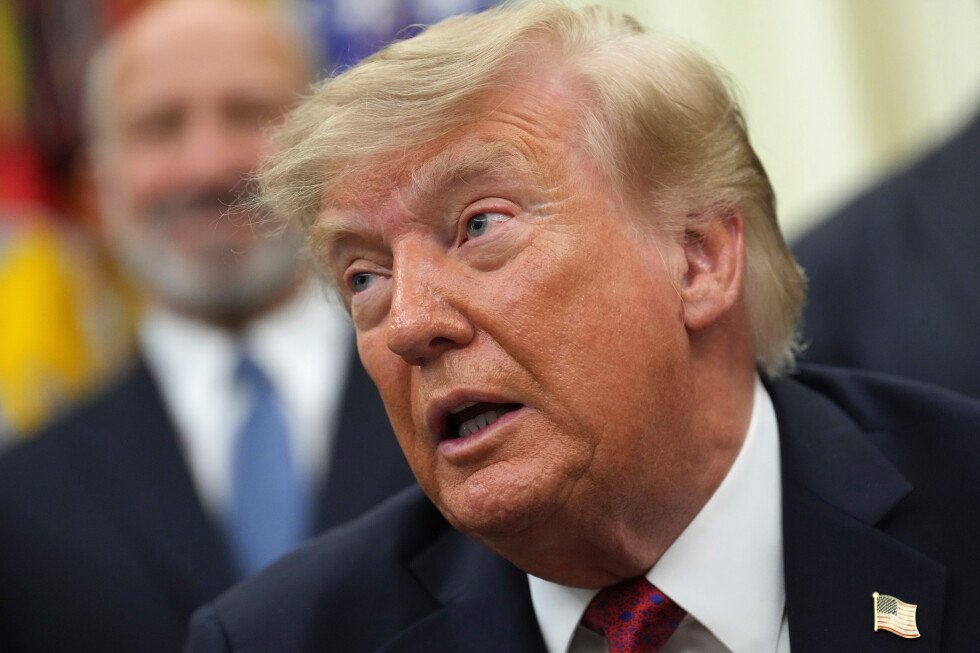
At the same time, crude oil prices were on track for their largest single-day drop in a month after President Trump said the US is in the “final stages” of reaching a deal with Iran and several tankers moved to transit the Strait of Hormuz.
Wall Street awaited Nvidia earnings as investors looked for a strong signal on AI demand. While shares in the world’s most valuable company have continued to rise this year, chipmaker rivals are closing in. Markets are pricing in a move of about 5.5% for Nvidia shares in either direction following the results, per Bloomberg.
Elsewhere on the earnings front, Target’s (TGT) blowout first quarter results highlighted a flurry of reports from retailers on Wednesday as energy price hikes strain wallets. Lowe’s (LOW), like Target, beat expectations on the top and bottom lines.
LIVE COVERAGE IS OVER 19 updates
-
Nvidia tops Q1 estimates, offers upbeat outlook on strong chip sales
Yahoo Finance’s Dan Howley reports:
Nvidia (NVDA) reported its fiscal first quarter results after the bell on Wednesday, topping analysts’ expectations on the top and bottom lines and offering a better-than-anticipated Q2 outlook.
For the second quarter, the company anticipates revenue between $89.1 and $92.8 billion. Wall Street was looking for $87.3 billion.
Read more here.
-
Dow, S&P 500, Nasdaq rally as investors await Nvidia earnings
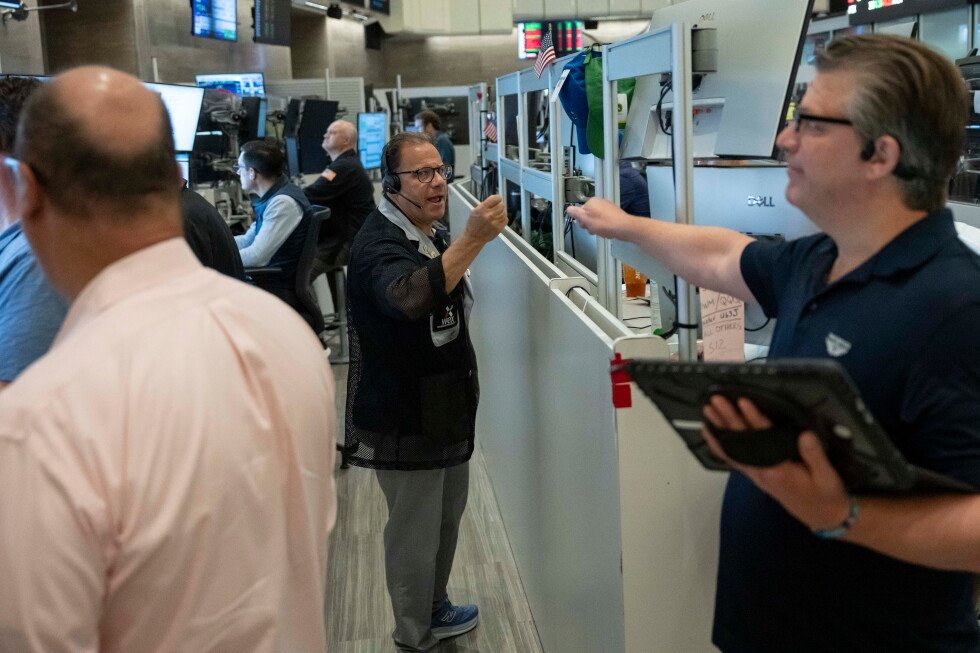
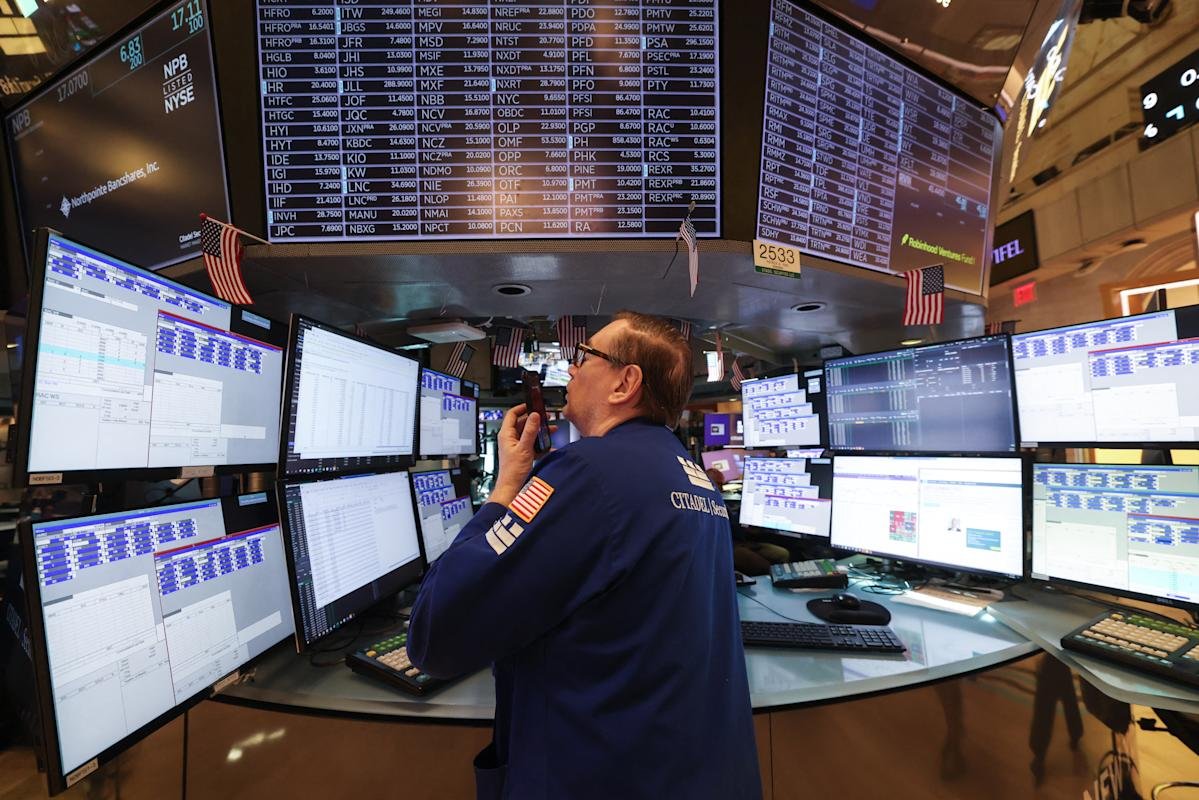
Stocks rallied as investors prepared for Nvidia (NVDA) earnings after the bell on Wednesday.
The chip heavyweight is the bellwether for the AI trade. Strategists expect the company to beat on earnings and revenue. The question is by how much. Wall Street has remained overwhelmingly bullish on the chipmaker, with most analysts covering the stock maintaining Buy ratings.
Bond yields eased as oil prices fell, and optimism grew over a possible deal between the US and Iran.
The S&P 500 (^GSPC) rose about 1%, while the tech-heavy Nasdaq Composite (^IXIC) gained 1.5%. The Dow Jones Industrial Average (^DJI) jumped more than 600 points, or around 1.3%.
-
US economy a ‘levered bet on AI,’ says Lazard chief Peter Orszag
The US economy is a “levered bet on AI,” Lazard (69Q.F) CEO Peter Orszag said in comments to Bloomberg on Wednesday, underscoring the degree to which the ups and downs of the AI market have come to dominate wider market returns, inflation, energy usage, and other critical aspects of the economy.
“If you look at the sources of growth in the US, it is artificial intelligence and high-income consumers,” Orszag said. “Like many bets, it may or may not pay off, but it’s a good bet to be making.”
Orszag’s comments come just after his bank advised NextEra Energy (NEE) on its $66.8 billion acquisition of Dominion Energy (D), marking the largest power sector deal of all time and creating a company that will have the country’s largest utility coverage and 110 gigawatts of power generation capacity.
Economists have increasingly focused on the AI trade as a key bellwether for the wider economy, given its transformational nature for both capital and labor markets.
-
Hasbro CEO on $600 Star Wars Ultimate Grogu, collectibles, and earnings beat
Yahoo Finance’s Brian Sozzi reports:
Hasbro (HAS) CEO Chris Cocks says the company’s first quarter defied conventional thinking that US consumers are pulling back due to high gas prices and a new wave of inflation.
The reason is simple: People are prioritizing their kids.
“There’s birthdays, Christmas, etc. They’re going to make sure their kids are taken care of. And toys are a small kind of thing that brings joy to a household. And then I think the second thing, it’s a small luxury for people. You know, when the price of going out to dinner eclipses $100, when filling up your tank eclipses $70 to $80, it’s nice just to buy a fun thing from a fandom that you love that’s accessible,” Cocks said on Yahoo Finance’s Opening Bid (video above).
Read more here.
-

Airlines and cruise stocks jump as oil slides
Travel stocks are ripping as oil drops on optimism around US-Iran talks, with the rally strongest in the names most exposed to fuel costs.
Airlines and cruise lines are doing the heavy lifting. Alaska Air (ALK), Frontier parent Frontier Group (ULCC), United Airlines (UAL), Carnival (CCL), Delta Air Lines (DAL), and Norwegian Cruise Line (NCLH) are all about 10% intraday.

Meanwhile, American Airlines (AAL), JetBlue (JBLU), Southwest Airlines (LUV), and Hyatt (H) are all up more than 5%.
United is on pace for its best day in nine months, as is the US Global Jets ETF (JETS). Delta is nearing its first record closing high in three months.
Lower fuel costs is the biggest catalyst.
Oil is falling on hopes for progress in US-Iran talks, and the same move pressuring energy stocks is lifting airlines, cruise operators, and other travel names.
The rally also comes off a weak base, with several travel stocks still down year to date or negative since the March 30 market low.
If oil keeps falling, travel bulls finally have a catalyst that might last beyond a one-day bounce.
-
Federal Reserve minutes show policy makers prepared to hike rates if inflation persistently runs above target
Minutes of the Fed’s April meeting revealed that policy makers are prepared to tighten monetary policy if the Iran war continues to push inflation higher.
“A majority of participants highlighted, however, that some policy firming would likely become appropriate if inflation were to continue to run persistently above 2 percent,” said the FOMC minutes.
Rising bond yields in recent sessions have put pressure on stocks, as investors anticipate the Federal Reserve will have to pivot to a more hawkish stance amid elevated oil prices that are pushing inflation higher.
-
OpenAI preparing to file for IPO ‘very soon’ says report
AI developer OpenAI is reportedly filing to go public “very soon,” according to a Wall Street Journal report.
The company has been working with bankers to prepare its filings, which could be submitted in the coming days, according to the report, citing people familiar with the matter.
Bankers at Goldman Sachs and Morgan Stanley have been assisting with the company’s IPO prospectus, which could be filed with regulators as early as this Friday.
-
Small caps are testing a key breakout level the bulls need to defend
Small caps spent six years going sideways before finally breaking out. Now the iShares Russell 2000 ETF (IWM) is bouncing off the first level bulls need to defend.
Small caps are testing a floor that used to be a ceiling · Yahoo Finance AlphaSpace That level is roughly $270. It capped the small-cap rally in January, turned into support once already in April, and is getting tested again after IWM pulled back for three straight sessions.
That is classic breakout behavior — if buyers keep showing up. The old ceiling gets revisited, and traders decide whether it has become the new floor.
The retest has some weight behind it. But the bigger line is still $240–$245. That zone roughly captures the 2021 and 2024 highs, the old multiyear ceiling IWM finally cleared, and the area that helped support the April lows.
Small caps recently broke out of a long-term sideways trading range. · Yahoo Finance AlphaSpace Above $270, small caps keep momentum. Below it, the real test is whether the old multi-year ceiling near $240–$245 still holds.
-
Stocks surge to session highs as oil prices pull back, bond yields fall
Stocks are rallying to session highs as inflation concerns subsided on some promising signs from the Strait of Hormuz and in the bond market.
The S&P 500 (^GSPC) and Dow Jones Industrial Average (^DJI) climbed 0.9%, while the Nasdaq Composite (^IXIC) led gains, rising 1.2%.
Lower oil prices and bond yields appeared to lift sentiment at around noon ET.
West Texas Intermediate crude oil (CL=F) was on track for its biggest daily loss since April 17, falling 4% to trade at $99 per barrel. Brent crude (BZ=F), the international benchmark, dropped 5% to $105 per barrel.
On Wednesday, financial data provider LSEG reported that three tankers carrying crude oil to China and South Korea successfully crossed the Strait of Hormuz. Investors have been closely monitoring US-Iran peace talks, though the two sides still appeared far apart on a resolution.
Meanwhile, Treasury yields continued to pull back, with the 10-year yield creeping back toward 4.5% and the 30-year yield at 5.11%.
-
AMC stock soars after CEO scoops up 250,000 shares, signaling ‘enormous confidence’ in the company
AMC (AMC) stock soared 17% in late morning trading on Wednesday after CEO Adam Aron said he purchased 250,000 more shares of the movie theater chain, sending a bullish signal to investors.
“I have enormous confidence in AMC and the 2026/2027 box office,” Aron said in an X post, adding, “So, again today, I put my money where my mouth is.”
Aron said he hasn’t sold any of his AMC stock since January of 2022. He owns 12.3 million shares of the company.
AMC has emerged as a favorite meme stock among retail traders since the 2021 momentum-driven frenzy that temporarily catapulted shares higher.
-
Intuit stock trims losses on report the company is laying off 17% of workforce
Intuit (INTU) is cutting approximately 17% of its global workforce, or roughly 3,000 employees, according to a memo seen by Reuters.
The financial software company, best known for products like TurboTax and QuickBooks, is restructuring operations and increasing its focus on artificial intelligence initiatives, according to the memo.
Intuit stock pared earlier losses after the report, falling about 3%. The shares are now down roughly 38% year to date.
Intuit is the latest in a wave of companies announcing layoffs, with some pointing to efficiency gains from artificial intelligence as a contributing factor, including Block (XYZ), Meta (META), Amazon (AMZN), and Coinbase (COIN).
-
Treasury yields steady, but bond markets remain on edge
The global bond sell-off appeared to ease slightly in the run-up to the Federal Reserve’s meeting minutes and as oil prices fell.
The 10-year yield (^TNX) and 30-year yield (^TYX), which have been closely monitored by investors after jumping to recent highs, ticked down by 1 basis point. The 10-year yield is at 4.65%, and the 30-year yield is at 5.18%. Both bond yields remain above the key psychological levels of 4.5% and 5%, respectively.
Higher yields have put downward pressure on stocks in recent days. But as oil prices declined on Wednesday amid hopes of a resolution to the Middle East conflict (Brent at $108 per barrel; WTI crude at $101), investors’ fears of inflation may be tentatively easing.
In order for rates to stop moving higher, “we would … need to see oil prices come down sharply,” Piper Sandler chief investment strategist Michael Kantrowitz told Yahoo Finance on Tuesday. “The other thing that we could see, which I would argue would be bullish for equities, is some softer labor data. Anything that brings down interest rates … is bullish, even some softer employment.”
-
SpaceX expects to buy AI startup Cursor 30 days after IPO: Bloomberg
SpaceX (SPAX.PVT) is planning to buy the AI startup Cursor shortly after Elon Musk’s rocket and satellite company goes public, Bloomberg reported Wednesday.
SpaceX’s acquisition of the AI coding platform would be expected to proceed 30 days after it begins publicly trading, per Bloomberg. With SpaceX expected to file for its IPO as soon as Wednesday and begin offering shares on June 12, the company would be on track to buy Cursor in July.
SpaceX said in April that it had entered into an agreement with Cursor that would allow it to purchase the startup for $60 billion. If the deal falls through, SpaceX will pay Cursor a $10 billion breakup fee, Bloomberg reported on Wednesday.
If the acquisition goes through, Cursor will add to SpaceX’s AI capabilities, following Musk’s merger of SpaceX and his AI startup xAI earlier this year.
-
US stock market opens higher on Wednesday
US stocks turned green on Wednesday as investors looked ahead to Nvidia (NVDA) earnings, due after the closing bell, which has become a quarterly bellwether for the AI trade.
The S&P 500 (^GSPC) picked up roughly 0.2%, while the tech-heavy Nasdaq Composite (^IXIC) rose by a stronger 0.6%. The Dow Jones Industrial Average (^DJI) ticked above the flatline.
Nvidia, the world’s largest company and largest chipmaker, will provide a key read on the state of the AI industry, and whether spending and demand are holding up. Investors will also look for the results to relieve some of the upward pressure in bond markets, which have sent yields on 30-year Treasurys (^TYX) above 2007 levels.
Elsewhere in the market, Target (TGT) results beat estimates on both revenue and earnings per share, and the company reported its largest sales gain in years. Lowe’s (LOW) also beat expectations on the top and bottom lines.
-
Goldman Sachs set to get top billing as lead bank on SpaceX IPO
Shares in Goldman Sachs (GS) ticked up by 1% in premarket trading on Wednesday after news that the investment is set to take the lead role on the upcoming initial public offering of Elon Musk’s SpaceX (SPAX.PVT).
While Morgan Stanley (MS) is also expected to act as a lead bank on the offering, Goldman Sachs is expected to get the “lead-left” position on the prospectus, which gives it top billing — and often access to higher fees — on the IPO, per the Wall Street Journal.
JPMorgan (JPM), Citigroup (C), and Bank of America (BAC) are expected to participate as well in what is likely to be the largest IPO on record. SpaceX is reportedly targeting a $75 billion IPO, dwarfing Saudi Aramco’s (2223.SR) $29.4 billion IPO in 2019.
Major IPOs typically pay out large fees for the banks leading the offering process.
-
Oil prices pull back as Trump and Vance signal diplomatic progress, Iran warns of retaliation
Oil prices fell on Wednesday after President Trump said he believed the war would end “very quickly,” even as Iran threatened widespread retaliation if the US attacked.
Futures on Brent crude, the international benchmark, lost roughly 2.4% to trade below $109 per barrel, while those on US WTI crude fell 2% to trade at $102.
Adding to the president’s comments — even as Trump warned the US may need to “give them another big hit” — Vice President JD Vance said Tuesday that the US had “made a lot of progress” in negotiations with Iran, and that “We think the Iranians want to make a deal.”
In Iran, the regime warned on Wednesday of “crushing blows in places you do not expect” throughout the Middle East if the US were to resume military action against the Islamic Republic, according to the state-owned Tasnim news agency.
“If aggression against Iran is repeated, the regional war that had been promised will this time extend beyond the region,” the Islamic Revolutionary Guard Corps said on Wednesday.
The comments from the IRGC come after President Trump said he had canceled a large wave of strikes against Iran planned for Tuesday at the request of Gulf state leaders, who he said had assured him a deal was near.
As the Strait of Hormuz remains closed, analysts continue to warn that drawdowns in global oil stocks could approach dangerously low levels in the next few months if traffic through the waterway doesn’t normalize.
-
Intel, Micron, and other semiconductor stocks extend bounce ahead of Nvidia earnings
Yahoo Finance’s Ines Ferré reports:
Intel (INTC), Micron (MU), and Sandisk (SNDK) stocks bounced back for a second day in a row on Wednesday. AMD (AMD), Marvell (MRVL), and Arm Holdings (ARM) also gained in premarket.
Semiconductor stocks rose in anticipation of Nvidia’s (NVDA) quarterly results as shares of the artificial intelligence chip heavyweight rebounded by more than 1%.
The semiconductor complex came back from a broader sell-off driven by rising bond yields and growing inflation fears. Memory and storage stocks like Micron and Sandisk also recovered from recent profit-taking by investors following an epic run.
-
Target CEO on earnings blowout: We saw broad-based strength in consumers
Yahoo Finance’s Brian Sozzi reports:
Somehow, Target (TGT) defied US consumer trends in the first quarter.
Gas price spikes across the country have hammered shoppers’ wallets and driven inflation higher. Consumer sentiment has plunged, while interest rate cut expectations have dropped.
One would have thought Target — with its well-documented operating struggles in 2025 — would have reported a horrid first quarter.
Instead, it reported a $0.28 earnings beat on Wednesday. Sales increased in all merchandise departments, led by beauty, hardlines, and food. Store traffic increased.
The company even jacked up its full-year sales outlook and said it expects sales to increase in each quarter of the year.
“No doubt there’s a lot to pay attention to there [with consumers], because the consumer’s got headwinds and some tailwinds, and so we’re paying a ton of attention to how consumers are finding value on our site and on our shelves, and some of the changes that we’ve made are with that in mind. Now, for us, it will always be about being sharp on price,” Target CEO Michael Fiddelke told Yahoo Finance.
Customers shop at a Target store on Feb. 10, 2026, in Chicago, Illinois. (Scott Olson/Getty Images) · Scott Olson via Getty Images -
Global long bond yields hit highest in almost two decades
The sell-off in longer-maturity government bonds has pushed up yields to levels last seen during the global financial crisis, and market participants are warning the move has room to run.
From Bloomberg:
A surge in global inflation expectations has brought the average yield on sovereign debt due in a decade or more to the highest since July 2008, a Bloomberg gauge shows. It comes as the war in Iran chokes off the vital Strait of Hormuz waterway, sending Brent crude above $110 a barrel.
Global long-dated bonds have been under pressure on concern the jump in energy costs will feed into everything from plastic bottles for soda to gasoline for tractors needed to harvest crops.
Add in worries over government spending in Japan, the UK and the US, as well as an artificial intelligence boom supporting growth in the world’s biggest economy, and investors have been seeking greater compensation to own longer-maturity debt.
“We’re seeing a broader repricing of duration driven by fiscal realities, persistent inflation risks and some political uncertainty, as well as a more demanding investor base,” said Patrick Coffey, head of a research group at Barclays Plc in London. “It’s hard to point to a near-term catalyst outside of the reopening of the Strait of Hormuz that could fully reverse the current selloff.”