Updated 1 min read
US stocks retreated on Thursday as investors watched for Iran’s response to a US peace proposal and combed through labor updates and fresh earnings reports.
The Nasdaq Composite (^IXIC) hovered near the flat line. The S&P 500 (^GSPC) declined 0.3% on the heels of record-high closes for the tech-exposed benchmarks. The Dow Jones Industrial Average (^DJI), meanwhile, sank 0.5%.
Iran is said to be evaluating a US proposal to end the near-10-week war, and it is expected to give its response as soon as Thursday, CNN reported. The signs of progress toward easing the Strait of Hormuz blockade temporarily pushed Brent (BZ=F) oil futures lower, helping spur a rally in gold (GC=F) as inflation worries eased.
Earlier this week, market sentiment got a lift from the steady march of tech earnings, indicating strength in the AI trade. Shares in Arm (ARM) initially rose on the chip designer’s upbeat revenue forecast but then sank on Thursday on concerns about a lack of chip supply.
In a busy week for labor data, Thursday brought a Challenger report on layoffs in April, which showed AI was blamed as the tech sector got hit hardest. A weekly reading on jobless claims came in cooler than expected, setting the stage for the all-important monthly jobs report on Friday.
LIVE 15 updates
-
AI-sensitive stocks are leading 52-week gainers
The artificial intelligence trade is back in the driver’s seat, helping drive stocks to all-time highs.
Since the March 30 low, markets have relentlessly pushed higher, helped by one of the most impressive quarters for corporate earnings in years. AI has been the other factor propelling stocks higher — but it’s not just the “Magnificent Seven” names.
As SoFi head of investment strategy Liz Thomas points out, 47 S&P 500 (^GSPC) stocks are within 2% of a 52-week high, including companies like Apple (AAPL) and Intel (INTC).
Roughly two-thirds of those companies are exposed to the artificial intelligence build-out, with many of those coming from semiconductor and industrial parts of the economy.
-

The AI race is eating into Big Tech’s cash flow
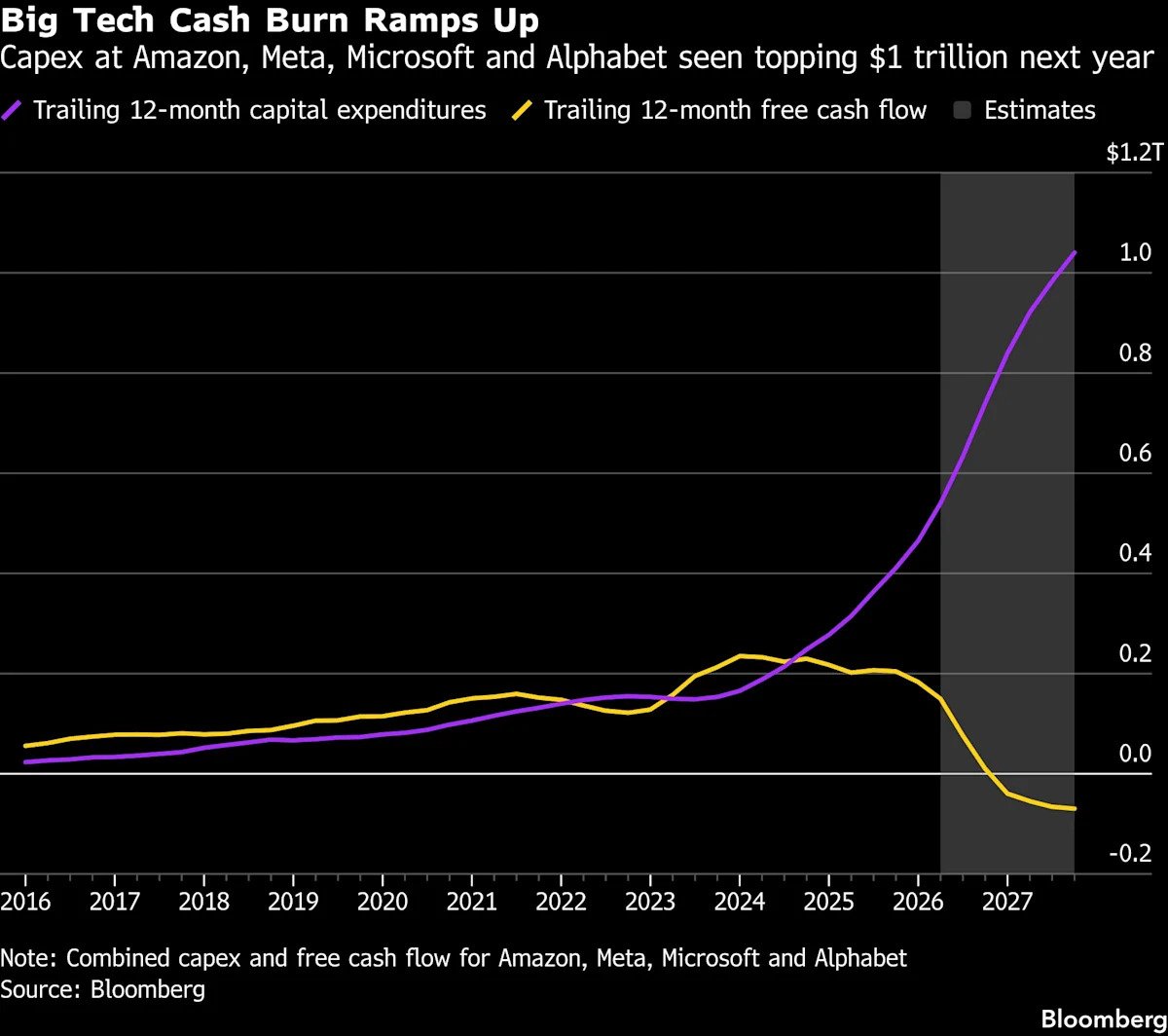
The AI boom has made Big Tech richer, bigger, and suddenly much hungrier for cash.
Alphabet (GOOGL), Microsoft (MSFT), Amazon (AMZN), and Meta (META) are pouring more money into the physical backbone of artificial intelligence — data centers, chips, servers, and power-hungry infrastructure.

AI infrastructure is eating more of hyperscalers’ cash flow · Bloomberg, Yahoo Fincance That spending shows up as capital expenditures, or capex, and it’s taking a bigger bite out of the cash these companies generate from day-to-day operations. Amazon is spending nearly all of its operating cash flow on capex, while Meta and Alphabet are not far behind. Microsoft is lower, but climbing too.
That turns the AI trade into a cash-flow test.
Alphabet is where the trade-off is easiest to see. Its forward price-to-free-cash-flow multiple has surged above 200x, according to Bloomberg data, as investors pay up for AI upside while expected free cash flow gets squeezed.
Alphabet’s AI rally is outrunning free cash flow · Bloomberg, Yahoo Finance For Alphabet, investors need the AI build-out to start producing cash.
-
Short-term inflation expectations rose to 3.6% in April, per NY Fed survey
Americans’ short-term inflation expectations rose in April, according to the New York Federal Reserve, as concerns over energy costs and the broader economic ramifications of the war in Iran have put cost increases front and center for consumers.
Consumers now expect inflation at 3.6% over the next year, compared to expectations of 3.4% over the same time period in March, according to survey data released Thursday. Gas price expectations, however, have “retreated appreciably from a spike” in March, the NY Fed found.
Long-term expectations remained unchanged at 3.1% over the next three years and 3% over the next five years. The Fed traditionally targets 2% inflation, though US price increases have remained above target.
Household finances have also deteriorated, the NY Fed survey showed, with more households reporting worsening finances and fewer reporting improved financial situations from a year ago.
-
Whirlpool stock drops 12%. The appliance maker hasn’t seen demand levels this low since the ‘great financial crisis.’
Shares of Whirlpool (WHR), the appliance maker behind brands like Maytag and KitchenAid, dropped as much as 20% on Thursday before paring losses to a decline of 12%.
The company posted first quarter results that missed Wall Street’s expectations, saying that it was facing dire demand conditions — the worst, in fact, since the 2007/2008 financial crisis.
Yahoo Finance’s Brooke DiPalma reports:
Whirlpool (WHR) said demand for major appliances like dishwashers and refrigerators in the US and Canada “reached recession-level lows” in the first quarter, as historically low consumer confidence led to fewer big-ticket discretionary purchases.
Whirlpool CFO Roxanne Warner told Yahoo Finance that a “perfect storm” of low consumer sentiment “fueled by the impact of the Iran war” and winter weather hit the company’s North America business in March.
“The industry contracted about 7.4%,” Warner said. ”These are levels that last time you’ve seen was in the great financial crisis.”
In the first quarter, Whirlpool reported revenue declined nearly 10% year over year to $3.27 billion, below estimates of $3.42 billion. Whirlpool’s adjusted loss per share was $1.43, while the Street forecast a $0.36 loss per share, per Bloomberg consensus data.
-
Datadog stock soars after posting beat and raise in earnings report
Shares in cloud monitoring and security leader Datadog (DDOG) surged by more than 30% after the company raised its outlook and beat top- and bottom-line estimates in its earnings report on Thursday.
The stock performance marks the largest jump for the company’s shares in six years, according to Bloomberg.
Full-year revenue is now expected to land between $4.3 billion and 4.34 billion in 2026, Datadog said Thursday, coming in above analyst expectations of $4.09 billion. The company cited AI as a leading driver for growth.
“There is no change to our overall view that digital transformation and cloud migration are long-term secular growth drivers for our business,” CEO Oliver Pommel said on a call with investors. “But we now have an additional secular growth driver with AI as we help our customers deliver more value with this transformative new technology.”
The company reported earnings of $0.60 per share, outperforming expectations of $0.51. Revenue for the quarter was roughly $1 billion, against estimates of $959 million. Quarterly revenue grew 32% year over year.
Pommel said the company signed one seven-figure deal and one eight-figure deal with “the AI research divisions at two of the world’s largest technology companies,” without naming the firms involved.
“By using Datadog, both companies are accelerating their past of innovation on their hyperscale AI training workload,” Pommel said.
-
Apple and ‘Magnificent 7’ ETF join the intraday record high party
Apple (AAPL) notched its first intraday record high since December after closing at a record Wednesday. Similarly, the Roundhill Magnificent Seven ETF (MAGS) hit its first all-time intraday record since October.
Here are this morning’s intraday record highs:
Indexes: Nasdaq Composite (^IXIC), S&P MidCap 400 (^MID), S&P 500 (^GSPC), Nasdaq 100 (^NDX), S&P 500 Equal Weight (^SP500EW), S&P SmallCap 600 (^SP600)
Dow Jones Sectors/Industries: Large-Cap Technology, Construction and Materials, Computer Hardware, Industrial Suppliers, Industrials, Industrials TR, Internet Services, Technology, Technology TR
Large-cap sector ETFs: Technology (XLK)
Small-cap sector ETFs: Small-cap tech (PSCT)
Industry/Style/Country ETFs: Emerging markets (EEM), Taiwan (EWT), Micro-cap (IWC), Magnificent Seven (MAGS), Mega Cap (MGC), S&P 500 Equal Weight (RSP), High Beta (SPHB), Semiconductors (XSD)
Consumer discretionary stocks: Ross Stores (ROST)
Health care stocks: DaVita (DVA)
Financial stocks: Interactive Brokers (IBKR)
Industrial stocks: Caterpillar (CAT), Cummins (CMI), F5 (FFIV), Grainger (GWW), Howmet Aerospace (HWM)
Tech stocks: Apple (AAPL), ASML (ASML), Cirrus Logic (CRUS), Diodes (DIOD), ChipMOS (IMOS), Intel (INTC), Keysight (KEYS), Kulicke & Soffa (KLIC), Lam Research (LRCX), MACOM (MTSI), MKS Instruments (MKSI), Silicon Motion (SIMO), SiTime (SITM), Semtech (SMTC), Taiwan Semiconductor (TSM), Wolfspeed (WOLF)
Communication services stocks: Alphabet (GOOGL)
-
US stock market ticks up after opening bell
US stocks edged up at the opening bell on Thursday as investors digested headlines from Iran and a slew of numbers from the corporate and economic data calendars.
The S&P 500 (^GSPC) gained less than 0.1% to sit just above the flat line, while the Nasdaq Composite (^IXIC) rose roughly 0.2%. The Dow Jones Industrial Average (^DJI) moved up roughly 0.1%.
In the commodities market, Brent (BZ=F) oil futures fell below $100 a barrel as Iran is expected to respond to Washington’s negotiation terms, helping spur a rally in gold (GC=F) as inflation worries eased.
Shares in Arm (ARM) initially rose on the chip designer’s upbeat revenue forecast, but fell around 2.5% after the opening bell. In the consumer sector, McDonald’s (MCD) first quarter earnings beat estimates, sending shares higher.
Labor market data from Challenger showed job cut announcements jumped 38% in April from March, with AI-driven cuts in focus. Weekly data on jobless claims showed 200,000 initial claims, above the previous week’s reading but below what economists had been expecting.
-
Initial jobless claims rise to 200,000, below expectations
Initial jobless claims rose to 200,000 in the week ended May 2, according to data released by the Department of Labor on Thursday, coming in above the previous week’s revised tally of 190,000 first-time claims.
Economists had expected initial claims to be slightly higher at 205,000 for the week, according to consensus estimates compiled by Bloomberg. The four-week moving average of initial claims fell to 203,250 from the previous week’s 207,750 average.
Continuing claims, which track the unemployed population still seeking work, ticked down to 1.76 million in the week ended April 25 compared to the previous week’s revised count of roughly 1.77 million continuing claims.
Economists had been looking for an increase in continuing claims, estimating roughly 1.8 million.
-
Oil prices fall below $100 as US awaits Iran response to terms for ending war
Crude oil dropped further on Thursday as markets awaited Iran’s expected response to a new framework for negotiations offered by Washington, with traffic through the Strait of Hormuz still at a standstill.
Futures on international Brent crude (BZ=F) lost roughly 4.8% to trade near $96 per barrel after dropping under the $100 mark around 3 a.m. ET. Those on US WTI crude (CL=F) shed a steeper 5.2% to trade around $90 per barrel.
Oil prices fell by as much as 11% on Wednesday before paring losses after reports that the US and Iran were closing in on terms to end the war that has stymied global oil markets.
Washington reportedly sent a memo to Tehran that would set a framework for peace negotiations, per reporting by Bloomberg and Reuters, with the Iranian regime’s response expected in the coming days. Terms reportedly include a reopening of the Strait of Hormuz by both sides.
With traffic at a standstill, the market is losing upward of 13 million barrels’ worth of oil supply per day, according to JPMorgan analysts.
-
Wall Street bankers on pace for big pay bumps in 2026 amid AI gold rush
Yahoo Finance’s David Hollerith reports:
As the AI boom spurs activity across almost every corner of Wall Street, bankers are coming out on top in compensation hikes.
“The big banks had a very good 2025. They’re doing at least as well, if not better, this year, and pay will be up significantly,” Alan Johnson, managing director of Johnson Associates, said in an interview.
“They’re going to be pay leaders for the first time in probably a decade,” Johnson added.
About half of Wall Street workers are expected to see some increase in compensation in 2026. IPO and M&A bankers are estimated to see the biggest jumps, up as much as 20% from last year, according to first quarter compensation projections from consulting firm Johnson Associates.
-
Citi: 2 negative consequences if quarterly earnings reports vanish
On Tuesday, SEC Chair Paul Atkins introduced a proposal that would give public companies the option to file a new Form 10-S every six months instead of the traditional Form 10-Q every quarter.
But as Yahoo Finance’s Brian Sozzi reports, doing away with quarterly reporting by companies could come with a few negative consequences.
“One unintended consequence could be for a greater shorter term influence of macro data and inputs,” Citi strategist Scott Chronert warned in a note on Thursday. “That is, against a backdrop of less frequent fundamental disclosures, markets may be more inclined to trade stocks relative to perceived sensitivity to economic and monetary inputs. In some cases this could create shorter term inefficiencies.”
Chronert added, “We would expect that the sell side will need an adjustment period. Here, there is risk of inefficiency where analyst models are updated less frequently. The same issue will affect us from an equity strategy perspective. Simply, full year and next twelve month estimates are at risk of getting stale, if not inaccurate, in a two vs four reporting cycle circumstance.”
-
The stock market’s semi-charmed life
Yahoo Finance’s Myles Udland writes:
The stock market has surged to record highs, and the names doing most of the work to get us there are coming from one industry: semiconductors.
In a note to clients Wednesday morning, the team at Bespoke Investment Group noted the recent rally in semis is “one of the most epic runs in history.”
… As a group, Bespoke noted that the Philly Semiconductor Index is 56% above its 200-day moving average.
For readers who aren’t technically inclined, the 200-day moving average is the average price of an asset over the last 200 trading days, or roughly 10 months, and can best be thought of as where the long-term trend for something — a stock, an ETF, an index — sits. Moves far above or below this level indicate prices that may be overheated or oversold.
Anything trading 56% of its 200-day moving average, in other words, is on a historic heater. The only other two times the group was this far above its 200-day were July 1995 and March 2000.
Read more here in the takeaway from today’s Morning Brief.
-
One of the S&P 500’s best earnings seasons in 20 years comes with a catch
The S&P 500 (^GSPC) is not just beating Q1 earnings expectations. It’s blowing them up., writes Yahoo Finance’s Jared Blikre.
Here’s why that may not be all good news, from the Chart of the Day:
This earnings season is shaping up as one of the index’s strongest in 20 years, with profit growth accelerating, beat rates running hot, and analysts lifting estimates instead of cutting them.
That’s the good news.
The catch is that Wall Street may already be treating great earnings as the new floor.
Deutsche Bank is calling this “one of the best earnings seasons in 20 years,” and the charts show why. The share of S&P 500 companies beating earnings estimates is running well above normal, while quarterly profit growth is tracking near 25% — more than double the typical pace outside recessions.
… The bigger tell is what is happening to future earnings estimates.
-
Space data firm HawkEye360 raises $416M in IPO
Reuters reports:
Space analytics firm HawkEye 360 has raised $416 million in its U.S. initial public offering, the company said on Wednesday.
The Herndon, Virginia-based firm sold 16 million shares priced at $26 apiece in the IPO, giving it a valuation of roughly $2.42 billion. It had targeted a price range of $24 to $26 per share.
Traders work on the floor of the NYSE in New York After a strong April, IPO activity is expected to pick up in the coming months, with HawkEye 360 and Suja Life set to test investor demand for defense technology and consumer brands, respectively.
HawkEye will also gauge appetite for space-technology offerings, as investors await a public filing from SpaceX that could bolster confidence among peers to pursue listings and tap equity markets.
-
Gold maintains after US-Iran peace push drives precious metal in positive direction
Bloomberg reports:
Gold (GC=F) steadied after its biggest daily advance since late March as traders assessed the optimism of a US-Iran deal to the end the war that has sent oil prices plunging and eased inflation concerns.
Bullion traded around $4,690 an ounce, after jumping 3% on Wednesday. Falling energy prices weighed on bond yields, while the dollar fell to pre-war levels, tailwinds for gold that’s priced in the US currency and doesn’t offer interest.
Iran is evaluating a fresh proposal from the US to end the near 10-week conflict, according to a person familiar with the matter, as China added its voice to global pressure to wrap up the war.
President Donald Trump has indicated on multiple occasions throughout the conflict that a deal is near, though none has materialized. He said on social media on Wednesday that the US will end its military campaign and lift its blockade of the Strait of Hormuz “assuming Iran agrees to give what has been agreed to, which is, perhaps, a big assumption.”