Updated 1 min read
US stocks dropped on Friday despite President Trump further delaying promised US strikes on Iran’s energy infrastructure, as oil rallied amid doubts about the chances of a peace deal.
The tech-heavy Nasdaq Composite (^IXIC) dropped 1.3%, sinking further into correction territory. Meanwhile, the Dow Jones Industrial Average (^DJI) fell 1%, while the S&P 500 (^GSPC) moved 0.9% lower, following steep losses for Wall Street stocks on Thursday.
Oil prices pushed over 2% higher on Friday as attacks continued across the Middle East, raising concerns the war could run into April and beyond. Brent crude (BZ=F) traded above $104 a barrel, while West Texas Intermediate (CL=F) topped $97 as investors eyed the growing economic hit from the halt to Strait of Hormuz traffic.
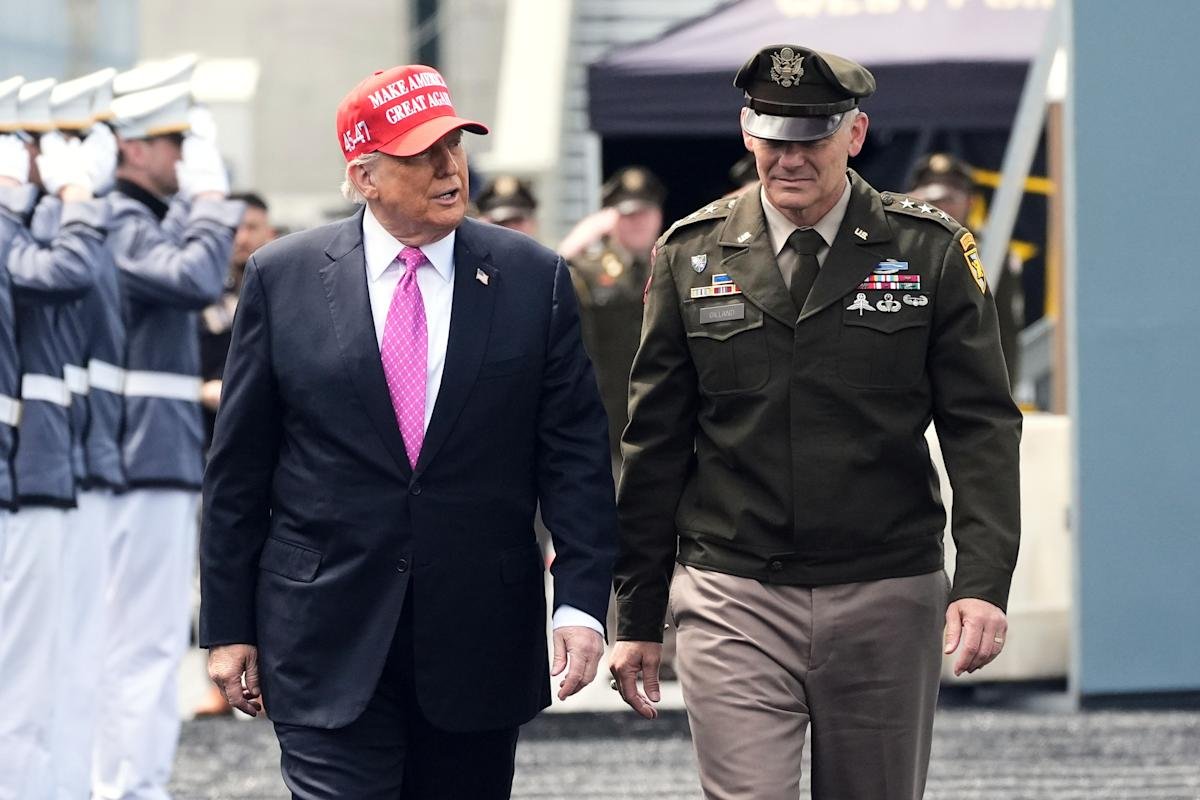
Trump extended his deadline for Iran by 10 days, giving the country until April 6 to comply with US demands or face strikes on its power plants. The move marks a shift in Trump’s tone around the war, showing a potential path toward deescalation. Still, uncertainty lingers over whether Trump’s pause will pay off, given Iran’s sustained rejection of US efforts to reach a deal.
In the early hours of Friday, the Senate passed a bill that will fund the TSA and other Department of Homeland Security operations, but not ICE. The vote opens the way to an end to the partial federal shutdown that has caused airport chaos and risked damaging the US economy.
LIVE 13 updates
-
10-year Treasury yield climbs to highest level since July
The 10-year Treasury (^TNX) yield jumped to 4.46% on Friday, its highest level since July, as President Trump’s postponement of strikes on Iranian infrastructure failed to calm the bond market and lower oil prices.
The move is significant, given that the 10-year Treasury was around 3.96% before the start of the Iran conflict.
Yields move inversely to bond prices.
Strategists point to expectations of higher inflation, driven by surging oil prices, as the main force behind rising yields. Investors have scaled back expectations for Fed rate cuts anytime soon, as Brent crude remains above $100 per barrel, despite Trump’s suggestions that the US is negotiating with Iran.
“After months of expecting the Federal Reserve Board to cut interest rates this year, investors have returned to a familiar refrain: ‘Higher for longer,'” wrote Mike Dickson, head of research and quantitative strategies at Horizon.
That investor sentiment shift has been the main driver of the 2-year yield, which has climbed to 4%, up roughly 50 basis points since late February.
“Given the disruptions to natural gas, fertilizers, helium, etc., markets might also be anticipating a broader commodity shock, which would likely pass through into core inflation,” Bank of America economist Aditya Bhave wrote on Friday.
-
US stocks turn into the red at the opening bell
US stocks turned into the red again on Friday as oil rallied despite a second delay from President Trump on US strikes on Iran’s domestic power infrastructure.
The Dow Jones Industrial Average (^DJI) and Nasdaq Composite (^IXIC) dropped 0.8%, while the S&P 500 (^GSPC) lost a slightly slimmer 0.7%.
Oil prices rose more than 3% on Friday as investors increasingly view the war through alonger-term lens. Futures on the international benchmark Brent crude (BZ=F) traded above $104 a barrel, while those on the US benchmark West Texas Intermediate (CL=F) crossed $97.
On Friday morning, the Senate passed a bill that will fund the TSA and other Department of Homeland Security operations, excluding ICE. The vote is the first step toward ending the partial federal shutdown that has roiled US airports.
-
Rates surge ahead of oil prices as market prices in a more hawkish Fed
After tracking oil prices through March, short-term Treasury yields have surged ahead of oil since the Federal Reserve’s March meeting — suggesting that expectations are shifting hawkish for the Fed.
Over the past 10 days since the Fed’s meeting, futures on the US oil benchmark, West Texas Intermediate (WTI) crude (CL=F), have remained flat, down less than 1% over that period. Those on international benchmark Brent (BZ=F) have lost roughly 3%.
In the rates market, however, two-year Treasurys have split off from oil, gaining roughly 30 basis points since the meeting.
The reaction in Treasurys can be at least partially attributed to more hawkish positioning from the Fed’s leadership, Bank of America US economist Aditya Bhave wrote in a client note Friday morning.
Fed Chair Jerome Powell’s comments after the Fed’s meeting skewed hawkish, and Fed governor Christopher Waller “sounded very concerned about the oil spike” in an interview he gave on March 20, Bhave wrote.
Given the post-meeting split between short-term rates and oil prices, “We think markets are now anticipating a more hawkish Fed reaction function and, possibly, a broader commodity shock,” Bhave wrote.
-
Oil prices could cross $200 per barrel if war last through June, Macquarie Group says
Oil prices could hit $200 per barrel if the war in Iran persists through the end of June, according to strategists from Macquarie Group.
If the war were to stretch well into the summer, the strategists wrote in a client note on Wednesday, prices would need to move high enough to “destroy an historically large amount of global oil demand,” likely requiring Brent crude prices above $200 per barrel and pushing US gasoline prices up to roughly $7 per gallon.
On Friday, Brent (BZ=F) futures traded above $104 per barrel, holding onto roughly 3% gains on the day even after President Trump pushed back his deadline for striking Iranian domestic power infrastructure for a second time. US benchmark WTI crude (CL=F) held onto slightly higher gains to trade above $96 per barrel.
Earlier in the conflict, the two energy products reached prices not seen since the early months of 2022, following the Russian invasion of Ukraine.
The Macquarie strategists, led by Vikas Dwivedi, assigned a roughly 40% probability to their bull case of $200 per barrel oil. More likely, the strategists wrote, is a situation in which the war ends by the beginning of April, oil prices moderate, economic costs remain small, and global growth only slightly slows.
“The market is still expecting President Trump to soon declare victory, with oil and gas futures heavily backwardated,” the strategists wrote. “However, given uncertainty about what victory looks like, and recent attacks on energy infrastructure, there is a risk that prices may need to move significantly higher first to incentivise a near-term deal.”
-
Senate passes Homeland Security deal after airport delays
The US Senate passed legislation early on Friday to fund most of the Department of Homeland Security, creating a path to end the partial government shutdown that created long lines and chaos in some of the nation’s biggest airports.
Airline stocks remained in the red in premarket trading despite hopes that the affected airports in Atlanta, Houston, and New York could soon see some relief.
Bloomberg reports:
-
Premarket trending tickers: Unity Software, TripAdvisor, and Coinbase
Unity Software (U) stock rose 12% before the bell on Friday after the videogame developer said it now expects first-quarter earnings to come in above its guidance.
TripAdvisor (TRIP) stock rose 3% during premarket hours today. The travel guidance platform recently added two new directors to its board as part of a new plan made in agreement with activist investor Starboard Value.
Coinbase (COIN) stock fell 3% before the bell on Friday. Coinbase and Better Home & Finance (BETR) announced on Thursday they would be teaming up to let homebuyers use their crypto holdings as collateral for down payments.
-
Microsoft is set for its worst quarter since 2008 as AI takes two bites
Bloomberg reports:
Microsoft Corp. (MSFT) is at the intersection of two troubling trends roiling the technology sector, which has the stock on track for its worst quarterly performance since the global financial crisis two decades ago.
First, the software giant is doubling down on capital expenditures as Wall Street increasingly asks when investments in artificial intelligence infrastructure will produce more dramatic payoffs in revenue growth.
And second, investors are selling software stocks over fears that AI startups like Anthropic (ANTH.PVT) and OpenAI (OPAI.PVT) are creating agents that can replace products made by companies like Microsoft.
“There is this concern that rather than paying Microsoft, we’ll see more customers go directly to AI vendors, which could disrupt the core business, or at least pressure pricing and margins,” said Jonathan Cofsky, portfolio manager at Janus Henderson Investors, which holds the shares.
The company’s stock is down 24% in the first quarter, on pace for its biggest loss since its 27% drop in the fourth quarter of 2008. It’s by far the weakest performer among the Magnificent Seven tech giants to start the year, with an index tracking the group falling 13% over that time.
-
Unity stock jumps 13% on preliminary results
Video game developer Unity (U) said it was exiting its non-strategic ad business on Thursday, sending its shares up more than 12% in premarket trading.
The announcement came alongside preliminary first quarter results that boosted expectations.
Unity expects to report revenue of $505 million to $508 million, up from previous guidance of $480 million to $490 million. Adjusted EBITDA is expected to grow 58% to be between $130 million and $135 million, versus prior guidance of $105 million to $110 million.
The gaming software maker also announced it would divest its ironSource Ads Network by the end of next month to enhance profitability and speed up revenue growth.
-
The dollar is on track for its best month since July
Wall Street started 2026 forecasting losses for the dollar (DX-Y.NYB), based in part on expectations that the Federal Reserve would keep cutting interest rates. But that dim view has turned bullish as the Iran war spikes oil prices.
From Bloomberg:
-
Gold gains as Trump pushes back Iran talks deadline
Gold (GC=F) continued to march higher on Friday after President Trump reset the deadline for Iran to come to the table to agree on a ceasefire deal.
Bloomberg reports:
-
Oil falls as Trump delays Iran energy infrastructure attack plans
Bloomberg reports:
-
OpenAI’s ad trial shows $100M annualized revenue in six weeks
OpenAI‘s ChatGPT ads pilot in the United States has crossed the $100 million annualized revenue mark within six weeks of launch, a company spokesperson said on Thursday, pointing to robust early demand for the AI startup’s nascent advertising business.
Sam Altman-led OpenAI had said in January that it would start showing ads in ChatGPT to some U.S. users, ramping up efforts to generate revenue from the AI chatbot to fund the high costs of developing the technology. The ads were to be tested with users on the company’s free tier and the lower-priced Go plan.
The ads are separate from the answers generated by ChatGPT and do not influence its outputs. User conversations are not shared with marketers, the company said at the time.
OpenAI has now expanded to over 600 advertisers, with nearly 80% of small- and medium-sized businesses signaling interest in ChatGPT ads, the spokesperson said.
-
Netflix increases subscription cost for all US plans
Reuters reports:
Netflix (NFLX) has increased prices on all its plans in the U.S., as the streaming giant pushes into new programming formats such as video podcasts and live sporting events.
The company’s ad-supported tier will now cost $8.99 a month, compared with $7.99 earlier, while prices for its standard plan rose $2 per month to $19.99, according to its website.