Updated 2 min read
In This Article:
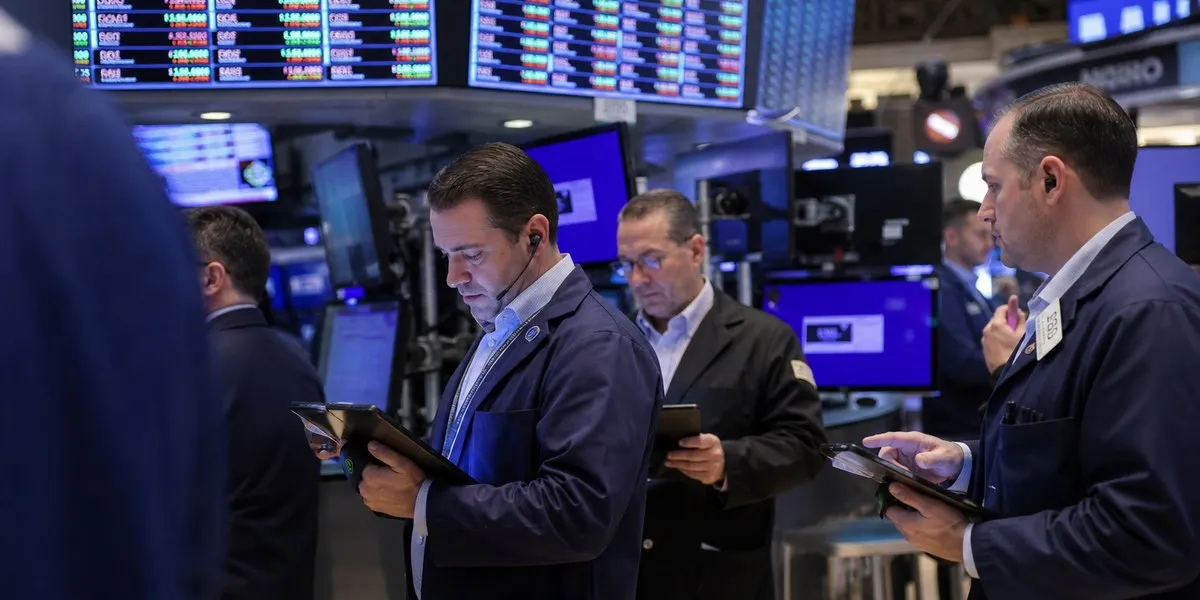
US stocks rocketed higher on Wednesday as President Trump announced a 90-day pause on tariffs for most countries, yet at the same time upped increasingly ballooning levies on China.
The benchmark S&P 500 (^GSPC) roared up nearly 8% at last check, while the tech-heavy Nasdaq Composite (^IXIC) rallied a whopping 10%, aiming for its biggest gain since 2008. The Dow Jones Industrial Average (^DJI) was up over 7%, or over 2,500 points. All three of the major averages had previously been lower at some point in the session.
“I have authorized a 90 day PAUSE, and a substantially lowered Reciprocal Tariff during this period, of 10%, also effective immediately,” Trump posted on Truth Social just before the market lifted off. Trump also said in the post that the US would be raising its tariffs on China to 125%.
Big Tech led the rally on Wednesday. Nvidia (NVDA) soared over 15% while Tesla (TSLA) added 17%. Apple (AAPL), Amazon (AMZN) and Meta (META) were up about 10%.
SNP – Free Realtime Quote USD
As of 2:22:39 PM EDT. Market Open.
^GSPC ^DJI ^IXIC
Meanwhile, the benchmark 10-year Treasury yield (^TNX) continued a recent surge, moving up near 4.4% after paring some gains.
China had retaliated on Wednesday in an escalating trade war between the world’s two biggest trading partners, which has roiled markets amid worries about the broader economic fallout. Beijing said the hike to 84% duties will take effect on Thursday.
Trump’s abrupt backtrack Wednesday completed a remarkable week of tariff whiplash. Trump’s announcement of the so-called “reciprocal” tariffs stunned markets last week, and massive hikes on Vietnam, Japan, India, and others went into full effect early Wednesday. The Nasdaq has already entered into a bear market, while the S&P 500 and Dow were creeping closer until Wednesday’s sharp move higher.
Read more: Live updates on Trump tariffs fallout
Trump had weighed in on the volatile market action just after the open on Wednesday, writing on social media that it is a “great time to buy!!!”
“BE COOL! Everything is going to work out well. The USA will be bigger and better than ever before!” he added.
Meanwhile, minutes from the Federal Reserve’s March meeting could show how worried policymakers were about stagflation risks from Trump’s tariff push. The release due later sets the stage for Thursday’s update on the Consumer Price Index, which will signal where inflation was headed before Trump’s tariffs went into full force.
LIVE 34 updates
-
US dollar still flat despite tariff news
The US dollar (DX=F, DX-Y.NYB) didn’t see much of a boost after the White House paused tariffs against non-retaliatory countries.
The US Dollar Index — which measures the dollar’s value relative to a basket of currencies (the euro, Japanese yen, British pound, Canadian dollar, Swedish krona, and Swiss franc) — traded flat in afternoon trading.
The index is down over 5% year to date as Wall Street remains on edge that shifting trade dynamics could induce a self-inflicted recession.
-
The bond market isn’t so euphoric
While stocks move higher, bond market investors are still signaling they’re worried about inflation.
The yield on 10-year Treasuries fell only marginally after Trump’s announcement, and remains up 11 basis points on the day to around 4.4%. A strong Treasury auction this afternoon also helped bring yields down somewhat from this morning’s highs, but right now no one is rushing back in to buy US debt.
-
Gold pares gains, still up 3% as stunning market rally unfolds
Gold pared gains after President Trump announced a 90-day tariff pause on imports from non-retaliatory countries, while upping levies on China to 125%.
The initially precious metal pared gains following the announcements as stocks skyrocketed higher in a stunning rally.
Gold futures were up aroung 3% at around 2:10 p.m. ET to hover near $3080, below the session highs of around $3111.
-
Russell 2000 also rips higher as small caps rally
The Russell 2000 (^RUT) ripped higher on Wednesday as the White House paused tariffs against non-retaliatory countries, fading concerns of a recession.
Small caps gained more than 7%. The index had been in a bear market over concerns of a full-blown trade war impacting the economy.
-
Treasury yields still rising after Trump tariff news
Yields aren’t reacting much to President Trump’s tariff news.
Shortly following the announcement of Trump’s 90-day reciprocal tariff pause (and more levies on China), the 10-year yield (^TNX) jumped another 12 basis points to trade around 4.38%. That represents a massive 51 basis point swing from Monday’s low of 3.87% — and the biggest three-day jump since December 2001.
The 30-year yield (^TYX) posted more modest gains but still rose six basis points after it logged its biggest move to the upside since March 2020 earlier in the week. As of the afternoon, the 30-year yield traded at 4.79%.
Yields and bonds are inversely correlated, meaning higher yields equal falling bond prices. Over the past few trading sessions, the unusual surge in long-term Treasury yields has rattled investors — and it looks like those concerns could continue.
-
Crude oil leaps above $61 a barrel
Oil bounced back after Trump announced a pause on his reciprocal tariff plan and increased US levies on Chinese imports.
West Texas Intermediate (CL=F) rose around 2.5% to trade above $61 a barrel, despite opening the day at just over $58. Brent (BZ=F), the international benchmark, jumped to $64 per barrel.
Earlier in this day, China — the biggest import of crude — announced it would implement 84% tariffs on US-made goods.
-
Sectors surge, XLK up 10% on Trump tariff news
-
Big Tech soars as Trump announces tariff pause
Wow.
-

Trump announced 90-day pause on reciprocal tariffs, market goes nuts
There it is — a pause in Trump’s reciprocal tariff plans.
On Wednesday afternoon, the president posted on his social media platform, Truth Social, that he would institute a 90-day pause on reciprocal tariffs for a swath of countries while also raising tariffs on China as that tit-for-tat trade war escalates.
Following this news, stocks were going bonkers, with the Nasdaq (^IXIC) up as much as 8% and the S&P 500 (^GSPC) rising in excess of 6%.
-
Tech is leading a narrow market rally
There is finally some green on the screen in markets.
The benchmark S&P 500 (^GSPC) was up 0.7%, while the tech-heavy Nasdaq Composite (^IXIC) rallied about 1.5%. The Dow Jones Industrial Average (^DJI) lifted 0.5% or more than 200 points. All three of the major averages were well off their session lows.
Under the surface things don’t look quite as positive though. At this time of this writing there are 59 more stocks declining in the S&P 500 on Wednesday than there are rising.
The traditional S&P 500 (^SPX) is market-cap weighted meaning the larger stocks in the index hold more weight. Therefore as they rise, they pull the index higher with it. But if you look at the equal-weighted S&P 500 (^SPXEW), which doesn’t have a company’s size influence its contribution to the index, the story is clear.
A few large cap stocks are dragging the benchmark higher on Wednesday well the rest of the market is catching less of a bid.
-
Earnings season to test how much bad news markets have priced in
The S&P 500 (^GSPC) is off nearly 20% from its most recent all-time high on Feb. 19 as fears that President Trump’s tariffs will weigh on economic growth have gripped markets.
Now, American corporates are set to report first quarter financial results as investors search for any answers on how the changing fiscal policy landscape could impact companies.
Truist co-CIO Keith Lerner told Yahoo Finance that the recent stock sell-off proves that “the market knows that [earnings] cuts are coming.”
“What I’m going to be looking for in the earnings season is maybe less about what companies are saying and more how are these stocks [acting], especially some of these ones that have been really beaten up in retail or some of these areas that really have been walloped,” Lerner said.
If a company cuts its earnings guidance but the stock moves higher it can be a sign that the bad news is already priced in, per Lerner. Piper Sandler chief investment strategist Michael Kantrowitz pointed out that companies are entering this reporting period with “super low expectations.”
“I don’t actually think earnings are going to be a negative,” Kantrowitz said.
He pointed to two companies that issued financial updates on Wednesday. Delta Air Lines (DAL) reported revenue growth stalled in the first quarter while also not reaffirming its previous full-year financial guidance. Meanwhile, Walmart (WMT) maintained its first quarter sales guidance but also warned operating profit growth will be lower than initially thought, citing tariff risk.
Still, both stocks were higher during midday trading.
-
Kashkari becomes latest Fed official to pour cold water on any near-term rate cuts
Yahoo Finance’s Jennifer Schonberger reports:
-
Apple rises 4% amid broader tech rally
Apple (AAPL) stock rose more than 4% on Wednesday as the broader tech trade attempted to stage a comeback following heavy selling in the sector in prior sessions.
Shares of the iPhone maker are still down more than 20% over the past five days as investors fear President Trump’s aggressive tariff plans will significantly impact Apple’s supply chain.
In a note to clients on Wednesday, Bank of America analyst Wamsi Mohan cited “stable cash flows, earnings resiliency and potential beneficiary of AI use on edge devices” as reasons he’s keeping a Buy rating on the stock with a $250 price target.
Elsewhere in tech, Microsoft (MSFT) and Nvidia (NVDA) were up more than 2% while Tesla popped over 4%.
-
JPMorgan’s Dimon says US recession now a ‘likely outcome’
Yahoo Finance’s David Hollerith reports:
-
Economist says the US economy is headed for a ‘brief recession,’ and it’s not all about Trump’s tariffs
Another economist believes the economic turmoil spawned from President Trump’s tariffs will push an already slowing US economy into recession.
“We are going into a recession,” Renaissance Macro head of economics Neil Dutta wrote in a note on Wednesday. “I don’t think it is especially controversial to say so. I suspect it will be relatively brief, but that the recovery off the lows will be pretty sluggish.”
Dutta listed tightening financial conditions, reduced government spending, and further escalation of the trade war as potential headwinds to economic growth. Last week, JPMorgan became the first Wall Street bank to call for a recession in 2025 following Trump’s tariff announcements.
In an interview with Yahoo Finance on Tuesday, Dutta highlighted that the recovery for the economy and the stock market won’t look like the V-shaped snapback seen in 2020.
He likened the slowdown he anticipates to the early 2000s recession, where a slowing economy was met by various exogenous shocks, including 9/11. This results in a “slog” of a recovery, per Dutta.
Dutta was early in calling out that economic data had been slowing prior to Trump taking office. He pointed to specific economic data points, like the employment rate of “prime age” workers ages 25-54 declining half a percentage point in the past six months.
“Go back in history and look at what that implies for recession,” Dutta told Yahoo Finance. “It’s very rare outside of recession.”
Dutta argued that outside of the tariff story, metrics like an unemployment rate hovering at 4% have masked a labor market that’s already deteriorating. The quits and hiring rates were already near decade lows, reflecting a low-churn labor market.
For the final months of 2024, the debate in the economic community had been about how long the labor market could hold on thin ice with slowing hiring and limited turnover. In the end, it appears the impact of Trump’s tariffs could be the final straw that turns the data for the worse.
“[Trump] didn’t have as much of an economic buffer as people think,” Dutta said.
-
Trump says ‘it’s a great time to buy’
Just minutes after the stock market opened, President Trump posted on Truth Social “THIS IS A GREAT TIME TO BUY!!!”
Before sending that message Trump had also posted “BE COOL! Everything is going to work out well. The USA will be bigger and better than ever before!”
Trump’s tweets come as an escalating trade war has gripped markets. Most recently, China said it will raise its tariff on US goods to 84%. This comes in response to the US initiating 104% duties on China early Wednesday.
Initially the tariff announcements had weighed on equity market futures, pointing to another bleak open for stocks. But in early trading, both the Nasdaq Composite (^IXIC) and S&P 500 (^GSPC) were higher. The Nasdaq was up about 1.2% while the S&P 500 was up 0.2%.
-
EU approves tariffs on $23 billion of US goods in response to Trump’s metal duties
-
Tech attempts a comeback
After two straight days of the market seeing green at some point in the day only to later close in the red, perhaps the third time is the charm.
The Nasdaq Composite (^IXIC) is up about 0.8% in early trading with the S&P 500 (^GSPC) hovering just above the flat line.
In individual movers, Apple (AAPL), Nvidia (NVDA), Broadcom (AVGO) and Tesla (TSLA) were all up 3% or more. Below is a look at the Nasdaq 100 (^NDX).
-
Stocks open mixed
After futures tied to the major indexes pointed to a lower open for most of the morning, US stocks were a mixed bag in early trading on Wednesday as Wall Street assessed the prospects for trade war after China struck back with an 84% tariff on US goods.
The benchmark S&P 500 (^GSPC) fell about 0.1%, while the tech-heavy Nasdaq Composite (^IXIC) rose over 0.5%. The Dow Jones Industrial Average (^DJI) fell 0.4%, shedding just over 150 points.
SNP – Free Realtime Quote USD
As of 2:22:39 PM EDT. Market Open.
^GSPC ^DJI ^IXIC