Here are the top stories to read during Tuesday trading:
Latest Updates
President Donald Trump’s inaugural address at the U.S. Capitol Monday has had an “immediate influence on oil prices,” said Fawad Razaqzada, market analyst at City Index and Forex.com.
During the speech, Trump promised that “we will drill, baby, drill,” emphasizing a push for increased domestic oil production and “aiming to lower global energy prices by boosting supply,” Razaqzada said in market commentary Tuesday.
Against this backdrop, the February contract for U.S. benchmark West Texas Intermediate, which expires at the end of Tuesday’s New York Mercantile Exchange session, fell by $1.20, or 1.5%, to $76.68 a barrel. The soon-to-be front-month contract, March WTI crude, traded at $76.11, down $1.28, or 1.7%.
The “lack of a more meaningful drop” in oil prices can be explained by the fact that Trump had already announced his plans for an increase in drilling, Razaqzada said. “Regardless of what prices do in the short-term, the long-term outlook is bearish: the expected increase in U.S. shale production, combined with the OPEC potentially returning withheld supplies, means the upside should be capped.” Demand growth may not keep up with the potential increase in global supplies, he added.
Canada and Mexico are on the list of U.S. allies that are likely to make requisite concessions to the U.S. to avoid permanent tariffs under the Trump administration, according to Thierry Wizman, a strategist at Macquarie.
Should such a scenario occur, it would likely remove one of the biggest questions facing financial-market participants right now, which is the extent to which inflationary pressures might arise from fresh tariffs.
“Our own view deals with end points, as that’s what is ultimately important, rather than how we get there,” Wizman wrote in a note on Tuesday. “Whether the U.S. turns up the heat in [the] interim negotiating period, or whether it institutes full tariffs to ‘show it means business,’ remains a source of uncertainty, of course. But within a definite period of time, those full or tentative tariffs that are put on to extract concessions will be reversed.”
The exception to this is China, the strategist said. “Here, the U.S. is likely to continue to be guided by the need to ‘de-risk’ China, and tariffs would not contradict that strategy. … So our view is that tariffs on China are coming.”
Demand for fixed-income bond exchange-traded funds and mutual funds remained solid last week, bringing total year-to-date inflows to $31 billion versus $29 billion for the same period last year, according to a team at Barclays.
“Most fund types recorded inflows, with intermediate-term government and corporate funds being the two exceptions with outflows,” the team wrote in a note released on Tuesday.
Over the five-day period that ended on Friday, U.S. bond funds posted $12.2 billion of inflows, compared with the prior four-week average of $2.4 billion in inflows, according to Barclays.
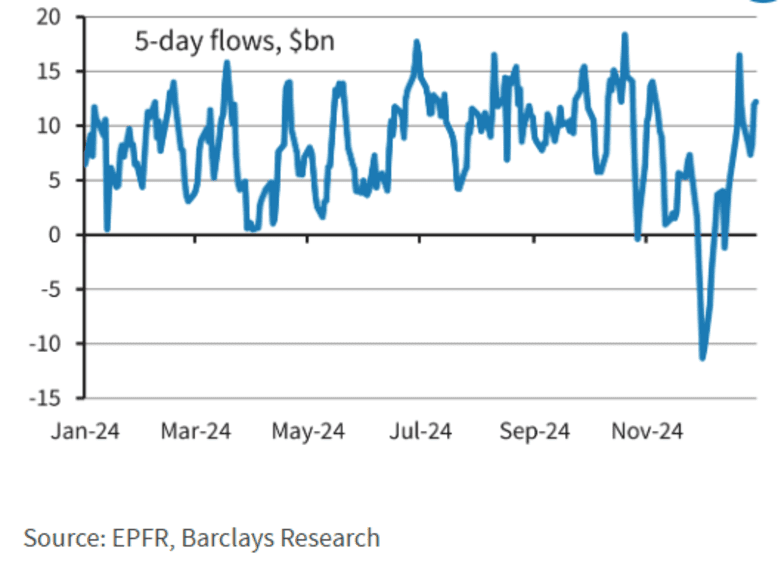
(EPFR, Barclays Research)
Investors have been trying to anticipate what President Trump’s second term will mean for equities. As those investors get more concrete details, expect the market to react.
“We expect a headline-driven stock market under Trump 2.0, especially when it comes to tariffs, budget negotiations and as the debate over the expiration of the 2017 Trump tax cuts comes into play. While headlines create volatility, that volatility also creates opportunity for investors,” Clark Geranen, chief market strategist at CalBay Investments, said in an email.
Geranen said investors should stay invested in the market, but be ready to deploy more cash when the market dips. He mentioned that his firm will invest in large-cap tech, financials and healthcare companies with exposure to artificial intelligence.
“We believe that what has worked over the past two years will continue to work in 2025,” he wrote.
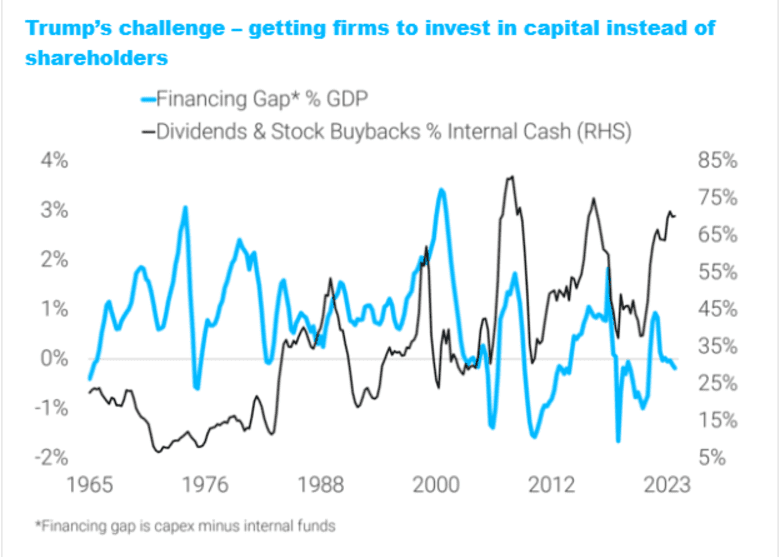
President Donald Trump’s plans to revive the “old economy” will hinge on getting companies to start spending their cash to bolster their businesses instead of on stock buybacks and dividends, says economist. (Federal Reserve, GlobalData. TS Lombard)
President Donald Trump used his inaugural address to focus on ways to “resurrect the old economy by making it cheaper to build it here, using taxes, regulations, tariffs and abundant energy,” according to Steven Blitz, chief U.S. economist at GlobalData, TS Lombard.
His chart shows about a 70% share of internal cash being used by companies on dividend and stock buybacks. It also shows the “financing gap” between capital expenditures and internal cash turning negative, “not surprising given the shift to use productive capacity outside the US and, in turn, earn the wide margin” over the past quarter-century.
The major U.S. stock market indexes opened higher on Tuesday, looking to continue the gains seen last week.
“Stocks are coming off their biggest up week in more than two months, as traders embraced cooler-than-expected inflation data and strong earnings from big banks,” Chris Larkin, managing director of trading and investing at E-Trade, wrote in an email. “With a light economic calendar this week, earnings may dictate whether the S&P 500 can post back-to-back up weeks for the first time since early December.”
Because Monday was a market holiday, stocks have a short week without too many economic updates. However, since it’s President Donald Trump’s first week in office, markets may react if there are further economic policy announcements.
The Dow Jones Industrial Average opened at 43,528.65, up around 0.4%.
The S&P 500 opened at 6,014.12, up 0.3%.
The Nasdaq Composite opened at 19,734.39, up 0.5%.
Bond-market participants responded to a flurry of announcements from the White House by producing a rally in U.S. government debt that sent 2- through 30-year yields lower as of Tuesday morning.
The 30-year yield led the decline in rates by falling almost 6 basis points to 4.789%. Ten- and 2-year yields dropped respectively to 4.56% and 4.253%
It “hasn’t been lost on the market that tariff increases, even those apparently slated for Canada and Mexico, were not officially announced on Trump’s first day in office,” said BMO Capital Markets rates strategists Ian Lyngen and Vail Hartman.
Trump has indicated that he may impose tariffs on Mexico and Canada of 25% as soon as the first day of next month. According to Lyngen and Hartman, “there remains a narrow window of opportunity (i.e. between now and the February 1 deadline) for the U.S.’s closest neighbors to make significant concessions/commitments on the issue of border control and trade.”
Correction: An earlier version of this post misstated the day of the week.
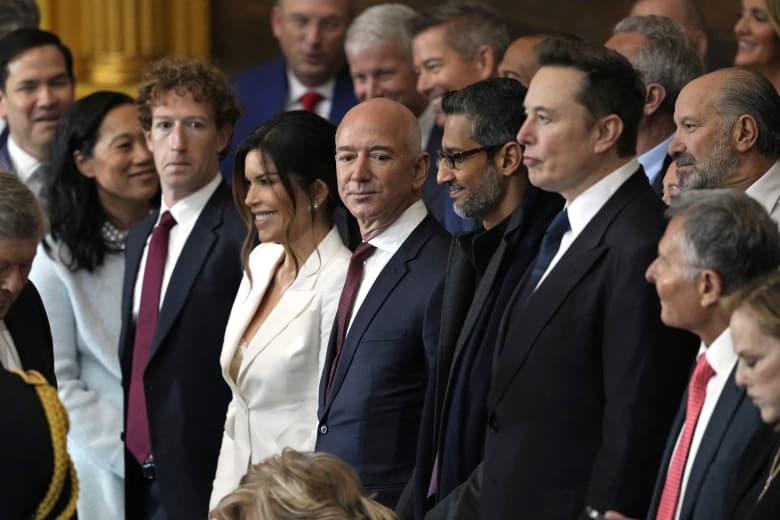
(Julia Demaree Nikhinson/Agence France-Presse/Getty Images)
The “who’s who” of powerful tech executives at Donald Trump’s second inauguration Monday points to a crucial power shift, Greg Valliere, chief U.S. policy strategist at AGF Investments, said in a client note.
“Years from now, when historians look at this speech, a sea-change will be clear: the dominance of the tech sector is now the biggest economic story in Washington,” Valliere wrote. “Virtually all of the Silicon Valley superstars were at the inauguration; they have bowed to Trump and in exchange they will enjoy a gentle, laissez-faire regulatory climate for the next four years.”
With stock-index futures higher early Tuesday it seems that so far President Trump’s policy decisions have brought little or no surprise to markets, and have arguably added to recent upward momentum in U.S. equities, according to Longview Economics.
However, in a trading recommendation published Tuesday, Longview notes that many of the short-term measures it observes, such as its risk appetite models and put/call ratios, “highlight signs of near term frothiness and complacency.”
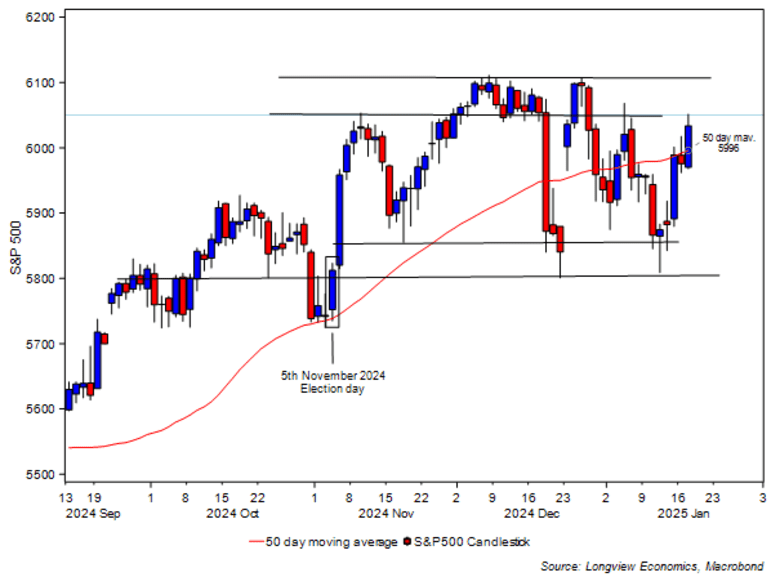
In addition. S&P500 futures sit close to key resistance levels, i.e. towards the top of their recent trading range, as the chart below shows.
“Initial resistance is just above current levels at around 6,052 (intra-day highs from last Friday, early January, and mid-November). Above that the next key resistance level is at 6,100 (highs from early and late December),” says Longview
“The case for moving short is building,” they say.
Still, Longview recognizes selling the current maket may be dangerous. “Risks, as always, are multiple and include the potential for (market positive) policy surprises from the White House. It’s also possible that, having consolidated recent gains, the uptrend in US equities is now resuming,” they say.
(Longview Economics)
Stocks making notable moves in Tuesday’s premarket action: