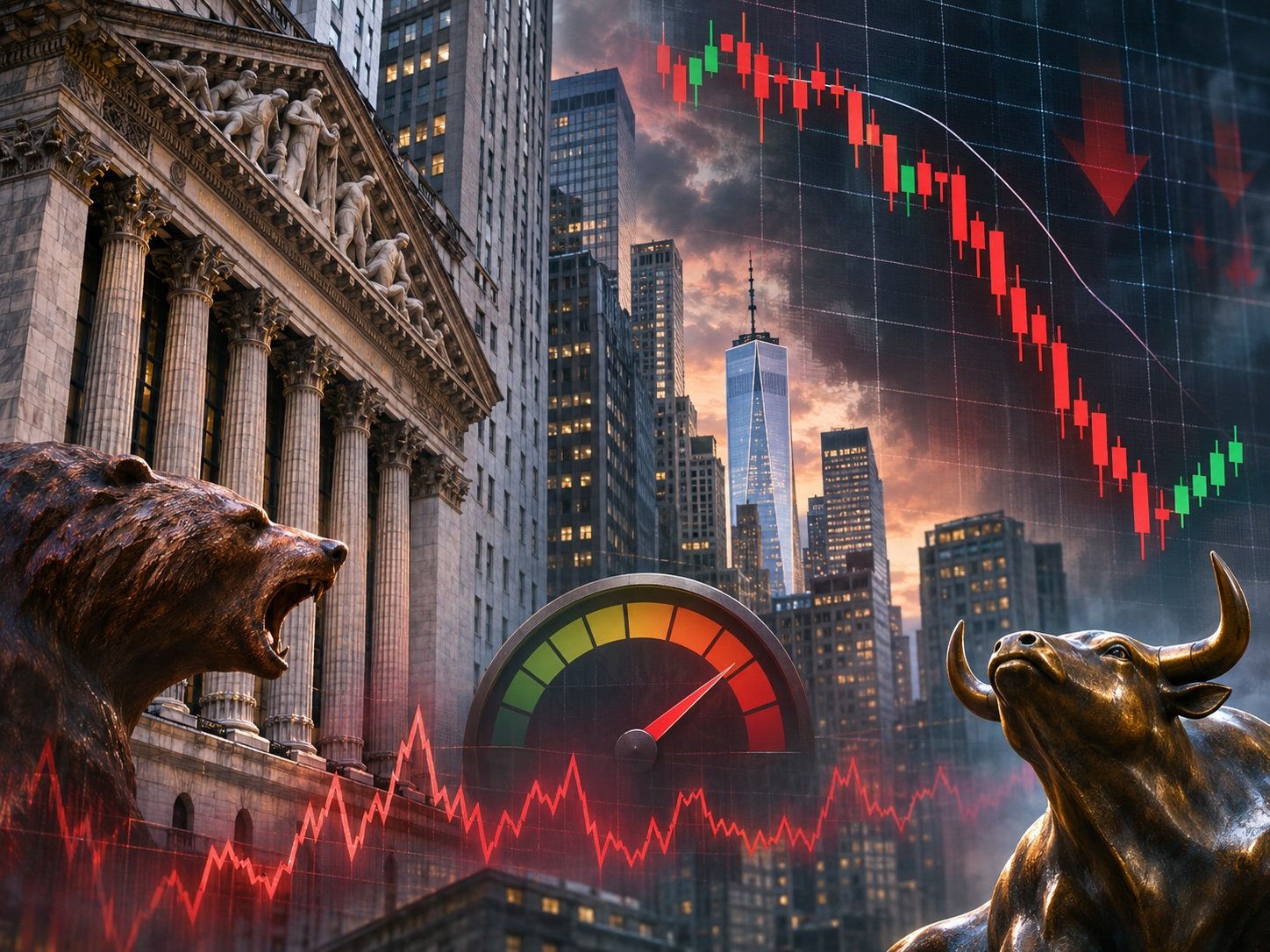
After seven straight sessions of losses, Wall Street may be poised for a relief rally. But persistent concerns over AI valuations, interest rates and weakening market breadth suggest the correction may not be over.
 After a sharp selloff, the bullish case is easy to state: the market looks oversold, fear is high, and much of the bad news may already be priced in. With futures about to reopen, a relief rally feels plausible. But three separate questions are hiding in that argument. Is the market oversold? Is it ready to bounce? Is the correction over? They are related, but they are not the same question.
The case for a bounce
The selling has been relentless. The S&P 500 fell for a seventh straight session, its longest losing streak since February 2020, and the VIX hit its highest level since April 2025. History gives bulls something to work with: since 1950, the S&P 500 has had 17 episodes of falling 8% or more over five sessions, and it was higher three months later in 15 of them, with a median gain of 8.1%.
But “oversold” only measures how intense the recent selling has been. It does not mean stocks are cheap, and it does not mean sellers are finished. Markets can stay oversold for a long time, and an oversold bounce can be a pause in a downtrend rather than the start of a lasting recovery.
A correction is not a bear market
One strategist noted this week that only five of the past 15 corrections from all-time highs since 1983 became bear markets. That is one sample, and the answer depends on how you count. Other studies find that roughly a quarter to two-fifths of corrections went on to become bear markets. Even so, corrections usually stop short of a bear market.
READ: Akhlaq Siddiqi: | To orbit and back: The two firms reshaping power (November 21, 2026)
Still, “this is not a bear market” is a different claim from “the correction is over.” An investor could be right about the first and still be early on the second.
Why the downside case cannot be dismissed
The damage is real. On Friday, the S&P 500 fell 3.7% to 6,910.39, finishing the week down about 8.6% and more than 11% below its October 6 record. The Dow also entered correction territory. The Nasdaq composite lost about 10% for the week and is now negative for 2026. The Nasdaq-100 closed 19.8% below its record, missing a bear market by just two-tenths of a percentage point.
The causes have not gone away. Worries about AI valuations and spending, along with a political backlash against data-center buildout, have weighed on the sector. The Fed is also tightening, not just uncertain: it raised rates in September, and a December hike is seen as close to certain. The S&P 500 closed Friday about 6% below its 200-day moving average, a widely watched long-term trend measure.
None of this proves a bear market is inevitable. But markets do not need a fresh shock every day to keep falling. A reassessment of growth expectations and valuations can be enough.
What would make the recovery more convincing?
Rather than demand certainty before the open, a more useful approach is to watch for three things: a rebound that holds, a pullback that stays above the recent low, and participation that extends beyond a handful of large technology companies.
Breadth is the weak spot so far. Last week, decliners outnumbered advancers by roughly three to one or worse on four of five sessions, and new 52-week lows far outnumbered new highs on the Nasdaq. These are tests of the thesis, not predictions about what happens next. An initial rally would be encouraging but insufficient on its own. The more important question is what the market does after the first burst of optimism.
Constructive, but not certain
A short-term bounce is plausible, and a correction that stops short of a prolonged bear market remains a credible outcome. What the evidence does not yet show is that the low is in.
That is not an argument for panic. It is an argument for separating a reasonable thesis from a confirmed result. The strongest bullish case is not simply “stocks have fallen enough.” It is “stocks have fallen sharply, and buyers are beginning to show they can regain control.”
(DISCLOSURE: This article is for general information and discussion only. It is not financial, investment, tax, or legal advice, and it is not a recommendation to buy, sell, or hold any security. Markets are volatile, past performance does not predict future results, and the figures cited may change. Consult a licensed financial professional before making investment decisions. The author may hold positions in securities or futures.)