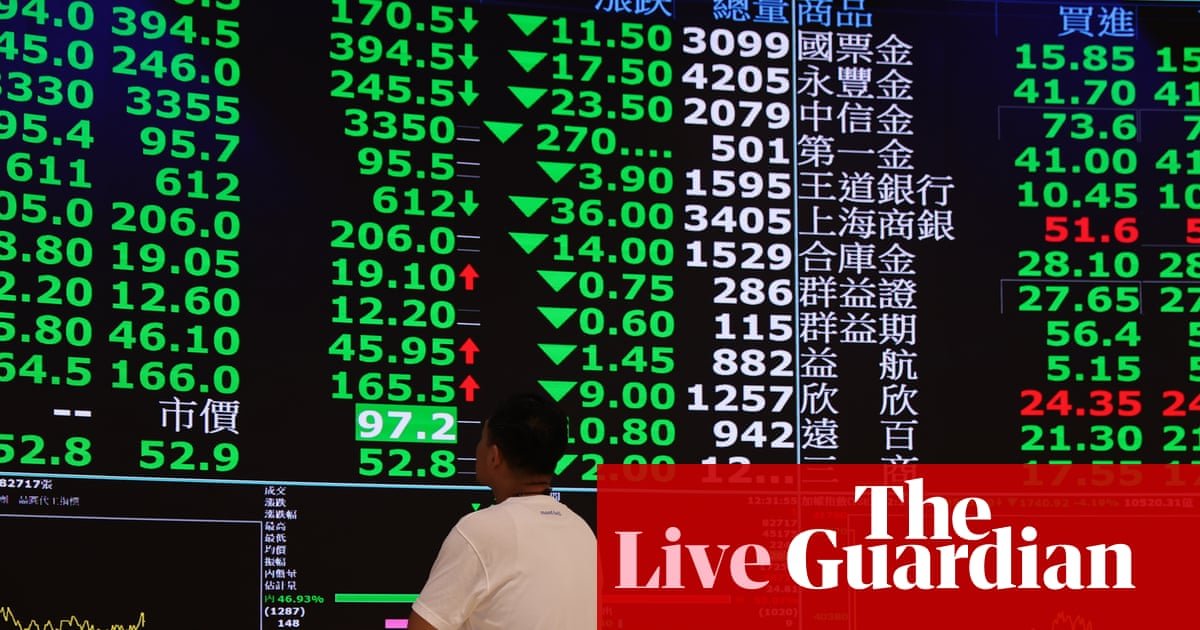
Taiwan’s stock market has suffered consecutive sharp declines, shattering retail investor confidence, with “graduation posts” and “stop-loss confessions” appearing one after another on social media. One poster on Threads described liquidating all Taiwan stock holdings with paper losses exceeding NT$9.28 million (approximately $280,000), a post that drew more than 100,000 views and nearly 2,000 likes, making it the most closely watched sample of retail investor psychology in this crash.
The decline came fast and fierce. The weighted index plunged a cumulative 5,248.23 points over just three trading sessions, successively breaking through the 40,000 and 39,000-point round-number thresholds. At one point, the index plummeted more than 2,600 points intraday on a single day, with the closing decline still reaching 5.60%, and the battle to defend 36,000 points was declared lost. Market estimates put the evaporation of Taiwan stock market capitalization in the trillions of New Taiwan dollars over just a few days, with selling pressure on high-priced stocks particularly heavy — the number of stocks hitting limit-down at one point exceeded 100, and even market leader Aspeed Technology (5274.TW) could not escape a limit-down fate.
Looking back at the triggers for this selloff, the market had initially expected the National Stabilization Fund to enter and support the market, and the index briefly rebounded. But then came news of Nvidia CEO Jensen Huang’s resignation — even though Nvidia reported stellar earnings, the board’s refusal to reinstate Huang shattered the market’s “last hope,” and disappointed selling pressure surged once again. At the same time, the US tightened chip export controls and restricted remote use of computing power through third-country data centers, raising doubts about the outlook for the AI server supply chain.
On social media, one investor liquidated all holdings on November 17, describing the investment journey with the phrase “the music ends and everyone disperses.” He admitted that after pressing the final sell button, he stared at the screen for a long time, his mind constantly calculating how much less he would recover if the market rebounded the next day — only then did he realize that “selling a stock takes just a second, but accepting the loss in your heart truly takes longer.”
This investor reflected that the bull market in the first half of the year had filled the market with a “money is easy to make” atmosphere, and he himself believed that paper profits would eventually be banked and that pullbacks were only temporary. So he kept less and less cash on hand while trading with growing boldness. When the market reversed, human weaknesses were laid bare: when it was time to take profits, he always thought “I’ve held it this long, let me make just a little more”; when the stop-loss level was breached, he clung to the wishful thinking of “let me wait one more day.” Ultimately, he went step by step from “can’t bear to sell” to “can’t bear to accept the loss.”
After this sobering lesson, he summarized three iron rules at the end of his post: “Take profits with discipline, honor your stop-losses, and always keep some cash on hand.” He also reminded readers not to blindly follow others’ market calls, because “when the lights go out at night, the person who knows best how much this loss hurts you is yourself.”
Another investor who posted a “massive graduation post” on PTT faced an even more brutal situation. He posted his brokerage statement showing he had liquidated all five stock positions; after deducting commissions and transaction taxes, total proceeds from the sales were NT$45.71 million, with a loss of NT$19.86 million — meaning he exited with a devastating loss of nearly NT$20 million (approximately $610,000). The statement showed that three of the stocks had originally been held at 200, 45, and 42 lots respectively, with losses of NT$4.77 million, NT$9.07 million, and NT$5.80 million — the heaviest casualties.
This investor said he had previously adopted a strategy of “buy small amounts on every dip, hold on through rallies” during the downturn, only to find that the market not only failed to stabilize but escalated into a “daily stock market disaster” with daily point drops continuously expanding. To prevent losses from spreading indefinitely, he ultimately resolutely executed disciplined stop-losses. He joked, “I hope my personal pain benefits fellow forum members — today must be the ‘fool’s valley’!”
The two stop-loss posts together drew tens of thousands of responses from retail investors, with comment sections flooded with commiseration and self-deprecation. Some lamented, “The stock market is truly a spiritual practice,” and “Everything I made this year was a dream… and I’m actually down.” Others expressed admiration for the million-level stop-loss, saying bluntly, “I wouldn’t dare criticize someone whose total P&L is nearly NT$10 million in the red.” Other netizens estimated from the brokerage statement that being able to recover more than NT$40 million after cutting positions indicated substantial capital strength — “This is just taking a leave of absence, not graduating; you can re-enroll anytime.”
Notably, this crash has also prompted overseas investors to share their experiences. One investor said he disposed of his US Nvidia holdings on the same day, with paper losses shrinking by $640,000 (approximately NT$21 million) within a week, and also liquidated a seven-year dividend stock position — the synchronized cross-market correction caught many investors off guard.
Regarding the relentless selloff in Taiwan stocks, veteran analyst Lin Chang-hsing noted that the US recently tightened chip export controls and restricted remote use of computing power through third-country data centers, which could cause high-end AI server orders in Southeast Asia to face delays or cancellations. If a stress test assumes 20% of GPU server orders are unaccounted for, Nvidia concept stocks would face the double-kill risk of “stock prices correcting valuations first, then institutional investors cutting revenue forecasts.”
Lin Chang-hsing further warned that with the dollar index approaching 104 and foreign investors continuing to sell heavily, Taiwan stocks’ 37,000-point level may also fail to hold. He advised investors to continue reducing positions rather than buying on rebounds, and to strictly follow hedging principles including reducing exposure to Nvidia concept stocks, avoiding margin trading, preserving cash, and increasing allocations to high-dividend and high-bond-yield positions to weather this stock market disaster.
From a market structure perspective, this correction has spread from technology stocks to traditional sectors including finance and shipping, with even supposed safe-haven targets weakening — indicating that the selling pressure is not a single-industry problem but a rapid contraction in overall risk appetite. Institutional investors believe the key to whether the index can stabilize in the short term still lies in whether US chip control policy will be further expanded and when foreign selling will ease. Before the situation becomes clear, the cash positions and stop-loss discipline in investors’ hands may prove more practical than any rebound.
Once added, BigGo Finance appears first in Google Search Top Stories, so you get the broadest, most up-to-the-minute, and most comprehensive global financial news first.