TIMOTHY A. CLARY / AFP via Getty Images
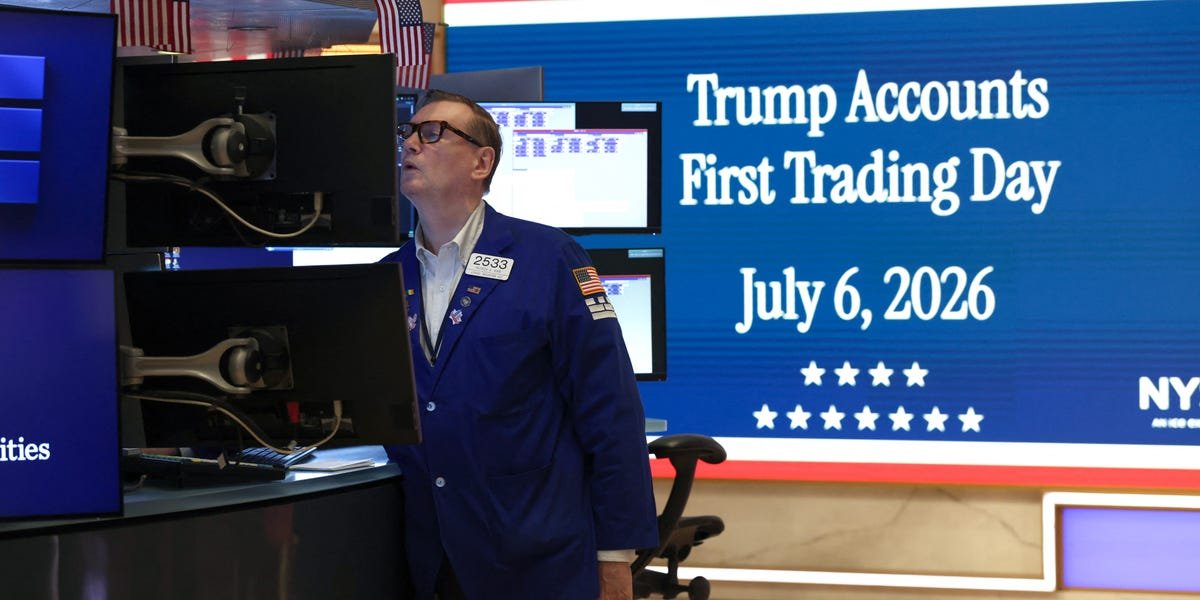
Trump Accounts went live on July 4, providing a new avenue for parents to start investing on behalf of their kids.
As part of the One Big Beautiful Bill Act passed last year, children born between 2025 and 2028 are eligible for a one-time $1,000 deposit from the US government into their account that will then be invested in the stock market.
Kids born before this window can also open an account, but won’t be able to claim the government handout — though some wealthy donors are also offering funds to kids based on other criteria.
Parents can contribute up to $5,000 a year until the child turns 18. Employers can also chip in $2,500 a year. Like an individual retirement account, Trump Accounts are tax-advantaged, with funds growing tax free while held in the account.
Americans can open an account with the Internal Revenue Service and manage it through the Trump Accounts app, which was developed by Robinhood and BNY Mellon.
The idea is that starting an investment account at such a young age allows one to take advantage of the extra years of compounding returns.
The government is giving account holders a choice between five funds to invest in, but if being a portfolio manager isn’t exactly your expertise, you won’t have to stress over how to invest the money.
First, you don’t necessarily have to choose a fund — the State Street SPDR Portfolio S&P 500 ETF (SPYM) is set up as the default fund if investors don’t specify another fund or funds. That means the money will be automatically invested no matter what.
Second, all of the funds offer broad market exposure, so there’s not a “wrong choice.”
Here are the five funds you can invest in through a Trump Account.
State Street SPDR Portfolio S&P 500 ETF

BI
Ticker: SPYM
Expense ratio: 0.02%
Notes: The default fund at launch, the ETF tracks the S&P 500 index, which comprises 500 of the largest stocks in the US. That means investors will get broad exposure to all US stock sectors, though the index is currently weighted heavily toward tech.
As an added advantage for investors, this particular fund has one of the lowest expense ratios for an S&P 500 index fund at 0.02% per year.
“The fund was selected to provide broad exposure to the U.S. stock market while maintaining expenses well below the statutory fee limitation,” the US Treasury Department said on its website.
Vanguard Total Stock Market Index Fund ETF
BI
Ticker: VTI
Expense ratio: 0.03%
Notes: Instead of tracking around 500 stocks, this fund invests in around 3,500 US stocks. To a degree, that means more diversification. However, since it’s a cap-weighted strategy like the others, the largest stocks in the market like Nvidia, Apple, Amazon, and Microsoft still make up a large chunk of the fund.
State Street SPDR Portfolio S&P 1500 Composite Stock Market ETF
BI
Ticker: SPTM
Expense ratio: 0.03%
Notes: This one is a bit of a mix between an S&P 500 fund and VTI, as it tracks 1,500 US companies across all market-cap levels. It captures about 90% of the US market.
Read next
William Edwards is a senior investing reporter at Business Insider primarily covering the US stock market and the broader economy.He’s interviewed some of the most influential voices in the market, including Joseph Stiglitz, Jeremy Grantham, Rick Rieder, Rob Arnott, Savita Subramanian, Nouriel Roubini, Ken Rogoff, Mike Wilson, Claudia Sahm, Albert Edwards, Andrew Ross Sorkin, and more.William launched BI’s annual Oracles of Wall Street list (2023, 2024, 2025), highlighting top calls from strategists, economists, and analysts. He also writes BI’s Where to Invest $10,000 column, and contributes to the First Trade newsletter.Prior to Business Insider, William covered the US economy for Bloomberg News in Washington, DC and contributed to TV tech coverage for CNBC in San Francisco. He has also spent time studying or reporting in France, Germany, and Tunisia.He is based in New York.