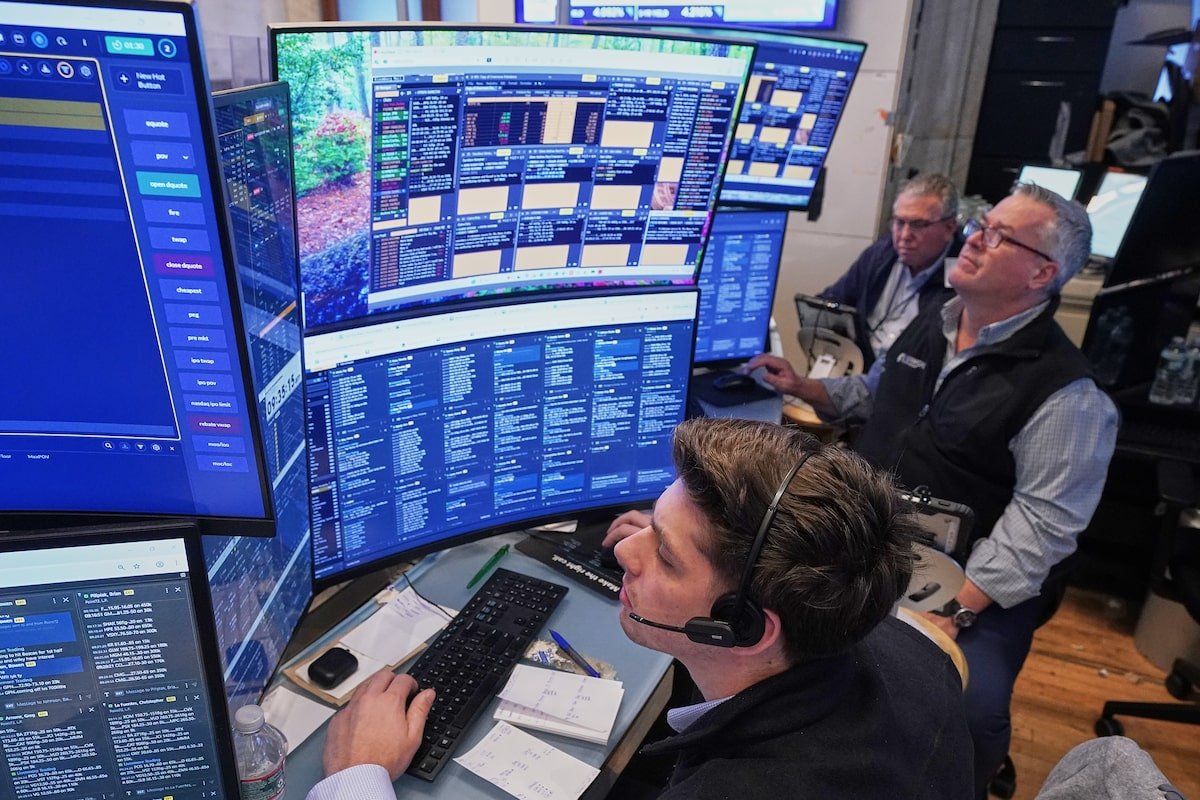

Traders work on the floor of the New York Stock Exchange.Richard Drew/The Associated Press
We now take you back to your regularly scheduled stock market frenzy.
Investors promptly resumed sending tech stocks to the moon this past week after U.S. President Donald Trump’s “brief excursion to Iran” finally wrapped up.
Or maybe not. By Friday, cracks were already forming in the fragile peace deal. The Iranians toyed with the possibility of reclosing the Strait of Hormuz, negotiations were postponed, the U.S. President got mad on Truth Social, etc., etc.
Doesn’t matter. Investors never really cared a whole lot about the mess in the Middle East, anyway. Why would they, when artificial intelligence is revolutionizing the entire economy before our eyes?
Corporate earnings are what matter above all else, and they are towering on the back of a vast AI buildout. The S&P 500 index reported profit growth of nearly 30 per cent in the past quarter alone. If you had to choose a single data point to justify the stock market’s unstoppable rise, this is the one.
But not all is what it seems on Corporate America’s income statement. A big chunk of that 30 per cent was driven not by Big Tech’s core businesses, but by their investments in each other.
It’s basically an accounting quirk that is artificially juicing the financial performance of the biggest publicly traded stocks in the world. And not just by a little bit. Nearly half of S&P 500 profit growth in the quarter can be traced back to this weird earnings distortion, according to University of Florida finance professor Baolian Wang.
This is what should concern investors more than valuations. If the earnings story falls apart, we’re all in trouble.
Consider how a company like Alphabet Inc. makes its money. There’s its core advertising business, subscriptions to services like YouTube, and sales of phones and other devices. These lines of business generated about US$25-billion in net income in the quarter.
Go a little further down Alphabet’s income statement and you come to a line called “other income (expense).” This has traditionally been a catch-all for minor, miscellaneous stuff like interest earned on cash, or gains and losses from selling equipment.
Alphabet made US$38-billion in “other income” last quarter – 60 per cent of the company’s bottom line. That’s also almost three times as much as Canada’s most profitable company, Royal Bank of Canada, made all of last year, by the way.
“Historically, this line item was a rounding error,” Mr. Wang wrote in a recent blog post. “Today, it’s an engine of massive earnings distortion.”
As it happens, Alphabet is the largest investor in Anthropic, the startup behind the Claude family of AI models. (Expect to hear a lot more about Anthropic in the lead-up to its own US$1-trillion IPO as soon as this fall.)
This is why Alphabet crushed earnings forecasts last quarter.
Same goes for Amazon.com Inc., which blew past analysts’ estimates for first-quarter earnings by more than 70 per cent. It wasn’t because it shipped more packages. It was because its own stake in Anthropic helped generate a paper gain of US$16-billion. Nvidia Corp. also reported US$16-billion in non-operating gains in its first quarter.
What we have here is a classic feedback loop. The hyperscalers have become so financially interdependent that they’re inflating each other simultaneously.
First, the publicly traded giants commit huge amounts of money to companies like Anthropic and OpenAI.
Next, the AI arms race pumps up the valuations of those private players.
The tech giants that trade on the stock market then mark up the value of their ownership stakes, artificially boosting their quarterly earnings.
And suddenly it looks like the sizzling stock rally is fully supported by soaring profits, making way for the next leg up in equity indexes.
The whole process could catch up to itself. These are giant, healthy companies that are being transparent about some unusually large investment gains. Nobody is trying to hide anything or pull one over on investors.
But it’s the inflated numbers that are making headlines and moving markets. Without these one-time effects, the earnings growth rate last quarter would not have been 29 per cent, as reported. It would have been 16 per cent, Mr. Wang said.
“But by letting the volatile, illiquid world of venture capital markups dictate public net income lines, the market has introduced a massive blind spot.”
It bears reiterating just how exposed we all are to American stocks. As of last year, Canadians held $2.6-trillion worth of U.S. equities, according to Statistics Canada. Plus, U.S. stocks account for around two-thirds of global stock market value. As goes the U.S. stock market, so go Canadian fortunes.
The thing about feedback loops is they can also go in the wrong direction. If valuations take a hit, for whatever reason, those one-time gains will turn negative, and we’ll see what the bad kind of ripple effect looks like.