Key Points
-
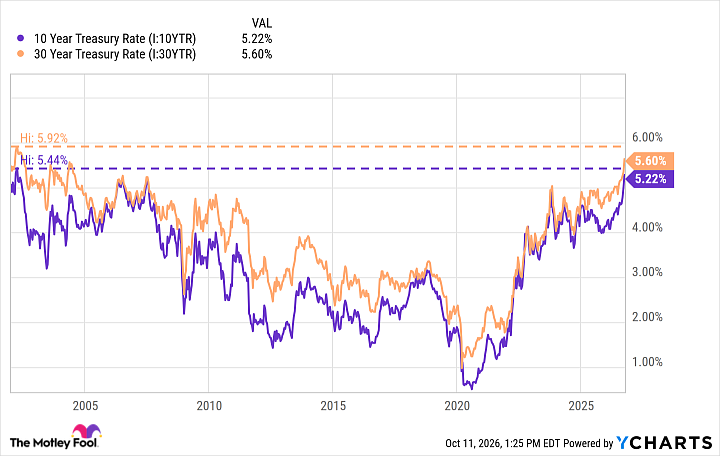
Long-term U.S. Treasury bond yields recently reached their highest levels since 2002.
-
Higher bond yields can be bad for stock prices, but so far in 2026, the S&P 500 has still delivered strong gains.
-
Higher bond yields could still be a positive sign for stock prices — and long-term investors should keep investing either way.
Bond yields are going up.
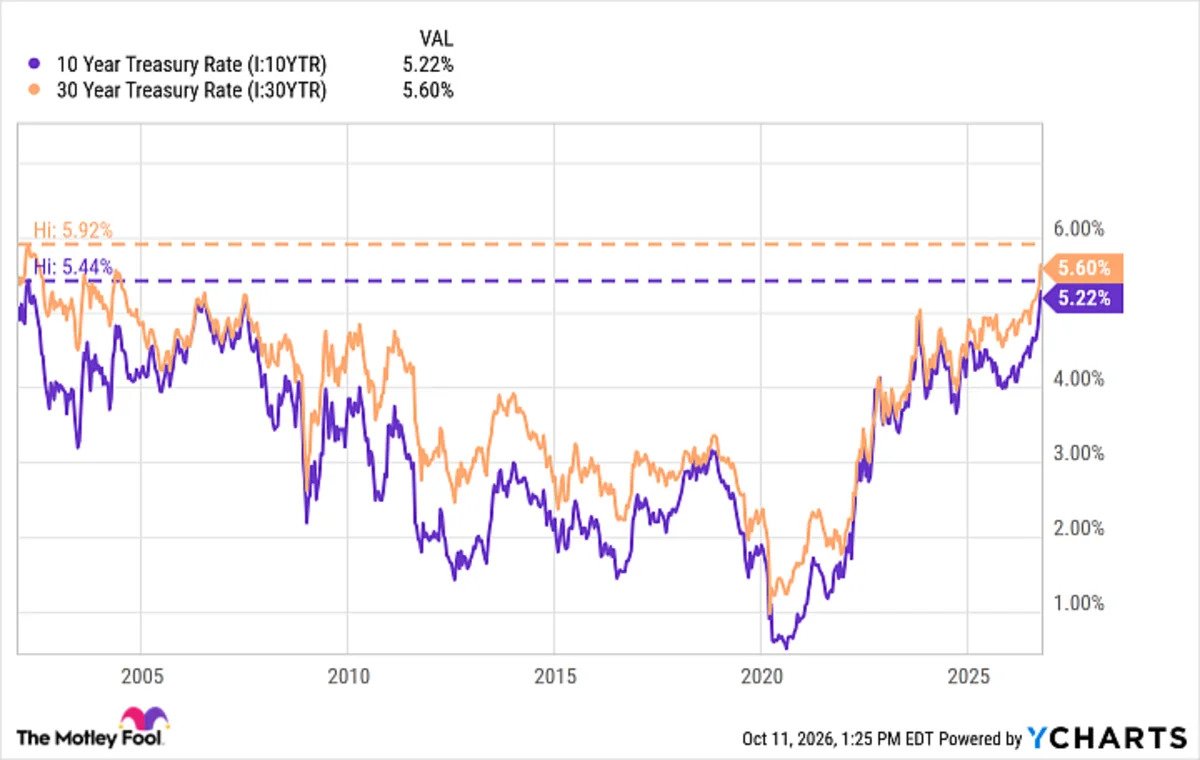
Along with a recent Federal Reserve hike in short-term interest rates in September, longer-term U.S. Treasury bond yields recently reached their highest levels in decades. Yields for the 10-year and 30-year bonds are both at their highest since 2002, at well over 5%.
Missed Nvidia in 2009? This Rare Signal Is Flashing Again.In 2009, a “Double Down” signal flashed for a little-known chipmaker called Nvidia. For the first time in years, that same “Total Conviction” signal is flashing for a company 1/100th the size of Nvidia. Continue »
Data by YCharts.
What do higher bond yields mean for stock prices? They could be bad news; sometimes rapid spikes in yields lead to a stock market crash.
But the bond market moves for all kinds of complex reasons, and it’s not always automatically connected to what happens next with stocks. When central banks raise interest rates, newly issued bonds must offer higher coupon (interest) rates to attract investors. This immediately pushes the overall yield on new debt higher. As a result, existing bonds with lower interest rates become less attractive. As investors sell them, their market prices drop.
Higher bond yields could put pressure on stock prices in the short run, but they shouldn’t be cause for panic. Higher yields mean that when old bonds mature, the returned principal can be reinvested into new, higher-yielding bonds, increasing long-term income.
Let’s look at the big picture of what higher yields might do to the stock market — and what long-term investors should do next.

Image source: Getty Images.
Higher bond yields: bad news for stocks?
There are a few reasons higher bond yields can be bad for stocks. As already noted, when yields rise, bond investors can earn higher income by buying bonds. This makes stocks a little less attractive. As a result, demand for stocks might go down — and stock prices would follow. Also, when bond yields go up, interest rates rise, too, raising borrowing costs. This can be seen in higher rates for mortgages, car loans, and business loans.
The cost of money rises with higher interest rates, making it harder for companies to refinance debt, take on new debt, or invest in expansion plans. Higher bond yields (and higher interest rates) can slow economic growth and reduce investment. That’s typically bad for stock prices.
Why stock investors shouldn’t worry about higher bond yields
Will higher bond yields lead to a stock market crash? Not necessarily. The S&P 500(SNPINDEX: ^GSPC) is still up 14% in 2026, despite these recent increases in interest rates. The market seems to be taking higher rates in stride … for now. Not all increases in interest rates are equally bad for the stock market.
Research from Fidelity, published in September, found that rising rates don’t have to be cause for alarm. Fidelity’s analysis suggests several reasons that rates going higher (and bond yields rising as a result) might also be bullish for stocks. It found:
- Continued higher-than-average inflation: Rising yields are often a reaction to inflationary pressures. And yet, stocks often outperform other assets during periods of high inflation, especially for companies with pricing power or industries that sell must-have products.
- Lots of corporate bonds being issued by tech companies: Major tech companies are borrowing hundreds of billions of dollars to help fund the artificial intelligence (AI) building boom in data centers and infrastructure. If this keeps going, it could also drive higher stock prices for companies that benefit from this spending growth.
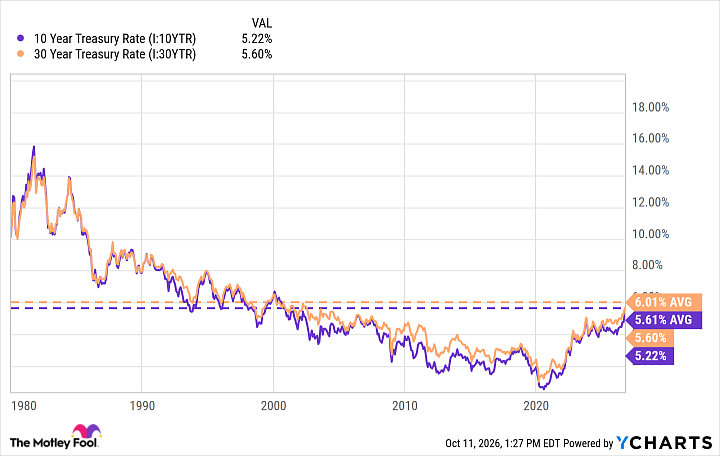
Another point to keep in mind is to take an even longer view of the bond market. If we look back to 1980, the U.S. 10-year and 30-year Treasury yields are still below their long-term averages during the past 46 years.
Data by YCharts.
We were in an environment of unusually low interest rates during 2009 to 2022. Maybe today’s moves in the bond market are not signaling a crisis; maybe interest rates are just “getting back to normal.”
Keep calm and stay invested for the long term
Just as with all other financial news, most people shouldn’t get too worried about the latest moves in the bond market. The S&P 500 is likely to keep growing over the long term, even with higher rates in the short term. If you’re a long-term investor, you should probably just keep buying stocks in line with your financial goals, risk tolerance, and long-term plans.
Keep in mind that the Vanguard S&P 500 ETF(NYSEMKT: VOO) has delivered annualized returns of 14.94% for the past 16 years. In the past five years, it has delivered annualized returns of about 13.8%.
Those unusually strong gains of the past 16 years in the S&P 500 happened during a time of unusually low bond rates. It’s possible that stocks got a boost from the ultra-low interest rate environment because bonds weren’t paying significant yields; there was nowhere else for investors to go. If bond yields stay high or keep going higher in the next few years, that might push down the average annual return for S&P 500 ETFs. Instead of 13.8% or 15% per year, S&P 500 investors might “only” see future gains of 10% annualized returns, or less. There are no guarantees.
But if you look at the past 98 years of stock market history, the S&P 500 has been a pretty good long-term bet. Even during times of rapidly rising interest rates, short-term volatility, and scary global crises, the S&P 500 tends to deliver worthwhile returns. Higher bond yields are worth paying attention to, and could put more pressure on stock prices. But most long-term stock investors should stick with their plan, stay in stocks, and avoid making sudden moves.
Missed AI’s “Act 1”? Act 2 Could Be 14x Bigger
Most investors think they missed the AI boat because they didn’t buy Nvidia in 2005.
But according to our analysts, we’re only at the end of “Act 1″—the R&D phase. “Act 2” is the global rollout, a massive technology build-out that Google’s CEO says could be more profound than fire or electricity.
While everyone watches the chip designers, one “backbone” company provides the critical technology that Nvidia and AMD literally cannot function without. We’ve detailed this under-the-radar player in our new AI Playbook.
Ben Gran has no position in any of the stocks mentioned. The Motley Fool has positions in and recommends Vanguard S&P 500 ETF. The Motley Fool has a disclosure policy.
This article contains syndicated content. We have not reviewed, approved, or endorsed the content, and may receive compensation for placement of the content on this site. For more information please view the Barchart Disclosure Policy here.