Last week was another history-maker for Wall Street, with the benchmark S&P 500 (^GSPC +0.80%) and iconic Nasdaq Composite (^IXIC +1.63%) launching to record-closing highs. Although the Dow Jones Industrial Average (^DJI 0.16%) didn’t reach a record high, it’s a stone’s throw away from one.
Based on the performance of these indexes, you’d assume the U.S. economy and Wall Street are firing on all cylinders. But according to the latest inflation update from the Federal Reserve, things may not be as rosy as the Dow, S&P 500, and Nasdaq Composite imply.

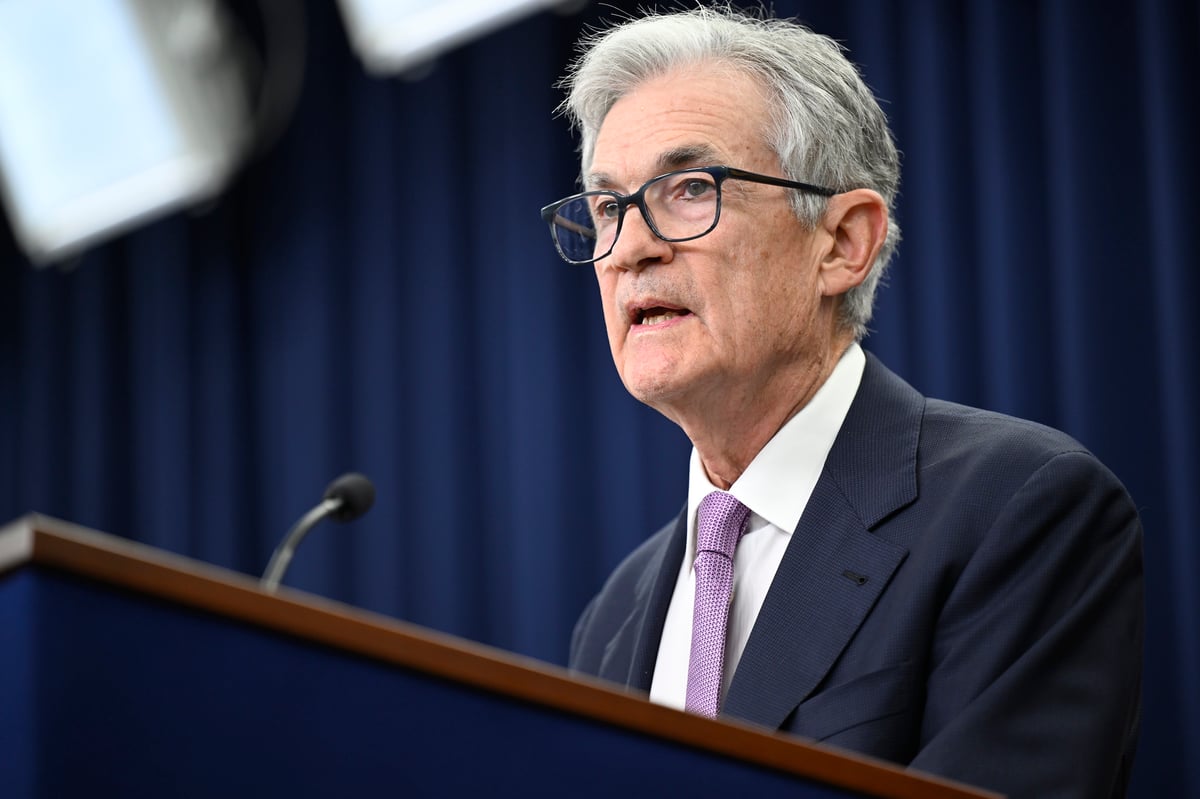
Fed Chair Jerome Powell delivering remarks. Image source: Official Federal Reserve Photo.
The Iran war is having a noticeable impact on prices
Roughly two months ago, on Feb. 28, President Donald Trump gave the order for U.S. military forces, along with Israel, to commence attacks against Iran. These actions spurred Iran to close the Strait of Hormuz to virtually all commercial vessels, throwing 20 million barrels of daily liquid petroleum shipments (roughly 20% of global demand) into limbo.
The law of supply and demand is straightforward: when demand for a good outstrips its supply, the price of that good rises until demand tapers off. The largest-ever global energy supply disruption sent crude oil prices soaring.
Average U.S. gas prices per gallon on April 7, per AAA:
• Regular: $4.14 (⬆️ $1.16 since war in Iran began on Feb. 28)
• Premium: $5.02 (⬆️ $1.16 since war began)
• Diesel: $5.65 (⬆️ $1.89 since war began)
— NBC News (@NBCNews) April 7, 2026
The immediate impact of this oil price shock was felt at the fuel pump. The national average price of a gallon of gas rose at its fastest pace in more than 30 years, while a gallon of diesel shot up by well over 40%, according to data from AAA.
But higher prices at the pump are just one part of the story. A significant uptick in energy prices threatens to meaningfully increase transportation and production costs for businesses, which could be devastating to a historically expensive stock market.

Image source: Getty Images.
The latest Fed inflation forecast is a mixed bag for Wall Street
In February, before the effects of the Iran war began showing up in trailing-12-month (TTM) U.S. inflation data, TTM inflation clocked in at 2.4%. One month later, in March, TTM inflation shot up 90 basis points to 3.3%. Although the stickiness of Trump’s tariffs in the goods sector isn’t helping, this jump was primarily tied to skyrocketing energy prices.
According to the Federal Reserve Bank of Cleveland’s Inflation Nowcasting tool, TTM inflation isn’t done climbing. While the modest silver lining is that April’s projected TTM inflation has dropped by two basis points from last week, the bad news is that it’s still expected to jump by 26 basis points to 3.56% (as of April 23).
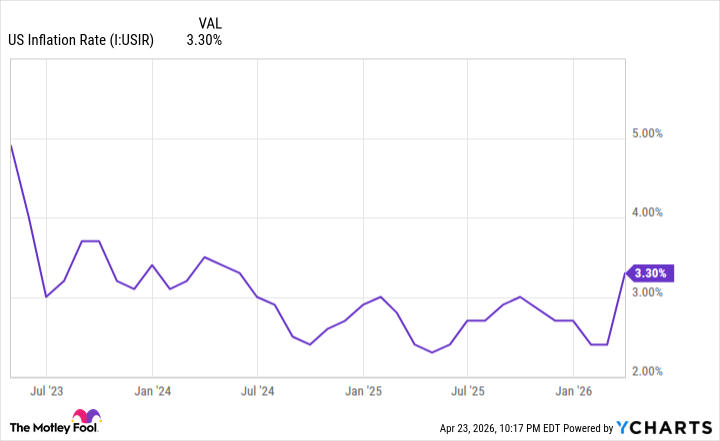
US Inflation Rate data by YCharts.
The stock market began 2026 at its second-priciest valuation over the last 155 years — a Shiller Price-to-Earnings Ratio north of 40! Although high-growth prospects tied to the artificial intelligence revolution have helped fuel these premiums, the expectation of additional Federal Open Market Committee (FOMC) rate cuts in 2026 has played a big role. The FOMC is the 12-person body, including Fed Chair Jerome Powell, that is responsible for setting the nation’s monetary policy.
A projected TTM inflation increase of 116 basis points over two months, coupled with no end in sight to the Iran war, as of this writing on April 23, effectively removes rate cuts from the table. Without the possibility of lower lending rates anytime soon, a historically pricey stock market is exposed and vulnerable to significant downside.