Stocks are hitting records as earnings surge. Meanwhile, bonds are competing harder for investor cash.
The S&P 500 (^GSPC) is in the middle of one of its strongest earnings seasons in decades, with profit growth accelerating, beat rates running hot, and analysts lifting future estimates instead of cutting them.
Profits are strong enough to justify the record highs that stocks keep hitting.
But the bond market is making that climb harder.
The chart below shows the S&P 500’s realized earnings yield minus the 10-year Treasury yield (^TNX), a version of a bond-stock valuation gauge recently highlighted by the Kobeissi Letter.
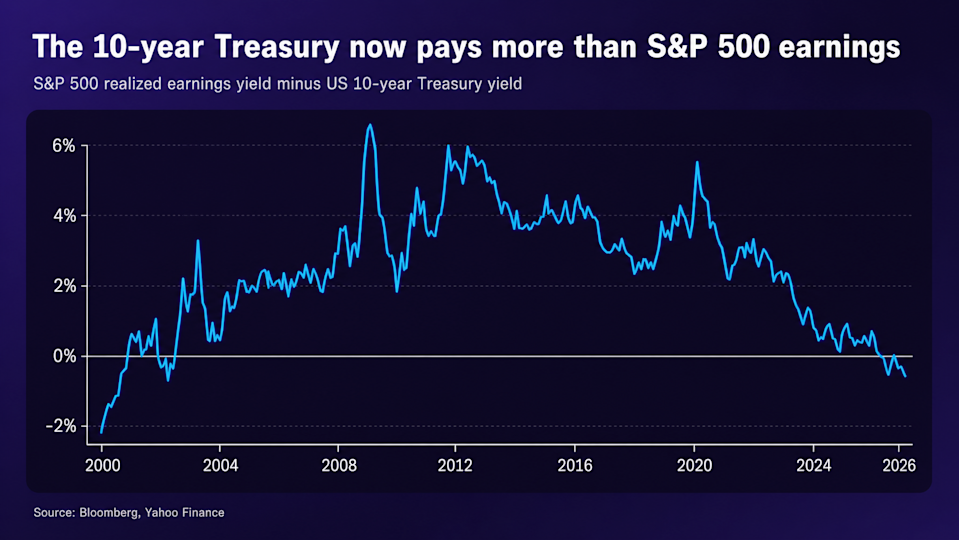
Earnings yield is the inverse of the famous price-to-earnings (P/E) ratio — basically, it’s how much earnings investors are getting for every dollar they pay for the index. The government’s borrowing rate on 10-year debt is subtracted to show how much extra earnings yield investors are getting — or not getting — for owning stocks instead of Treasurys.
Right now, the S&P 500’s realized earnings yield is roughly 3.4%, below the 10-year Treasury yield near 4.5%. That leaves the gap at roughly negative 110 basis points — or 1.1 percentage points — the widest negative reading since 2003.
That gap is often used as a rough proxy for what’s called the equity risk premium, or the extra compensation investors expect for owning stocks instead of “safer” government debt.
The chart doesn’t imply that stocks need to fall. It just means the old post-financial-crisis math has changed. When long-term bond yields were historically low, expensive stocks were easier to justify. Now Treasurys are offering a real alternative.
The important caveat is forward earnings.
Using the forward P/E — which reflects what analysts predict for earnings over the next year — instead of realized P/E, changes the picture a little.

With the forward P/E, the S&P 500’s earnings yield is around 4.5%, slightly over the 10-year yield. In other words, the realized chart says bonds are winning. The forward version says stocks still have a tiny edge — if earnings keep showing up.
But if the 10-year yield definitively breaks above 4.6% and surges higher — as it’s been threatening to do for over a year — the investment math will shift strongly in favor of bonds over stocks.
That’s why the current earnings boom is so important. The market is not ignoring the bond warning. It’s betting that future profits can outrun it.
Jared Blikre is the global markets and data editor for Yahoo Finance. Follow him on X at @SPYJared or email him at jaredblikre@yahooinc.com.