South Korea’s stock market has gone from the world’s hottest to its coldest in just a few months.
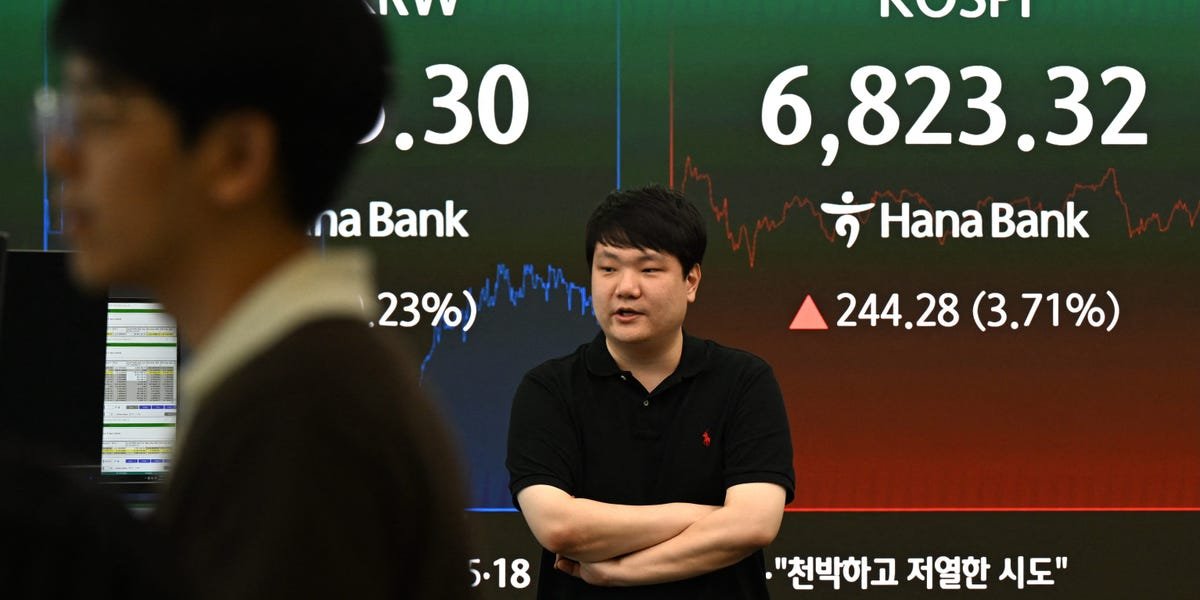
The Kospi, the world’s best-performing major stock benchmark in the first half of 2026, has since fallen about 24%, making it the worst-performing major market in the second half. It’s still more than 50% higher this year.
The AI trade isn’t losing its appeal. But investors are increasingly looking beyond South Korea’s memory-chip giants to companies with broader exposure to the AI hardware boom.
In July, analysts at GlobalData.TS Lombard pointed out that much of the earnings growth at Korean memory-chip makers came from higher memory-chip prices. By contrast, TSMC and Japanese chip-equipment makers relied more on advanced manufacturing and process expertise, giving them more durable growth prospects, they added.
Taiwan’s Taiex has climbed about 7% in the second half of the year, taking its year-to-date gains to about 70% as investors broaden their bets across the AI hardware supply chain.
South Korea’s rally was driven largely by Samsung Electronics and SK Hynix, whose soaring memory-chip profits made them among the biggest winners of the AI boom. Together, the companies account for more than half of the Kospi, leaving the market unusually dependent on a single segment of the semiconductor industry.
Even blockbuster earnings are no longer enough to excite investors. Last Thursday, Samsung forecast a nearly ninefold increase in quarterly operating profit, yet its shares have fallen for two straight trading sessions.
The reversal followed months of extraordinary volatility. The Kospi plunged 22% in July, its worst month since the 2008 financial crisis, before rebounding 18% on the month’s final trading day for its biggest one-day gain on record. The swings triggered multiple market-wide circuit breakers as leveraged bets on chip stocks amplified the moves.
Young South Koreans flooded social media with memes and dark humor about their battered portfolios, while regulators tightened rules on leveraged single-stock exchange-traded funds after concerns the products had fueled speculation.
Trading has cooled sharply. Turnover has dropped 70% from its late-May peak, while foreign investors have continued pulling money from Korean equities.
The next phase of the AI trade
The shift didn’t happen overnight.
Even before Korea’s selloff, investors were debating whether the next phase of the AI boom would continue rewarding memory-chip makers or broaden to companies with exposure across the semiconductor supply chain.
Taiwan appears to be benefiting from that shift. Its market offers exposure across AI infrastructure, from advanced chip manufacturing and packaging to servers and networking equipment.
That includes TSMC as well as companies involved in advanced packaging, servers, networking equipment, and other AI infrastructure.
The Taiex outperformed the Kospi by more than 23 percentage points in the third quarter, as Taiwan’s benchmark gained nearly 4% while South Korea’s plunged more than 19%.
Read next
Huileng Tan is a senior reporter based in Singapore, covering markets, the global economy, commodities, and investing. Her reporting focuses on how shifts in money, demographics, technology, and policy are reshaping businesses, wealth, and everyday life around the world.Since joining Business Insider in 2021, she has covered everything from commodity booms and investor trends to China’s economy, the AI trade, and the forces driving global markets.Before joining Business Insider, she reported for CNBC, Dow Jones, ICIS, and The Wall Street Journal.Reach her at htan@businessinsider.com.