The S&P 500 is marching higher for a fourth straight year, on track for a gain of more than 100% over this period. Against this backdrop, some investors may feel exuberant, and a market crash might be far from their minds; others, however, may consider that these gains won’t last forever and, with valuations high, might predict a market crash on the horizon.
It’s impossible to forecast with 100% certainty what may happen next, but one thing is clear: A crash will eventually take place. Crashes are part of the overall stock market cycle, so they do occur from time to time. All of this means that, regardless of the current market direction, it’s always wise to prepare for such a moment, and for this, it’s a fantastic idea to turn to an expert.
My favorite expert is Warren Buffett, chairman emeritus at Berkshire Hathaway. As chief executive officer of the holding company for 60 years through the end of 2025, he led market-beating returns. Berkshire Hathaway delivered a compounded annual gain of almost 20% over that time period, while the S&P 500 delivered 10%. Buffett has always been generous in sharing his investing wisdom and strategies, and at any time, we, as investors, can look to his words and gather valuable knowledge.
The following Warren Buffett strategy is key to surviving a stock market crash, and here’s excellent news: It requires absolutely no effort on your part. Let’s check it out.

Image source: The Motley Fool.
What is a market crash?
So, first, what is a market crash? Crashes happen when an index loses 20% or more in less than a week. And they’re generally triggered by a fear — this could be an event, such as the pandemic, to mention a recent example — that prompts investors to liquidate assets. As mentioned, they happen periodically over time, so it’s clear that we’ll see another one at some point in the future.
Warren Buffett, at the helm of Berkshire Hathaway for so many years, experienced his share of crashes, and he didn’t exit the market at such times. In fact, as the financial crisis heated up in 2008, Buffett actually was a buyer of stocks for his own personal account. Buffett’s successes over time have come from being present in the market throughout market cycles, including bull and bear markets and even market crashes.
So, what’s Buffett’s key to surviving a stock market crash? It’s actually pretty simple. Investors should hold on to their positions through the volatility and the tough moments. The message is: Don’t sell quality stocks, and instead, consider their long-term possibilities and hold on to benefit from that growth down the road.
Today’s Change
Index Level
7,807.24
Choose quality stocks
To put this strategy into place, it’s important to invest in quality companies, or those that have the competitive advantage and earnings strength to win over the long run. For example, today, as some investors worry about the future of spending on the artificial intelligence (AI) build-out, certain tech players may see their shares suffer. But there’s reason to be confident that well-established companies with broad businesses like Amazon or Alphabet, for example, will go on to succeed — even if they were to come under short-term pressure.
Then, once a crash happens, focus on the long-term picture and resist the urge to sell. History shows us that the overall market and quality stocks have gone on to recover after every crash.
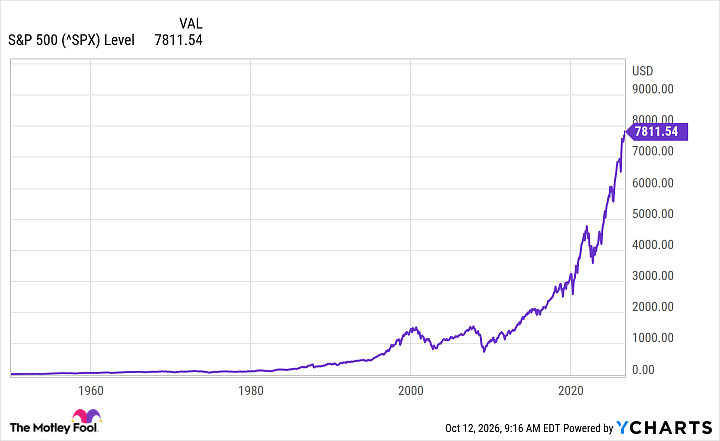
That’s a pretty amazing track record and one that should comfort us during the toughest of market times. And holding on to our positions means we don’t have to try to time the market and jump in and out of a stock to try to sell high and catch it before it takes off again.
Following down times, it’s likely “the market will move higher, perhaps substantially so, well before either sentiment or the economy turns up,” Buffett wrote in an op-ed piece in The New York Times in October of 2008.
Of course, it’s difficult to watch the value of your portfolio decline during tough times. But when a crash eventually takes place, instead of focusing on that short-term movement, remember Buffett’s words and history’s powerful message. And make the winning move that requires no effort: Hold on for the long term.