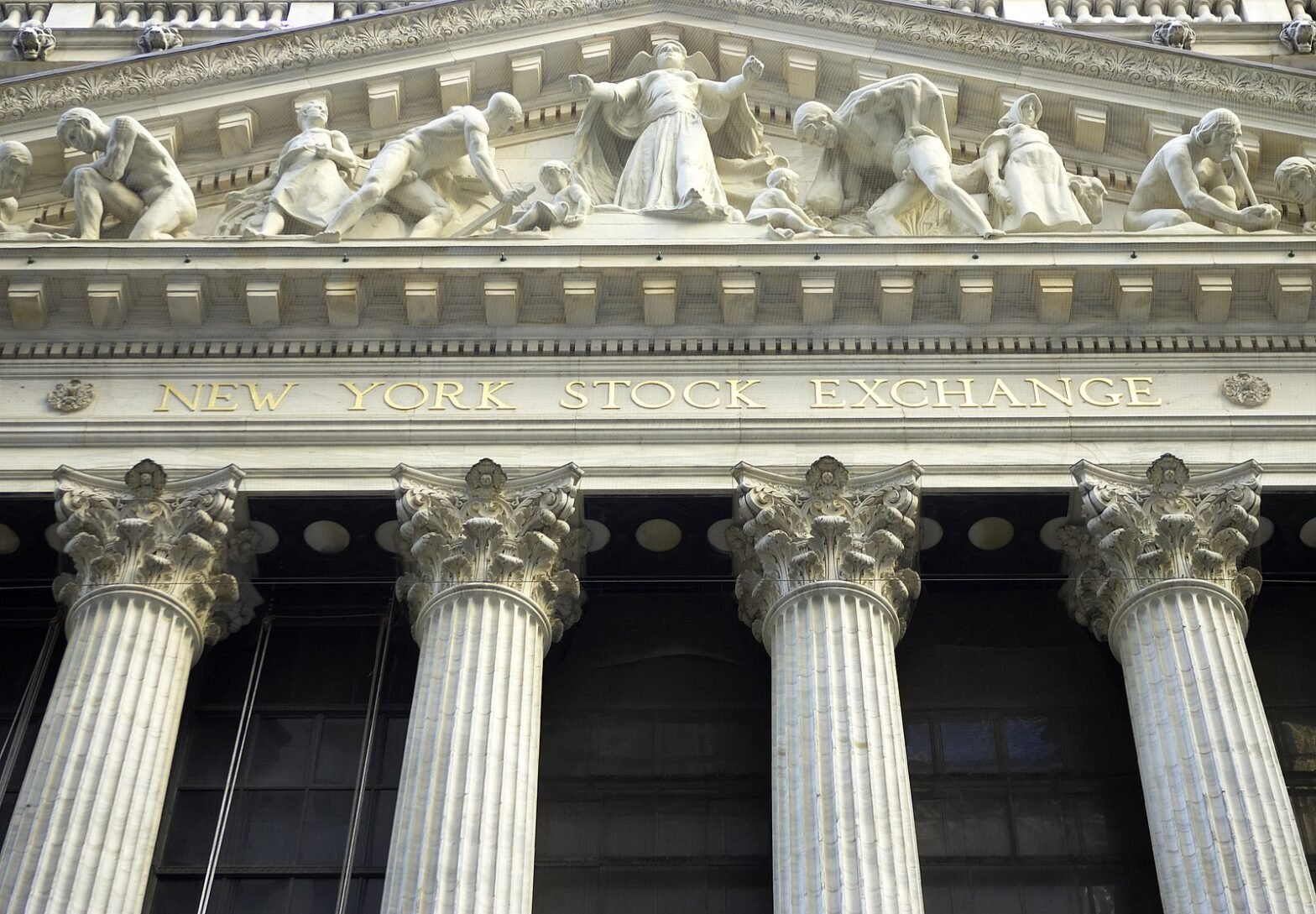
NEW YORK – October 7, 2026 (STL.News) US Stock Market Today – U.S. stocks finished lower Wednesday as rising Treasury yields, persistent inflation concerns, and uncertainty over the Federal Reserve’s next interest-rate move pulled Wall Street back from record highs.
The S&P 500 and Nasdaq Composite each declined 0.22%, while the Dow Jones Industrial Average lost 341 points, or 0.67%. The selling was considerably heavier among smaller companies, with the Russell 2000 falling 1.31%.
Modest losses in the headline indexes masked broader weakness beneath the surface. Declining stocks substantially outnumbered advancing shares on both the New York Stock Exchange and Nasdaq, while interest-rate-sensitive areas of the market came under pressure.
The biggest force affecting stocks Wednesday was the U.S. Treasury market.
The benchmark 10-year Treasury yield surged to 5.364%, its highest level since 2002, before retreating after strong demand at a Treasury auction. Oil prices also remained a major concern, with Brent crude briefly trading above $102 per barrel before settling at $100.20.
Meanwhile, minutes from the Federal Reserve’s September meeting showed policymakers unanimously supported the central bank’s latest rate increase, though officials expressed differing views on the risks that require tighter monetary policy. Most participants believed another increase would likely be appropriate by the end of 2026, while emphasizing that future decisions would depend on incoming economic data.
Together, high Treasury yields, elevated energy prices and uncertainty about future monetary policy created a more challenging environment for stocks following Tuesday’s record closes.
Stock Market Today – U.S. Stock Market Closing Snapshot
Stock Market Today: The major U.S. stock indexes finished Wednesday as follows:
- S&P 500: 7,801.77, down 17.16 points, or 0.22%
- Dow Jones Industrial Average: 51,179.87, down 341.41 points, or 0.67%
- Nasdaq Composite: 27,538.69, down 61.20 points, or 0.22%
- Russell 2000: 2,793.20, down 37.09 points, or 1.31%
The S&P 500 and Nasdaq retreated one day after both indexes posted record closing highs. The S&P 500 and Dow snapped four-session winning streaks, while Wednesday marked the Nasdaq’s first decline in six trading sessions.
Despite Wednesday’s losses, the major indexes remain higher for 2026. The Nasdaq was up approximately 18.5% for the year through Wednesday, while the S&P 500 was ahead about 14%. The Russell 2000 was up about 12.5%, and the Dow was about 6.5% higher.
Stock Market Today – Treasury Yields Hit Stocks
Stock Market Today: The day’s most important market development came from the bond market.
The yield on the benchmark 10-year Treasury note climbed to 5.364%, its highest level since 2002, while the 30-year Treasury yield reached 5.669%.
Those levels intensified concerns about inflation, government borrowing, and the effect of higher long-term interest rates on the economy and financial markets.
Higher Treasury yields can create multiple problems for stocks.
Government securities become more competitive with equities when investors can earn yields above 5% while assuming considerably less risk than they would owning stocks.
Higher yields also raise financing costs throughout the economy. Mortgage rates, corporate borrowing, commercial real estate financing and many consumer loans are influenced directly or indirectly by conditions in the Treasury market.
For the stock market, higher yields can also reduce the present value investors assign to future corporate earnings, placing particular pressure on companies carrying high valuations.
The bond selloff moderated later Wednesday following a strong Treasury auction.
The U.S. government sold $39 billion of 10-year notes, with the auction producing a yield of 5.300% and a bid-to-cover ratio of 2.77, indicating solid investor demand.
The 10-year yield subsequently retreated from its intraday high, easing one of the day’s biggest sources of pressure on stocks.
Stock Market Today – Oil Prices Add Another Inflation Risk
Stock Market Today: Oil provided another major source of uncertainty.
Brent crude briefly traded above $102 per barrel Wednesday before reversing course and settling at $100.20 per barrel, down 38 cents.
U.S. West Texas Intermediate crude settled at $88.28 per barrel, down $1.16.
Oil prices eased after the International Energy Agency agreed to accelerate the release of emergency oil stocks as policymakers attempted to address tight supplies and extremely high fuel prices.
The energy market remains particularly important to the inflation outlook.
Sustained high crude prices can affect transportation, manufacturing, agriculture, shipping, and consumer fuel costs. Those higher expenses can eventually spread through the economy as businesses attempt to pass increased costs to customers.
That possibility matters directly to the Federal Reserve.
If energy-related price increases broaden and persist, policymakers could face additional pressure to maintain restrictive monetary policy or raise interest rates again.
Wednesday therefore illustrated an important relationship currently confronting Wall Street: higher oil prices can increase inflation concerns, inflation concerns can push Treasury yields higher, and higher Treasury yields can put pressure on stock valuations.
Stock Market Today – Fed Minutes Show Another Rate Hike Is Possible
Stock Market Today: Investors also received an important update from the Federal Reserve Wednesday.
Minutes from the Federal Open Market Committee’s September 15-16 meeting showed that all participants supported raising the target federal funds rate by one-quarter percentage point to a range of 3.75% to 4.00%.
The official minutes showed policymakers remained concerned that inflation was elevated and had not demonstrated sufficient progress toward the Fed’s 2% objective.
Federal Reserve officials discussed several sources of inflation pressure, including higher energy prices, geopolitical developments and the continuing surge in artificial-intelligence-related investment.
The minutes showed that many participants believed a higher path for interest rates was prudent as risk management against inflation remaining persistently above target because of stronger-than-expected demand or additional adverse supply shocks.
Other participants viewed higher rates as necessary under their baseline economic outlook rather than simply as insurance against potential inflation risks.
A couple of policymakers specifically argued that a higher policy rate could help prevent sector-specific price increases tied to energy-market disruptions and AI-related demand from spreading into broader, more persistent inflation.
That distinction is important because the minutes did not show policymakers simply dividing into two clean camps over whether inflation was caused by energy or demand.
Instead, the discussion reflected several overlapping concerns about persistent inflation, resilient economic activity, energy-market disruptions, AI-related investment and the possibility that individual price pressures could become more broadly embedded in the economy.
Most importantly for markets, most Fed participants assessed that another increase in the federal funds rate would likely be appropriate by the end of 2026.
However, officials emphasized that they would approach each meeting with an open mind and that future decisions would depend on incoming economic information and its implications for inflation, employment and the broader outlook.
That leaves both the Fed’s October 27-28 meeting and its final meeting of the year important for financial markets.
Stock Market Today – Market Breadth Was Worse Than the Indexes Suggest
Stock Market Today: One of Wednesday’s more significant signals came from market breadth.
According to Reuters, declining stocks outnumbered advancing issues by approximately 3.34-to-1 on the New York Stock Exchange and roughly 2.37-to-1 on Nasdaq.
That matters because the S&P 500’s 0.22% decline alone makes Wednesday look like a relatively quiet pullback.
The underlying market was considerably weaker.
The Russell 2000’s 1.31% decline reinforces that picture.
Smaller companies tend to be more sensitive to borrowing costs because they frequently have less access to inexpensive financing than America’s largest corporations. A prolonged period of high interest rates can therefore place disproportionate pressure on small and midsize businesses.
Investors may want to watch the difference between the Russell 2000 and the major large-cap indexes closely.
A healthy bull market generally benefits from broad participation. Persistent weakness among smaller companies, while a relatively narrow group of large companies keeps the major indexes near records, can signal that financial conditions are tightening beneath the surface.
Stock Market Today – Housing and Rate-Sensitive Stocks Feel Pressure
Stock Market Today: Higher Treasury yields also weighed on interest-rate-sensitive areas of the market.
Reuters reported that a housing-related index fell approximately 2.3%, while a homebuilder index declined roughly 2.9%.
The relationship is straightforward.
Mortgage rates tend to move with long-term Treasury yields. When Treasury rates climb, mortgage financing generally becomes more expensive, reducing affordability for prospective buyers and increasing financing costs for builders and developers.
The 10-year Treasury yield moving above 5% therefore has consequences extending well beyond Wall Street.
Higher borrowing costs can affect residential construction, commercial real estate, corporate investment and consumer spending.
Semiconductor shares also weakened Wednesday, with the Philadelphia semiconductor index falling approximately 1.2% after substantial gains earlier in the year.
Stock Market Today – Wall Street Pulls Back From Record Highs
Stock Market Today: Wednesday’s losses came immediately after another milestone for the stock market.
The S&P 500 and Nasdaq both closed at record highs Tuesday, supported in part by enthusiasm around artificial intelligence and expectations for corporate earnings.
Wednesday did not erase that broader advance.
The S&P 500 remains approximately 14% higher for 2026, and the Nasdaq has gained roughly 18.5%.
However, the day’s trading demonstrated that investors are increasingly confronting a difficult question: How high can Treasury yields rise before they materially challenge stock valuations?
A 10-year Treasury yield above 5% gives investors an increasingly attractive alternative to equities.
That does not automatically mean stocks must fall. Corporate earnings growth, economic expansion and productivity improvements can continue supporting share prices even with higher interest rates.
But as the risk-free return available in government securities rises, investors may demand more from stocks to justify the added risk.
That calculation becomes particularly important when major equity indexes are already trading near record levels.
Stock Market Today – Global Debt Concerns Add to Market Pressure
Stock Market Today: Wednesday’s market concerns were not limited to the United States.
Stocks also fell across several international markets as investors grappled with questions about government debt, inflation, and borrowing costs.
France was among the markets under pressure, with the CAC 40 falling approximately 1.2% amid political and fiscal concerns.
The global backdrop matters for U.S. investors because rising sovereign yields outside the United States can tighten financial conditions worldwide.
Government borrowing requirements have become an increasingly important subject for financial markets as investors evaluate how much debt governments must issue and what yields buyers will demand to absorb that supply.
The United States’ successful 10-year Treasury auction Wednesday provided some reassurance, but the earlier jump in yields demonstrated that investors remain sensitive to inflation and debt concerns.
Stock Market Today – What Investors Should Watch Next
Stock Market Today: Several indicators could determine whether Wednesday’s pullback remains minor or becomes more significant.
The first is the 10-year Treasury yield.
Wednesday’s high of approximately 5.364% now provides an important reference point. Another sustained move higher could create additional pressure on stocks, particularly small caps, housing companies and richly valued growth shares.
The second is oil.
Brent crude settling at $100.20 keeps energy prices at levels that can influence inflation expectations. A sustained move significantly above $100 could renew concerns that higher energy costs will spread through the economy.
The third is the Federal Reserve.
The September minutes make clear that most policymakers believed another rate increase would likely be appropriate before year-end, but they also made clear that future decisions are not predetermined.
Incoming inflation, employment, and economic-growth data will therefore remain critical.
The fourth factor is corporate earnings.
As third-quarter earnings season develops, investors will be looking for evidence that corporate profits can justify stock valuations despite higher financing costs and elevated energy prices.
Stock Market Today – U.S. Stock Market Today: Bottom Line
Stock Market Today: Wall Street’s decline Wednesday was relatively modest at the headline level, but the trading session carried more warning signs than the S&P 500’s 0.22% loss might suggest.
The S&P 500 closed at 7,801.77, down 0.22%.
The Dow Jones Industrial Average finished at 51,179.87, down 0.67%.
The Nasdaq Composite closed at 27,538.69, down 0.22%.
And the Russell 2000 dropped 1.31% to 2,793.20, showing substantially greater weakness among smaller companies.
Wednesday’s market story centered on the Treasury market.
The 10-year yield’s climb to **5.364%—its highest level since 2002—**put pressure on equities before a strong $39 billion Treasury auction helped yields retreat.
Oil presented another inflation challenge, although Brent crude ultimately reversed its intraday advance and settled at $100.20.
The Federal Reserve added another important piece to the outlook. Its September minutes showed that policymakers unanimously supported last month’s quarter-point rate increase and that most believed another increase would likely be appropriate before year-end.
However, the minutes also showed a more nuanced debate over the forces driving inflation and the appropriate path for monetary policy than a simple hawkish-versus-dovish divide.
For Wall Street, the immediate question is whether Treasury yields and oil prices stabilize.
If they do, Wednesday could prove to be little more than a modest retreat after record highs.
If long-term yields resume their climb while energy prices remain elevated, the combination could pose a more serious challenge to a stock market that has already delivered substantial gains in 2026.
Market information is provided for news and informational purposes only and does not constitute investment advice.
Read Business News at STL.News