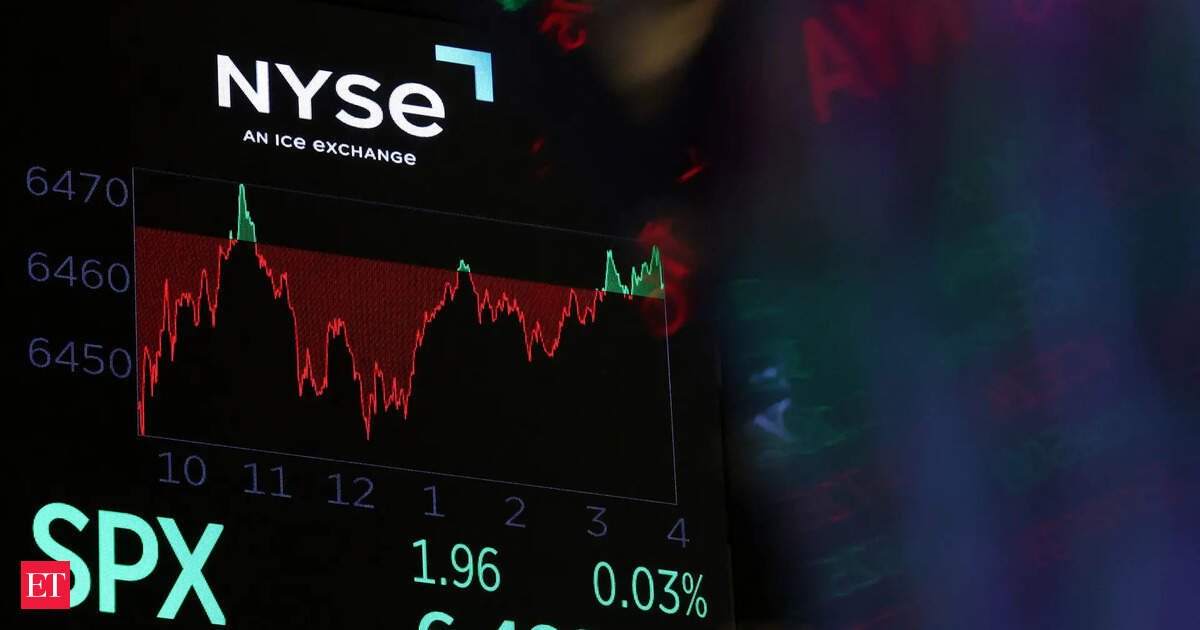
US stock market crashes today: why Dow Jones, S&P 500 and Nasdaq are down today? The Dow Jones slipped to 49,144.51, down 86 points. The S&P 500 hovered near 7,160, while the Nasdaq dropped over 50 points. After record highs last week, Wall Street turned cautious.
The reason is clear and immediate. Rising oil prices, geopolitical uncertainty around the Strait of Hormuz, and a major shift involving Microsoft and OpenAI have shaken investor confidence. Add to that a crucial Federal Reserve meeting and earnings from mega-cap tech firms, and markets suddenly look fragile.
So, why is the US stock market down today despite strong recent momentum? The answer lies in a mix of global risk, inflation fears, and shifting tech dynamics. Investors are not panicking—but they are repositioning. And that distinction matters more than the numbers themselves.
US stock market crashes today: why Dow Jones, S&P 500 and Nasdaq are down today despite recent record highs?
The US stock market crashes today story begins with a contradiction—markets were at all-time highs just days ago. But markets don’t move on past data. They react to future risk.
Oil prices surged sharply, with Brent crossing $107 and WTI nearing $96. That alone changes the inflation outlook. Higher oil means higher transportation, manufacturing, and consumer costs. Investors quickly recalibrate expectations when inflation risks return.
At the same time, geopolitical tension around the Strait of Hormuz created a supply shock scenario. Even though Iran proposed reopening the route, actual oil flow remained near zero. Markets don’t trust proposals—they react to real supply.
As a result, the Dow Jones decline today, the dip in the S&P 500, and the Nasdaq fall reflect caution, not collapse. Investors are pricing uncertainty back into the system.
Today’s top stock market gainers and losers
On the losing side, POET Technologies Inc. plunged over 45% to $8.22, making it one of the biggest shocks of the session. Compass Therapeutics, Inc. followed with an even steeper 55% drop to $2.25, signaling heavy sell-offs in high-risk biotech plays. Meanwhile, Plug Power Inc. slipped nearly 4% to $3.02, and Advanced Micro Devices, Inc. fell more than 3% to $336.97, showing weakness even in major tech names.
On the gaining side, the picture looks more selective but equally intense. Organon & Co. surged nearly 17% to $13.16, pushing close to its 52-week high and signaling strong momentum in healthcare stocks. Sagimet Biosciences Inc. jumped over 41% to $8.27, reflecting renewed interest in biotech despite broader sector volatility. Nokia Oyj Sponsored ADR gained over 5% to $11.04, supported by telecom strength, while Intel Corporation rose 2.3% to $84.44, continuing its recovery trend.
Among mega-cap leaders, gains were more measured but still meaningful. NVIDIA Corporation edged higher by 0.76% to $209.84, staying near its highs as AI demand remains strong. QUALCOMM Incorporated also posted a modest gain to $149.64, reflecting steady chip sector resilience.
Overall, today’s top gainers and losers highlight a market where extreme moves in smaller stocks contrast with cautious optimism in large-cap tech, reinforcing how uneven and selective this trading session has become.
How are oil prices and the Strait of Hormuz driving US stock market losses today?
The US stock market crashes today headline cannot be understood without oil. Energy is the backbone of inflation expectations.
When oil jumps above $100, it triggers a chain reaction. Airlines face higher fuel costs. Logistics slows. Manufacturing margins shrink. Consumers feel pressure. That feeds directly into stock valuations.
The Strait of Hormuz is critical because nearly 20% of global oil passes through it. With traffic near zero, supply fears intensified instantly. Goldman Sachs even raised its oil forecast, expecting Brent to average $90 in Q4—far above earlier projections.
This is where markets become forward-looking. Even if the situation stabilizes later, the damage to sentiment is immediate. That’s why the US stock market down today reflects oil more than earnings or economic data.
Why did Microsoft and OpenAI news hit Nasdaq and tech stocks today?
Another major trigger behind the US stock market crashes today move came from the tech sector. Microsoft’s announcement that its exclusive partnership with OpenAI is ending shocked investors.
This isn’t just about one company. It reshapes the AI landscape. Microsoft had positioned itself as a dominant AI infrastructure player through that partnership. Losing exclusivity introduces competition, uncertainty, and potential revenue impact.
Tech stocks drive the Nasdaq. When a heavyweight like Microsoft dips, the ripple spreads quickly. Investors start questioning valuations across the entire AI ecosystem.
This is why the Nasdaq drop today is sharper than the broader market. It’s not just macro pressure—it’s also structural change within the most important growth sector.
What role is the Federal Reserve playing in today’s US stock market decline?
The US stock market crashes today story also connects directly to the Federal Reserve. The central bank begins a key two-day meeting this week, and expectations are shifting.
Markets initially expected stable rates with a gradual easing path ahead. But rising oil prices complicate that outlook. Inflation could remain sticky longer than anticipated.
That uncertainty forces investors to rethink positions. If the Fed delays rate cuts, growth stocks become less attractive. If inflation rises, bond yields may climb. Both scenarios pressure equities.
Adding another layer, this meeting is among the final ones chaired by Jerome Powell before a potential leadership transition. That introduces policy uncertainty at the highest level.
So, the US stock market down today reflects not just current policy—but uncertainty about future direction.
The declines are relatively modest—less than 0.3% across major indexes. But the underlying signals are significant. Oil volatility, geopolitical risk, tech disruption, and monetary uncertainty are all converging at once.
This kind of alignment matters. Markets don’t fall because of one factor. They fall when multiple risks stack together. That’s exactly what’s happening now.
For investors, the key takeaway is clarity. This isn’t a random dip. It’s a structured response to changing global dynamics.
The Dow Jones today, the S&P 500 movement, and the Nasdaq decline all point to one reality—markets are entering a more sensitive phase where every headline matters.
Is this the start of a bigger downturn or just a temporary dip?
That’s the real question behind the US stock market crashes today trend. And the answer depends on what happens next.
If oil stabilizes and the Strait of Hormuz reopens, inflation fears may ease quickly. If the Fed maintains a balanced stance, markets could recover just as fast.
But if tensions escalate, oil stays elevated, and tech uncertainty deepens, this dip could evolve into a broader correction.
Right now, markets are not collapsing—they are recalibrating risk in real time. And that shift is far more important than a single day’s decline.