AI stocks just had their worst crash in years. If your 401(k) sits in a basic index fund, you lost about a nickel on the dollar.
The S&P 500 (^GSPC) fell more than 4% on Thursday, its worst day in more than a year and a half, as chip stocks had their worst day since the beginning of the pandemic in March 2020. Nvidia (NVDA) had its worst day since the DeepSeek scare in January 2025.
Here’s what that looks like in dollars: For every $1,000 invested in an S&P 500 index fund at the market’s Oct. 6 peak, you’d have about $950 today. The same $1,000 in chip stocks would be worth about $710, and in Nvidia, about $790.
If your fund tracks the tech-heavy Nasdaq (^IXIC), the damage is closer to a dime on the dollar. The index closed Thursday in a correction — Wall Street’s term for a drop of 10% or more from a record.
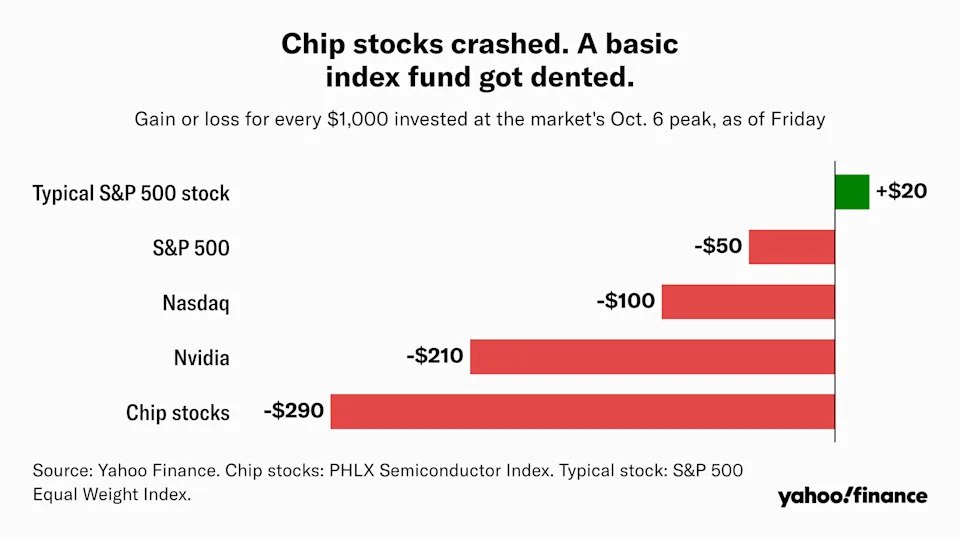
Meanwhile, the typical stock in the S&P 500 is actually up a little since that peak.
How? The S&P 500 gives the biggest companies the biggest say. Chipmakers alone make up about 14% of the index, by Yahoo Finance’s count. When they crash, the hundreds of other companies in the fund help cushion the blow.
Stocks are bouncing Friday after a strong jobs report showed employers added 165,000 jobs in October, more than double what economists expected.
But that cushion cuts both ways. AI-linked companies are a big slice of most index funds, and they’ve powered much of the market’s gains in recent years. If the AI slide deepens, your 401(k) will feel it a lot more.
The worry stems from the data centers that run on those chips. Democrats won control of Congress this week, and candidates in both parties campaigned against them. The market rout reflects “uncertainty about the cost and pace of the data center buildout,” Mark Haefele, chief investment officer at UBS Global Wealth Management, wrote in a note Thursday.
History offers some comfort — with an asterisk. The S&P 500 has been higher 12 months after every midterm election since 1950 — a track record of 19 for 19 — according to Yahoo Finance calculations. But that’s only 19 cases, and none came with an AI boom this big on the line. Thursday may also be a warning sign: It was the Dow Jones Industrial Average’s (^DJI) worst second day after a midterm in data going back to 1896.
Steve Sosnick, chief strategist at Interactive Brokers, has a simple message for nervous investors.
“Don’t freak out. Just keep your head about you,” Sosnick said on Yahoo Finance’s “The 8:30” on Friday. “There’s reasons to sell. There’s reasons to buy.”
Internal AI tools helped analyze interview transcripts, research, and draft this post. Humans reviewed, edited, and fact-checked this post before publication.
Follow Jared Blikre on X @SPYJared or email him at jaredblikre@yahooinc.com.