Is there any making sense of the stock market?
The US economy was struggling before the Iran War. The AI bubble was cresting, tariffs were chipping away at margins, employment was flat, and growth was anemic. Government had been trashed by Elon Musk’s DOGE operating in the first half of 2025. Health care costs spiked for millions and SNAP benefits were cut by the Big Beautiful Bill, which also came with big new tax cuts for the super-rich, a confirmation of their takeover of government. Trump’s image was raised and the rule of law was taken down.
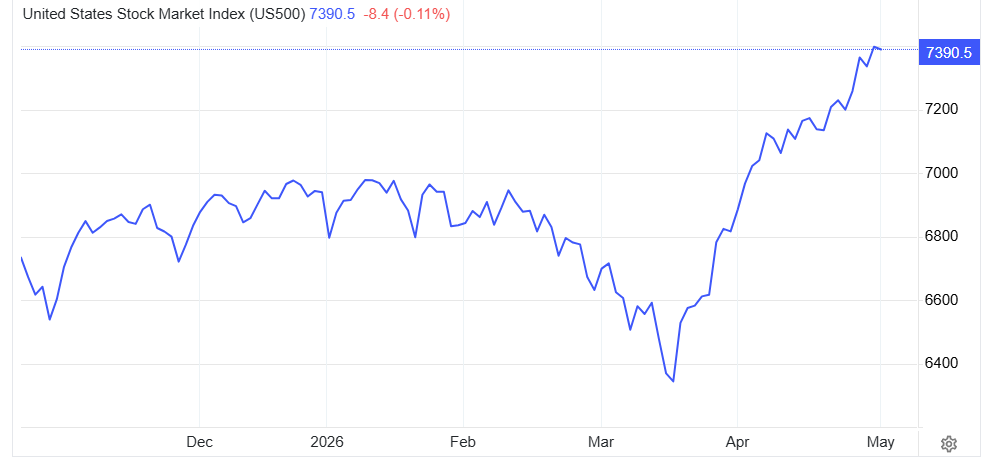
Then Trump and Netanyahu attacked Iran, the Strait of Hormuz was closed, and 20 to 30 percent of global oil and gas was choked off – the most severe oil shock since the 1970s and perhaps ever. So the stock markets hit new highs.
A dysfunction in AI (chatbot) appears when you ask the question, “Why is the stock market so much stronger than it should be?” It returns a list of reasons, none of which is the primary reason – that the Fed has insured financial markets against downturns. This insurance was formerly called “the Greenspan put”, then “the Bernanke put.” Now simply “injecting liquidity.”
We’ll get into the details of that $6 trillion insurance policy in a bit, and we’ll list out the many other reasons stock prices are divorced from reality. First we should offer a bit of evidence that stocks are indeed overpriced. After all, perhaps it could be that sophisticated investors can identify prospects the rest of us cannot appreciate.
Well, Warren Buffett is pretty sophisticated. The indicator of stock values that bears his name the “Buffett Indicator” is up to 225%. That’s not a good thing.
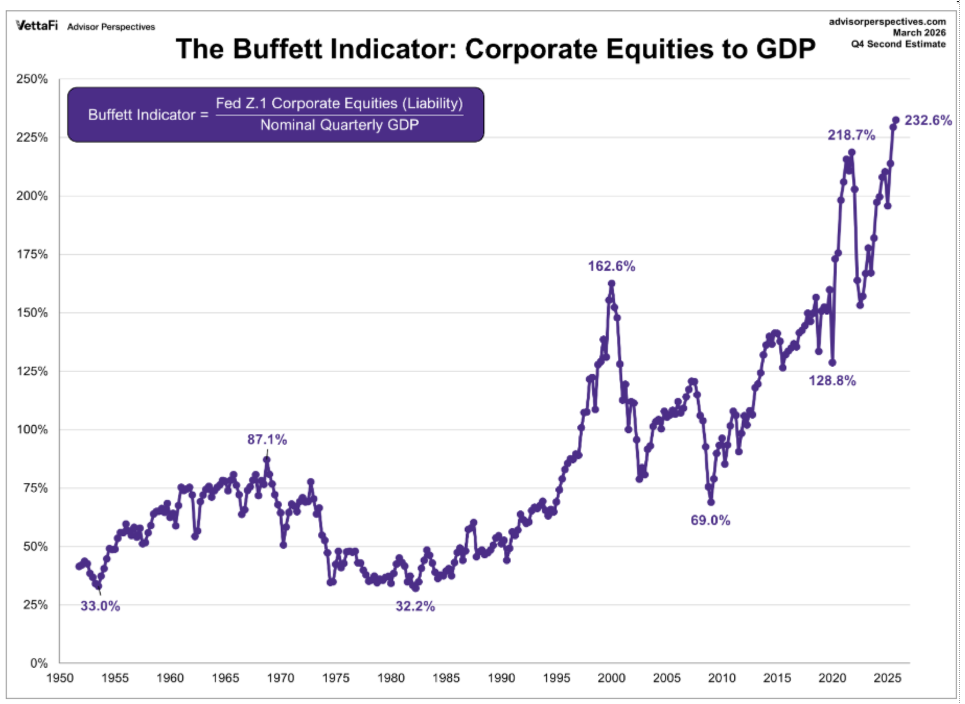
The Warren Buffett indicator has just one job: to tell investors whether the stock market is overheating. And right now, at 228%, it’s sounding the alarm.
As a quick reminder, the indicator divides the total value of the US stock market by GDP. And as Buffett says, it’s “probably the best single measure of where valuations stand at any given moment.”
The problem today is that at its current level, the indicator is beyond the 200% threshold that the Oracle of Omaha warned is when investors are “playing with fire”.[https://uk.finance.yahoo.com/news/228-warren-buffett-indicator-says-063100888.html]
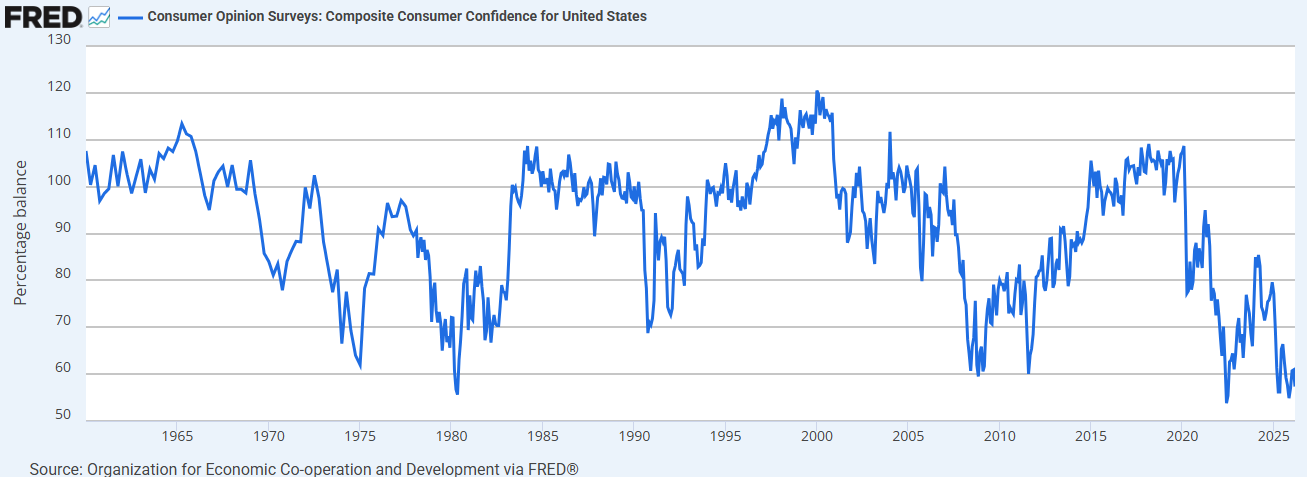
Maybe it is irrational exuberance that keeps stocks high in price while the real economy tanks, “irrational exuberance,” as in the Dot-Com bubble. If it is, the exuberance is confined to the Epstein class. But the average consumer does not own stocks. The top 10% of households own stock.Consumer confidence among the rest of us is tanking to an all-time low.
The estimated current valuation of the U.S. stock market is $46.2 trillion, according to Siblis Research. This value has tripled over the last 20 years. (In 2003, the total value was $14.2 trillion.) Based on this estimate, the richest 10 percent of U.S. households own roughly $42.7 trillion in stock market wealth, with the richest 1 percent owning $25 trillion. The bottom half of U.S. households own less than half a trillion dollars in stock market wealth.
https://inequality.org/article/stock-ownership-concentration/
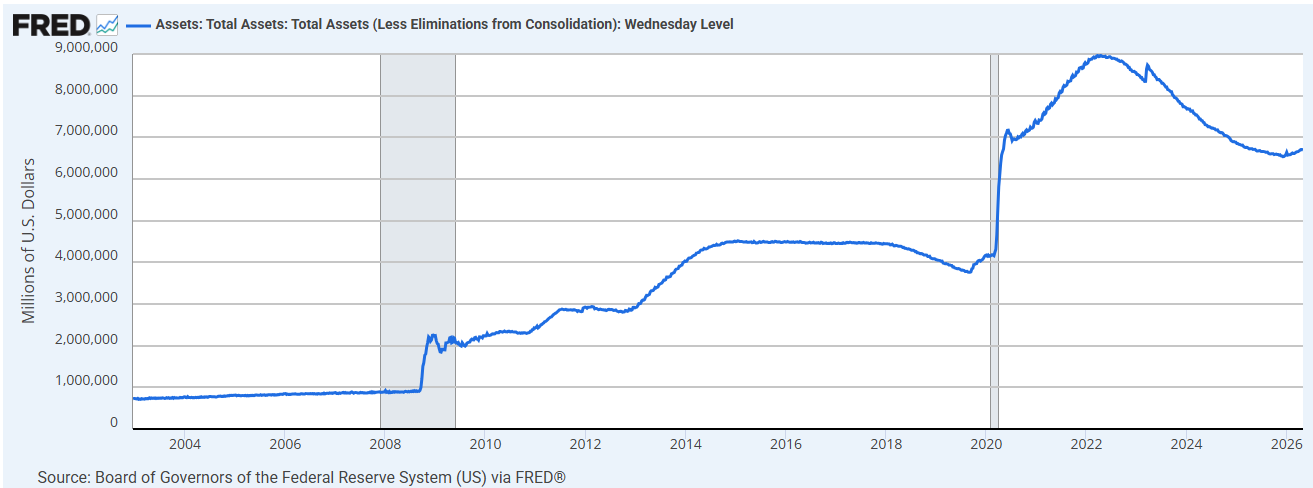
It’s no accident that stocks got detached from reality beginning in 2010. That was when the most resounding application of the “Bernanke put”, nee “Greenspan put”, occurred, with the huge Fed bailout of markets following the Global Financial Crisis (GFC). Little noticed by the mainstream press, that bailout continued. Compare the Fed’s balance sheet to the Buffett Indicator of stock overvaluation. (Yes, those are trillions on the Y axis.)
Now to the list provided by my chatbot. “What are nine reasons the stock market is overvalued?”
- Irrational Exuberance: Investor sentiment drives prices up regardless of fundamentals.
- FOMO Effect: Fear of missing out forces retail buyers into overvalued stocks.
- Algorithmic Trading: Automated momentum programs trigger cascade buying during market rallies.
[AI virtual traders are no doubt responsible for reflexive movements in stock from patterns they have “learned”, as for example, following sudden news like the next claim by Trump that peace is at hand. Of course, insiders in the criminal operation have lead time even on the fastest AI operation.] - Passive Inflows. Automatic index fund investing pumps money into to-heavy megacap stocks.
[Adding a comment: In downturns, in times of uncertainty, investors look for liquid investments, ones that can quickly be cashed out to meet other demands or to front-run a steep slide. They do not invest in real physical assets when the long term cannot be taken for granted.] - Speculative Leverage: High levels of margin debt artificially inflate overall purchasing power.
[Nobody knows how much AI trading is done with borrowed money.] - Earnings Manipulation: Corporate share buybacks reduce share counts to artificially boost EPS (earnings per share).
[This is done often for the benefit of corporate managers, whose remuneration is often tied to the stock price, even if the company itself bids up the price with buybacks.] - Monetary Echoes: Residual pandemic-era liquidly and credit expansions still circulate in assets.
[This is as close as it gets to mentioning the Fed’s put, the financial loss insurance program which makes upside bets far less risky than they would otherwise be. The chatbot neglected to notice that residual Global Financial Crisis liquidity from 2009 is also still circulating in assets.] - Tech Monopoly Concentration: A handful of massive tech giants skew market cap indexes higher. [The nursery of irrational exuberance.]
- Hopeful Fed Pivots: Markets constantly price in aggressive, optimistic future interest rate cuts.
Again, the financial economy was already in decline even before the unprovoked war on Iran slammed the real economy. The AI bubble was cresting, cracks in private credit were starting to show up among firms excessively exposed to the AI buildout (e.g., Blue Owl). But nothing on the scale of this overvaluation occurs without the Fed’s insuring bets to the upside, the Fed put. When and if the AI boom turns to bust, many in Congress (e.g., Ocasio-Cortez) expect the Magnificent Seven to petition for their own special insurance bailout, “injection of liquidity.” After all, in the opinion of the oligarchs and the criminal enterprise that is the Trump presidency, AI is already “too big to fail.”
The stock market is (like the inflation rate) a symptom not a cause in our economy. The price of stocks were made useless as indicator by government action in previous crises. In order to evade the collapse of the world’s financial structure n 2009, the Fed and Congress bailed out the banks and investors and financial players. Had they been allowed to reap the reward for their own mistakes, we would not have the economy we have today. The Epstein Class would have been missing. The elites would not have inspired such resentment, including the birth of MAGA. A cruel irony would have been avoided, Trump turning against his own brand to take his rightful place at the head of the Epstein Class.
* * * * *
BONUS CONTENT: FROM A COMMODITIES TRADER
This is a section of an interview of Jeffrey Currie, economist and director of Abaxx Commodity Exchange, by Mario Nawfal, May 11, 2026.
Everybody talks about US energy dominance, but the United States is still short crude oil. It’s a net exporter with the [petroleum] products, but with the crude oil, it is short. And for the first time since the 1940s, it exported so much oil that it’s now a net importer and it’s drawing down those strategic reserves exporting them to the rest of the world such that their refineries are going to have a problem. … Look out in a month, month and a half, it’s going to be start to begin to bite.
So that’s one. And the other point is you’ll listen to most of the macro people. They’re going to tell you, “No problem. No problem. You know, oil is a very small share of global GDP. It has shrunk.”
Now, I’m going to agree relative to prices, the price of oil spiking just doesn’t matter. But just like the magnets that went into the doors of Detroit cars – as a price man, they don’t matter. But when China threatened to take them away, you would shut down Detroit because you don’t have those critical minerals.
Oil is the same thing. From a price perspective and a share of GDP, it doesn’t matter. But you pull it out of the out of the system, it matters. And the reason I bring this up is I like to emphasize the volumes matter.
We in commodities, how do we quote things? We go millions of barrels per day or millions of metric tens, millions of bushels per day. Macro people quote in dollars, financial people quote in dollars. And that is a very important distinction. It was very similar during covid. We said, every commodity guy said, “You’ve got a big problem.” Every macro guy, every finance guy said, “Oh no, no, no. Boom. Inflation’s up 10% year-over-year.
And it’s because they do not respect the idea of volumetric change. And I and I I just want to give you an example like this. Let’s say I give you a $100 million and you give it to some rich guy. He goes to Tiffany’s and buys one necklace, lots of diamonds on it and everything. Does it contribute to GDP? Absolutely. Yes. The notional value is $100 million. Does it create any stress on the system? No. Not really.
Now, let’s take that same hundred million and give it to a bunch of low-income guys. What are they going to do? They’re going to go out and they’re going to buy corn, and then the volumetric impact it has on the economy is much larger. So, the notional hundred million is the same, but the volumetric impact is radically different. Who has that money and who spends it determines what kind of impact it would have in terms of volume. And so when people look at notionally, it doesn’t really matter. I agree with that statement. It doesn’t matter. It’s small, but volumetrically you pull it out? Ouch!
And I think that’s what the world’s going to learn sometime in the next three to eight, maybe twelve weeks, when we start to run out of these commodities.
Daily Kos is free for everyone—no paywall, no barriers. Help keep it that way
Daily Kos is committed to keeping all our content free. That’s why we don’t have a paywall, and never will. However, Daily Kos’ revenue is down, and we may not be able to continue producing the quality of work you have come to expect from us. Donations from our readers are our largest source of income. If you value independent, accessible, paywall-free journalism, please consider making a donation today.