The stock market is starting to look a little less safe. The CAPE ratio recently hit its second-highest reading on record, suggesting the stock market is quite overvalued. Add in continued high inflation, the highest rate for the 10-year Treasury in nearly a quarter century, and a new Fed rate hike cycle, and downside risks seem to be growing by the day.
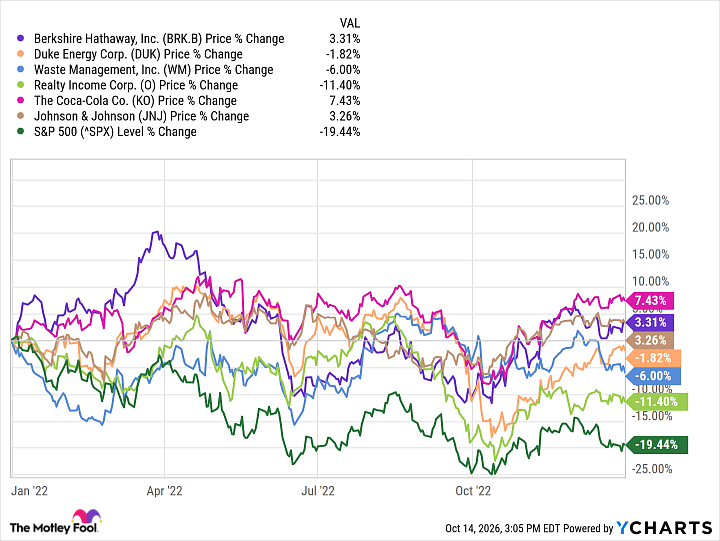
While that sounds bleak, several stocks have a history of holding up during market turbulence. Six that stand out for their resiliency are Berkshire Hathaway (BRKA +1.08%)(NYSE: BRKB), Coca-Cola (KO +2.06%), Duke Energy (DUK +2.18%), Johnson & Johnson (JNJ +0.90%), Realty Income (O +0.95%), and WM (WM +1.19%). We saw this during the last bear market in 2022 when they all outperformed the S&P 500, with several ending the year in the green:
Here’s a quick look at why these six stocks have historically held up during market downdrafts.
Berkshire Hathaway
Berkshire Hathaway owns a diversified portfolio of operating companies, including GEICO, BNSF, and MidAmerican Energy. The company’s insurance, financial services, transportation, energy, manufacturing, service, and retailing operations generate relatively stable earnings, which it retains. Berkshire uses its retained earnings to acquire additional operating companies and to invest in public equities, such as Coca-Cola. It currently has a massive cash balance ($365.5 billion at the end of June, nearly a third of its market cap). That large cash position provides ballast during market downturns, while enabling Berkshire to opportunistically repurchase shares, acquire additional operating companies, and buy more public equities.

Image source: Getty Images.
Coca-Cola
Coca-Cola owns a portfolio of satisfying beverage brands, including Coke, Dasani, Powerade, and Gold Peak. Demand for its products tends to be durable and steadily rising, enabling it to generate resilient, growing cash flows. That has enabled Coca-Cola to increase its dividend for 64 straight years, qualifying it as a Dividend King (a company with 50 or more years of annual dividend increases). The company also has a fortress balance sheet, which helps it weather storms and make acquisitions when opportunities arise.
KO Coca-Cola
$93.90+$1.90 (+2.06%)
NYSE · As of 4:00 PM ET 10/16/26
Duke Energy
Duke Energy is one of the country’s largest regulated electric and natural gas utilities. It benefits from durable energy demand, while government regulators set its prices. That enables it to generate resilient earnings, which has allowed it to pay dividends to its shareholders for over 100 years (and increase its dividend for more than 20 straight years). Duke has ample financial capacity to expand its operations and is currently executing a $103 billion capital investment plan through 2030, which should support 5% to 7% annual earnings-per-share growth. The company’s combination of durable cash flows and stable growth significantly reduces the volatility of its stock price.
Johnson & Johnson
Johnson & Johnson has one of the world’s healthiest financial profiles. It’s one of only two companies with a pristine AAA credit rating, giving it unparalleled financial flexibility and stability. Meanwhile, durable and growing demand for its innovative medicines and medical technologies has enabled the company to increase its dividend for 64 straight years. The company generates robust cash flows, allowing it to invest heavily in R&D. It also routinely makes strategic acquisitions to bolster its drug pipeline and medtech portfolio. These investments should support its continued growth.
JNJ Johnson & Johnson
$255.56+$2.28 (+0.90%)
NYSE · As of 4:00 PM ET 10/16/26
Realty Income
Realty Income is one of the world’s largest REITs. It owns a diversified portfolio of retail, industrial, gaming, data center, and other properties secured by long-term net leases with many of the world’s leading companies (most of which operate in industries resilient to economic downturns). Net leases provide very stable cash flow because tenants pay all property operating expenses, including routine maintenance, real estate taxes, and building insurance. Realty Income also has a fortress financial profile. These resilient features are one reason why the REIT has outperformed the S&P 500 during 11 of its 13 corrections (10%+ market declines) since its public market listing in 1994. They also support its steadily rising dividend (over 30 straight years).
O Realty Income
$56.08+$0.53 (+0.95%)
NYSE · As of 4:00 PM ET 10/16/26
WM
WM is North America’s leading environmental solutions provider. It generates very resilient recurring revenue because customers need their garbage and recyclables collected, medical waste handled, and their documents securely destroyed. That provides it with stable cash flow to pay a growing dividend (for 23 consecutive years), repurchase shares, maintain a strong balance sheet, and invest in its growth, including through acquisitions. WM’s durable features have made its stock about half as volatile as the S&P 500, while still generating above-average total returns.
Preparing for troubling times in advance
The stock market seems to be flashing lots of warning signs these days that we could be heading toward a more challenging period. The market has experienced many sell-offs throughout its history and will likely endure many more during our lifetimes. Companies like Berkshire Hathaway, Coca-Cola, Duke Energy, Johnson & Johnson, Realty Income, and WM have historically weathered these market storms better than most due to their more resilient cash flows and strong financial profiles. That makes them ideal stocks to consider buying before the next storm, as they can help lower your portfolio’s volatility, protecting your wealth and allowing you to sleep a little more soundly when the market starts getting dangerous.