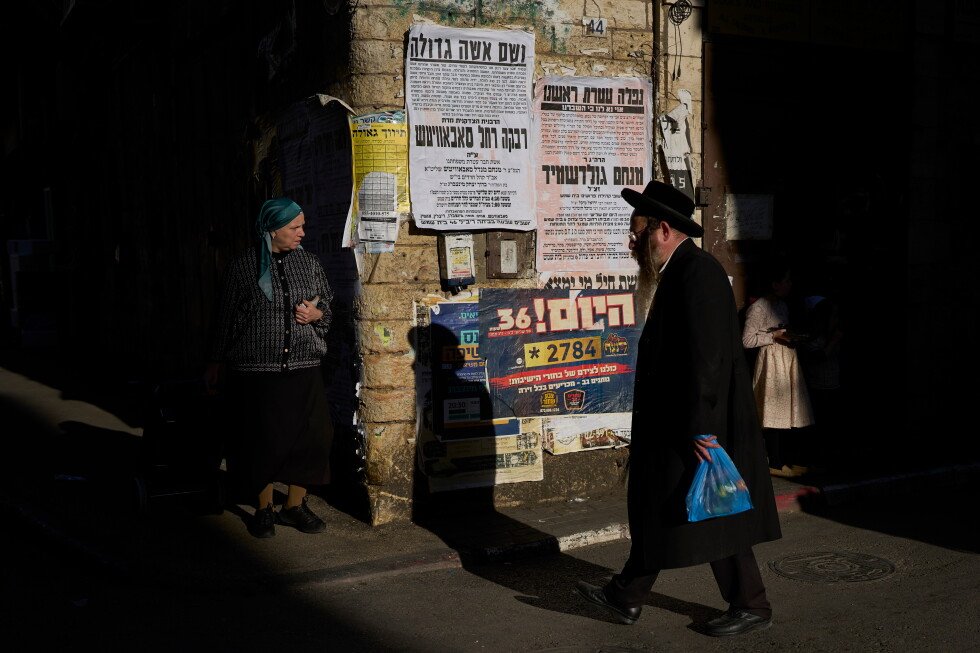
JERUSALEM (AP) — Ultra-Orthodox Jewish families are an unmissable facet of Israeli life. Immediately recognizable, the men dress in black suits and hats, the women in modest long sleeves and skirts with wigs, turbans or scarves covering their hair, and numerous children tag along, often in matching outfits.
They are growing in numbers and in political and cultural clout. That’s bringing their vision of faith, Jewish identity and civic practices into conflict with other Israelis, both religious and secular. Distrust spirals on all sides.
Mass protests over proposed changes to the exemption from the military draft for ultra-Orthodox men highlight the most contentious issue as the country approaches three years of war on multiple fronts — and national elections where ultra-Orthodox parties are likely to be kingmakers.
At the core of ultra-Orthodox doctrine is the belief that studying scripture — and teaching it to family and community — is the highest duty, above working or joining the armed forces even in wartime.
Judith Rosenblum, who has seven sons and one daughter, believes that ultra-Orthodox practice is under threat from secular culture, and that conscripting young men into the military can “compromise” their religious practice.
But when she ran into an acquaintance whose grandson lost two legs and an arm in the war in Gaza, she was proud to relay that three of her sons also signed up to serve after the Oct. 7, 2023, Hamas attack on Israel.
“If all my kids were cut out for full-time Torah learning and had the money to support themselves doing so, for sure that would be a preference,” Rosenblum said. “But my kids who left full-time Torah study are amazing human beings. And I believe that they did the right thing by going into the army and participating in the defense of the country.”
Full-time Torah study anchors ultra-Orthodox beliefs
In Hebrew, the ultra-Orthodox are called Haredim. The term was first used in the late 19th century by several rabbis and is derived from the Prophet Isaiah’s description of being “fearful or astounded by the word of God,” according to Rabbi Beryl Gershenfeld.
“God’s word is not supposed to be intuitive; you have to look deeply,” said Gershenfeld, who grew up in Philadelphia but has lived in Israel, studying and teaching the Torah, for half a century. “Understanding the Torah is the crucial mission of life.”
He runs two Jerusalem yeshivas — or seminaries — for ultra-Orthodox boys and men.
Such institutions are “the beating heart of the community,” said Rabbi Heshy Grossman, an administrator at a prominent yeshiva in the Jerusalem neighborhood of Ramot.
Inside the residential yeshiva, students aged 17-22 in white shirts and black pants spend long days praying, studying and discussing sacred texts and commentaries. Etl Lovy, 22, is completing his five years of study at the age when families start matchmaking for marriage.
“We have a lot of belief in what we’re learning,” he said a day before the start of summer break.
The Torah guides every moment of daily life
Lovy enthusiastically described how days begin at 7 a.m. with a prayer and continue with Talmud studies until late evening, learning “all commands from God and how to get close to him.”
As he took a sip of water on the hot day, he whispered a prayer. “Everything comes from the one above,” he explained with a smile.
For the ultra-Orthodox, each commandment and each good deed is not just a God-given obligation, but a way to find fulfillment and holiness.
And the highest one is studying God’s word — especially for men. Women receive a broader education in secular subjects like math, and they are expected to work while also raising large families. Ultra-Orthodox Jews believe many forms of birth control are opposed to God’s will, a view held by other conservative faiths but not all branches of Judaism.
“My life is not about making money, or building a nice house,” said Lovy, who plans to continue to study the Torah while his future wife works.
For the ultra-Orthodox, “every second of life is devoted to God,” said Rabbi Emanuel Feldman, adding that other Jews will either follow suit or “disappear into the mainstream.”
“The Orthodox are fighting assimilation,” said Feldman, who in his late 90s has witnessed the growth of the practice and still writes columns for a popular Haredi weekly magazine. “If you don’t study Torah and observe the commands, you become like any other Mediterranean country.”
He added that the ultra-Orthodox follow civil law so long as it doesn’t interfere with religious belief, such as forbidding or “affecting” the study of the Torah.
The ultra-Orthodox Jews’ complicated relationship with Israel
Much of the Torah studies tradition was lost during the Holocaust. When the state of Israel was founded shortly after, it gave ultra-Orthodox scholars special rights so they could rebuild, said Shlomit Ravitsky Tur-Paz, director of the Israel Democracy Institute’s Religion and State Program.
That included an exemption from the military draft, originally for a few hundred scholars and in later decades broadened by conservative governments to everyone who wanted to engage in Torah learning full-time, she said. The same body of men was also largely outside the workforce.
But the ultra-Orthodox have grown rapidly, outpacing other Israelis. Ravitsky Tur-Paz estimates they will be about 25% of the population by 2050, and about 40% of the potential army draft.
“Israelis aren’t concerned about the Haredi way of life; they’re concerned about their way of life,” she said, adding that includes everything from welfare tax impacts to how much time non-Haredi Israelis might need to serve in the reserves. “The question is, who’s paying the price for your choice of life? This has become the issue everyone is talking about.”
For many ultra-Orthodox, there’s no debate — they’re fulfilling their individual obligation to God, and nothing else matters more.
“The importance of the Torah is a genuine feeling, and not just an escape, not just an excuse,” Rosenblum said. “Haredi world will put Torah first, and then Israel.”
Fewer than 10% of ultra-Orthodox men reaching the conscription age of 18 enlist, according to a parliamentary committee, and they usually join separate units accommodating their religious practices. Reacting to a recent bill protecting the ultra-Orthodox from draft evasion prosecution, the Israeli army’s chief of staff, Lt. Gen. Eyal Zamir, called such exemptions “inconceivable” while troops are being asked for “unprecedented sacrifice.”
But most ultra-Orthodox rabbis are adamant about their youths’ exemption from the draft, to avoid “diluting their piety” at a critical age. Other Jewish men in Israel are required to serve for nearly three years, and women for two years.
“Studying the Torah is itself a spiritual protection,” Feldman added — an argument wearing thin with many Israelis, especially since about 1,000 troops have been killed fighting Hamas in Gaza and Hezbollah militants in Lebanon since the 2023 attack.
Asked if he had any qualms about his peers serving as soldiers while he devotes his life to studies, Lovy, the yeshiva student, said he prays “all the time” for soldiers.
“But we think because we believe in the Bible, we believe this is the right way to live. We don’t apologize,” he said. “I’m doing what God wants.”
___
Associated Press religion coverage receives support through the AP’s collaboration with The Conversation US, with funding from Lilly Endowment Inc. The AP is solely responsible for this content.