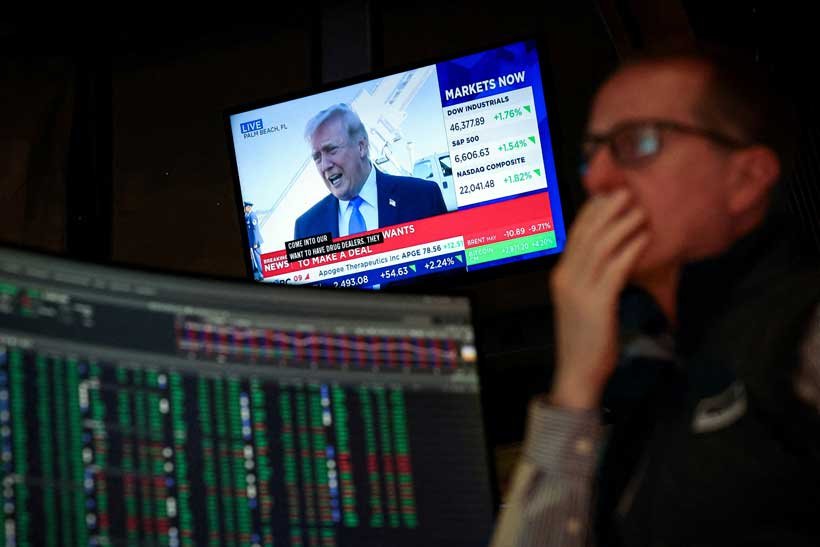
When U.S. President Donald Trump rang the opening bell at the New York Stock Exchange this week, it symbolized more than another presidential appearance on Wall Street. It reflected a defining feature of his second term: making the stock market one of the clearest measures of his administration’s success.
From speeches and campaign-style rallies to meetings with foreign leaders, Trump has repeatedly highlighted record highs in U.S. equities as evidence that his economic agenda is delivering results. Rising share prices have become central to his messaging on issues ranging from tariffs and tax policy to the conflict with Iran.
But economists warn that stock market performance tells only part of the story. While investors have enjoyed substantial gains, millions of Americans own little or no stock and continue to face high living costs, meaning Wall Street’s record-breaking run does not necessarily translate into broader financial wellbeing.
Wall Street becomes the administration’s report card
Trump has increasingly portrayed market gains as a direct endorsement of his policies.
Stay ahead of the geopolitical week.
MD Briefing delivers expert analysis across five global fronts — the Indo-Pacific, energy, geoeconomics, European security, and the Middle East — every Monday morning. Free.
He has cited rising stock prices after announcing tariffs, defended his handling of geopolitical crises by pointing to investor confidence, and regularly links higher equity markets with a stronger America.
His administration has also introduced policies designed to expand retail investing.
Republicans’ $4.1 trillion “One Big Beautiful Bill” established government-funded investment accounts for newborns known as “Trump accounts,” while the administration has proposed matching contributions for retirement savings through new “Trump IRA” accounts.
At the same time, the federal government has taken unusually active positions in corporate America, including equity stakes and revenue-sharing agreements with major technology and industrial companies such as Intel, Nvidia, AMD and U.S. Steel.
Administration officials argue these initiatives are intended to broaden wealth creation by encouraging greater household participation in financial markets.
Many Americans remain outside the market
Despite the administration’s emphasis on investing, stock ownership remains uneven across American society.
Gallup polling indicates that roughly four in ten Americans do not own stocks, either directly or through retirement accounts.
Ownership is also highly concentrated among wealthier households. The richest 1% of Americans control more than half of all capital market investments, while lower-income families tend to hold most of their wealth in housing, vehicles and other physical assets rather than financial markets.
That means rising stock prices disproportionately benefit higher-income investors.
Although U.S. equity markets have added trillions of dollars in value since Trump returned to office, those gains have largely accrued to households already holding substantial investment portfolios.
The economy presents a mixed picture
The broader U.S. economy remains relatively resilient by conventional measures.
Economic growth has continued, unemployment remains low and wages have risen modestly.
However, inflation—partly influenced by higher energy prices following renewed tensions with Iran has continued to pressure household budgets and consumer confidence.
Economists describe the current environment as a “K-shaped economy,” where wealthier households continue spending and benefiting from financial assets while middle- and lower-income families struggle with higher living costs.
In that environment, record stock prices may coexist with persistent economic dissatisfaction among voters.
Supporters see confidence, critics see distortion
Supporters argue Trump’s close attention to financial markets provides reassurance to investors and encourages pro-growth policymaking.
Some conservative economists acknowledge that stock prices are an imperfect measure of economic health but still view them as an important indicator of business confidence and future growth.
Others believe the president’s responsiveness to market movements reduces the risk of major policy mistakes that could destabilize the economy.
Critics, however, argue that focusing heavily on Wall Street risks prioritizing corporate interests over household finances.
They note that stock market gains reveal little about the financial condition of younger Americans, renters, small-business owners or families without retirement investments.
Many economists instead view broader indicators including gross domestic product (GDP), employment, wage growth and inflation as more comprehensive measures of economic performance.
Analysis: Politics and markets have become increasingly intertwined
Trump’s embrace of the stock market as a political scoreboard reflects both economic philosophy and political strategy. Rising equities provide a highly visible, real-time indicator that can be cited almost daily, allowing the administration to showcase tangible evidence of investor confidence.
Yet financial markets have always represented only one dimension of economic performance. Their gains are distributed unevenly, and record share prices can coexist with affordability pressures, stagnant purchasing power and widening wealth inequality.
The administration’s efforts to expand stock ownership through government-backed investment accounts suggest recognition that broader participation could eventually narrow that gap. Whether those policies materially increase household wealth remains uncertain and would likely take years to measure.
For now, Trump’s political fortunes have become more closely tied to Wall Street than those of most modern presidents. As long as markets continue climbing, they provide a powerful symbol of confidence. But if volatility returns or economic conditions weaken outside financial markets, the gap between investor optimism and everyday economic experience could become a more significant political challenge.
With information from Reuters.