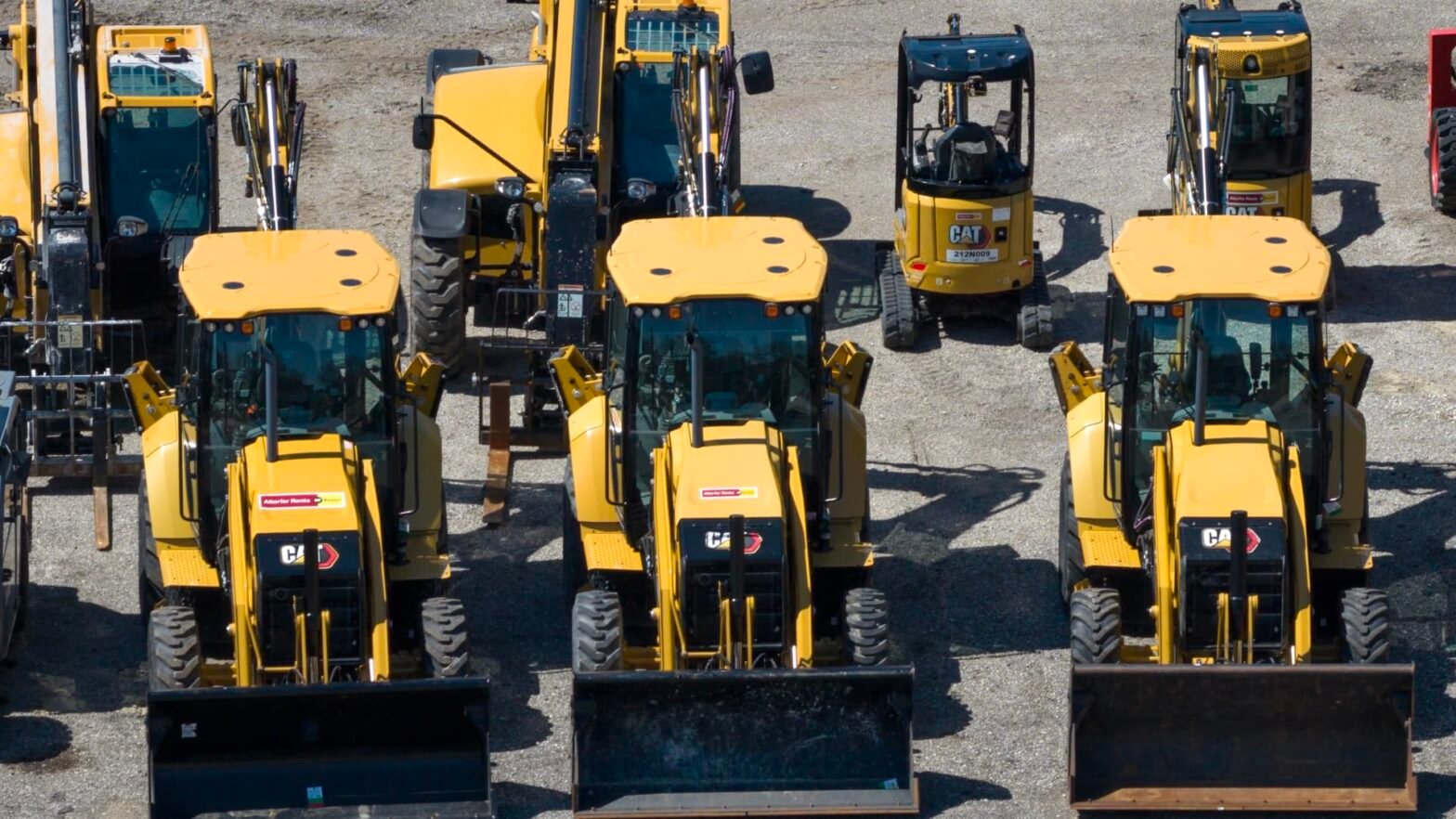
(This is The Best Stocks in the Market , brought to you by Josh Brown and Sean Russo of Ritholtz Wealth Management.) Josh — Today, we’re bringing you up to speed on three names we’ve been talking about all year. New stops and set-ups for traders and investors who took our calls in Interactive Brokers (IBKR) , Caterpillar (CAT) and Delta (DAL) . Here at The Best Stocks in the Market, we’ve been using the Monday columns to highlight entire sectors or themes. Today’s theme is winners win. It is part of our belief system. There doesn’t always have to be a new stock or a new story. Riding the big winners all year is great if you can identify them early enough. In the case of these names, we’ve done exactly that. Sean’s going to update you on the fundamental backdrop for each of the three. I’ll be back with the latest chart read. Let’s get after it. As of June 22, there are 196 names on The Best Stocks in the Market list. Top sector ranking: Top industries: Top 5 best stocks by relative strength: Sector spotlight: Winners win Interactive Brokers Group, Inc. (IBKR): Sean — We have written about IBKR a few times, starting with a mention of it on July 14 just prior to earnings. Here was Josh on the price pattern at the time: “IBKR is emerging out of a cup-and-handle pattern which you can clearly see in the chart above. RSI at 71 could be considered “overbought” but I don’t look at it that way. I see it as a sign of strength when it’s accompanying new record high levels in price.” Looking back at it almost a year later, it certainly was a sign of strength. The capital markets stock is now up 61% over that period vs a 21% return for the S & P 500. Most recently, we wrote about the beneficiaries of a strong stock market in early May, again mentioning IBKR. Our consensus was that the thesis hasn’t changed. Traders are itching to deploy capital. The price continues to consolidate at key levels and push higher and ultimately your bias should be to hold and not sell all time highs. IBKR is up 13% since that most recent write up vs a 1% return for the S & P 500. The fundamentals are following through on what price is telling us. IBKR client accounts grew 31% year over year to 4.75 million in Q1 2026 while client equity surged 38%. Margin loans were up 40% to $90.2 billion and customer credits were up 34% to $160.1 billion, both of which fed net interest income, up 17% to $904 million. Last but not least, commissions hit a record $613 million on broad-based volume (stock commissions up 25%, futures up 20% and options up 16%, all year over year), capping a record $2.1 billion commission year in 2025. With an even more chaotic 2026, you can expect that number higher this year too. Josh — The way I learned it, stocks in the 90’s get through 100. I’m sure there are exceptions, but I was taught this as a rule and based on 30 years of anecdotal evidence, you can’t convince me otherwise. Sorry, I’m stubborn that way. But putting aside my old wives tales for traders, I think it’s clear this name wants higher. The thing you gotta remember is that the float here is small relative to the ownership stake of the founder Thomas Petterfy. Investors have been snapping up every share he doesn’t control since this time last year. Interactive Brokers has been on this list since July, when the stock was breaking out of a cup-and-handle formation at much lower prices. The chart looked constructive then and the price has confirmed it ever since. Over the past year, IBKR has climbed in a nearly unbroken series of higher highs and higher lows, with the 50-day moving average, now at $83, rising steadily beneath price the entire way. The stock is currently trading at $96 and pressing toward $100, a round number that will act as the next meaningful test. A clean breakout through $100 on volume opens the door to the next leg higher with no obvious resistance above it. RSI is at a smoldering 71. Not overheating, but definitely on fire. As I said when we first wrote about this stock, an elevated RSI accompanying new highs is a sign of strength, not a warning. Nothing in this chart has changed that view. The momentum is clean, uninterrupted, and consistent with a stock that the market continues to reward. For traders who want to stay long, you can raise your stop just below $88 and use the most recent consolidation zone as the anchor. Investors can hold with a wider stop near $83, where the 50-day is currently providing support and where two recent pullbacks found buyers. Caterpillar, Inc. (CAT): Sean — Caterpillar has been another good pick of ours – we wrote this one up on April 16th, 2026, noting its importance to the AI build out . Allow me to quote myself here: “CAT’s Power & Energy segment is both the largest and fastest growing segment of the business. This segment supports industrial applications within oil and gas, power generation, marine, and rail markets. This includes the fabrication of engine-powered assets, turbines, and solutions for integrated systems within electric power generation applications.” Not only has that story not changed, but it’s stronger today than it was two months ago. CAT reported earnings shortly after our write up, confirming the AI story. CAT CEO Joe Creed frames it as providing “the invisible layer of the tech stack”—with its large engines and turbines increasingly powering data centers as both backup and 24/7 prime power. That demand drove power generation sales up 48% in Q1 2026 and helped push the total backlog up 79% year over year to a record level, prompting management to raise both its 2026 revenue outlook and its long-term power generation target (now more than 3x by 2030). Data center strength flowed through to a 30% jump in adjusted EPS and materially stronger free cash flow, even as segment margins absorbed a 270 bps tariff hit. The longer-term kicker for investors is its services. A gas engine running 24/7 generates roughly 40x the lifetime services revenue of a standby diesel unit, creating a high-margin, recurring stream as data centers continue to roar to life. Since our first mention of CAT, the stock is up 19% vs a 5% return for the S & P 500, confirming our original capex-related thesis. Management is focused on returning that uptick in cash flow to shareholders, too—on June 10th the board raised the quarterly dividend 8% to $1.63, extending CAT’s Dividend Aristocrat streak to 32 consecutive years. Josh — Caterpillar is doing something the chart has been telegraphing for months. It’s approaching $1,000 per share in a trend that has shown almost no meaningful deterioration along the way. Does the 90 to 100 “rule” I describe above apply to $900 to $1,000? I’d say yes but there aren’t as many thousand-dollar stocks in my memory banks to be as confident so let’s just respect the trend and not get bogged down in the folklore. The trend is higher. We wrote about CAT in April when the AI infrastructure buildout thesis was still being questioned in some corners. The chart was not questioning it then and it is not questioning it now. The 50-day moving average has tracked price higher the entire way and currently sits at $873, a level that has acted as support on every notable pullback this year. The $1,000 level is both a round number and the next logical test. A breakout there on volume would confirm the continuation of one of the cleanest uptrends on the board. RSI is at 65. That is a healthy reading for a stock in this kind of trend, not elevated enough to raise flags and not weak enough to suggest the move is losing steam. The momentum profile here is as orderly as the price action. Traders can use $940 as a stop, just below the most recent consolidation. Investors have the 50-day at $873 as a well-established support level worth anchoring to. The 200-day at $670 is so far removed from current price that it serves as a historical reference point only. Ignore it for now. Delta Air Lines, Inc. (DAL): Sean — It is no secret the “upper K” of the consumer is traveling. Flights are packed to and from World Cup games here in the states. Consumers looking for quality, comfort and good service are repeatedly going to Delta over other carriers. We first wrote about Delta on Dec. 8. The stock is up 25% vs a 9% return for the S & P 500, and that includes a 23% drawdown through March due to an oil price spike. With oil becoming less of a headwind (for now), consumer durability points to travelers willing to pay up for travel, with sales growing mid-teens in March and momentum carrying into April across all booking windows, geographies, and cabins. The strength is concentrated where margins are thickest. Premium revenue grew 14% and loyalty and related revenue grew 13%. Corporate sales hit a quarterly record with double-digit growth, while the main cabin posted its first full quarter of positive unit revenue growth since late 2024 — domestic unit revenue was up 6% and international was up 5%. CEO Ed Bastian framed the premium consumer as increasingly immune to geopolitical headlines, a sharp contrast to the prior year’s tariff-driven demand freeze. That demand resilience is translating into fundamental growth. DAL reported record Q1 revenue of $14.2 billion (up 9.4%), $1.2 billion of free cash flow, and Q2 guidance calling for low-teens revenue growth. Another upside surprise came last week when Delta raised its quarterly dividend 15%, a notable move given the company had pulled full-year guidance back in April amid the fuel spike, further evidence the business is feeling the momentum. Josh — Delta Air Lines knows its business very well. They’re making hay at the top of the K and, as such, we’ve seen a violently fast recovery after the oil price spike Sean describes above. Rich people didn’t cancel their vacations when the war started and businesses didn’t stop salespeople and executives from traveling. DAL has had the most eventful ride of these three names since we first covered it in December. The stock ran, gave back nearly a quarter of its value into March as oil prices spiked and sentiment around travel demand soured, then reclaimed all of it and pushed to new highs above $88. It is currently pulling back toward $84, which is constructive action after a sharp move. The 50-day at $74 held as support during the March correction and is rising again. That level has earned its credibility. RSI is at 63, which is exactly where you want to see it during a healthy consolidation after a strong run. There is no sign of deterioration in the momentum here, just a stock catching its breath before the next move. Traders should use $79 as a stop, just below the current consolidation lows where buyers have shown up twice. Investors can look to the 50-day at $74 as the level that matters most. A close below that on volume would be the first real technical warning this chart has produced in months. DISCLOSURES: We currently own shares of IBKR for clients in our Porterhouse strategy. All opinions expressed by the CNBC Pro contributors are solely their opinions and do not reflect the opinions of CNBC, or its parent company or affiliates, and may have been previously disseminated by them on television, radio, internet or another medium. THIS CONTENT IS PROVIDED FOR INFORMATIONAL PURPOSES ONLY AND DOES NOT CONSTITUTE FINANCIAL, INVESTMENT, TAX OR LEGAL ADVICE OR A RECOMMENDATION TO BUY ANY SECURITY OR OTHER FINANCIAL ASSET. THE CONTENT IS GENERAL IN NATURE AND DOES NOT REFLECT ANY INDIVIDUAL’S UNIQUE PERSONAL CIRCUMSTANCES. THE ABOVE CONTENT MIGHT NOT BE SUITABLE FOR YOUR PARTICULAR CIRCUMSTANCES. BEFORE MAKING ANY FINANCIAL DECISIONS, YOU SHOULD STRONGLY CONSIDER SEEKING ADVICE FROM YOUR OWN FINANCIAL OR INVESTMENT ADVISOR. Click here for the full disclaimer.
‘Winners win’ — Josh Brown on three winning Best Stocks to keep riding
Jun 22, 2026