There is often no escape from the volatility of a stock market crash. When a bear market hits, it can be hard to find any “safe” stocks or sectors to hide out in for long.
Instead of trying to pick “safe” stocks that might do better during a bear market, the best strategy for many investors is to buy low-cost index funds that track the total stock market. And then hold onto those investments through the short-term declines.
Three of the best low-cost total stock market index funds include the Vanguard S&P 500 ETF (VOO +0.29%), the Vanguard Morningstar Total Stock Market ETF (VTI +0.26%), and the Schwab U.S. Broad Market ETF (SCHB +0.30%). These funds let you own hundreds or thousands of U.S. stocks for one low fee — each ETF charges an expense ratio of only 0.03%.
Let’s look at why these low-cost index funds could be worth including in your portfolio — before the next bear market, and for many years to come.

Image source: Getty Images.
VOO, VTI, and SCHB: Ultra-low cost ETFs with strong track records of returns
The stock market tends to be a great way to invest your money if you want long-term growth. But you have to be willing to accept some short-term risks, volatility, and “stormy weather” as part of that journey.
The stock market’s average annual return, as represented by the S&P 500 index, is about 10%, going back 98 years to 1928. The Vanguard S&P 500 ETF (VOO) tracks this same level of performance.
VOO is designed to give investors about that same S&P 500 return generated by the 500 largest publicly traded companies in America. VOO has been available since September 2010, and it has delivered average annual returns of about 14.9% in the 16 years since its inception.
VOO Vanguard S&P 500 ETF
$708.87+$2.07 (+0.29%)
NYSEMKT · As of 3:02 PM ET 10/21/26
What if you want to own more than the top 500 largest U.S. stocks? The Schwab U.S. Broad Market ETF (SCHB) is even more diversified, with a mix of 2,394 large-cap stocks representing the 2,500 largest publicly traded U.S. companies. This fund has been around since November 2009, and in the nearly 17 years since its inception, SCHB has delivered average annual returns of about 14.3%.
SCHB Schwab Strategic Trust – Schwab U.s. Broad Market ETF
$29.60+$0.09 (+0.30%)
NYSEMKT · As of 3:03 PM ET 10/21/26
What if you want even more diversification from a larger number of stocks? The Vanguard Morningstar Total Stock Market ETF (VTI) holds a broad mix of 3,519 stocks, representing the entire publicly traded U.S. stock market. VTI is not just for large-caps; it includes mid-cap and small-cap stocks of companies that could grow into major household names of the future.
Compared to the other two ETFs, VTI has an even longer track record. In the past 25 years since the fund’s inception in May 2001, VTI has delivered average annual returns of about 9.4%.That 25-year track record includes major stock market crashes and recessions like the global financial crisis in 2008.
VTI Vanguard Morningstar Total Stock Market ETF
$378.06+$0.97 (+0.26%)
NYSEMKT · As of 3:03 PM ET 10/21/26
Do these 3 ETFs own “too much” of tech stocks?
One of the biggest questions facing the stock market right now is: can tech stocks keep outperforming, or will the artificial intelligence (AI) boom turn into the next stock market crash?
When you buy a total stock market index fund like VOO, VTI, or SCHB, you are also buying the biggest tech names. Those leading tech stocks take up a big share of the overall market by weighting. But that doesn’t mean you’re betting “too much” on tech stocks by buying index funds.
These 3 ETFs let you own the same stocks in the same weightings that the rest of the market owns. You’re accepting the “wisdom of the crowd.” Index funds let you invest based on the idea that the stock market is generally efficient — that stocks get priced in real time, based on their real market value, based on the latest information that the entire world of investors believes to be accurate.
When that collective understanding changes, stock prices change too. If the market decides that tech stocks are overpriced, investors will collectively move money out of tech stocks. They might buy bonds instead. Or they might put money into different stocks, by rotating into other sectors or themes, like value stocks or dividend stocks. Whatever happens next, index funds will adjust and rebalance and keep up with those market moves.
How these 3 ETFs performed in the last bear market (2022)
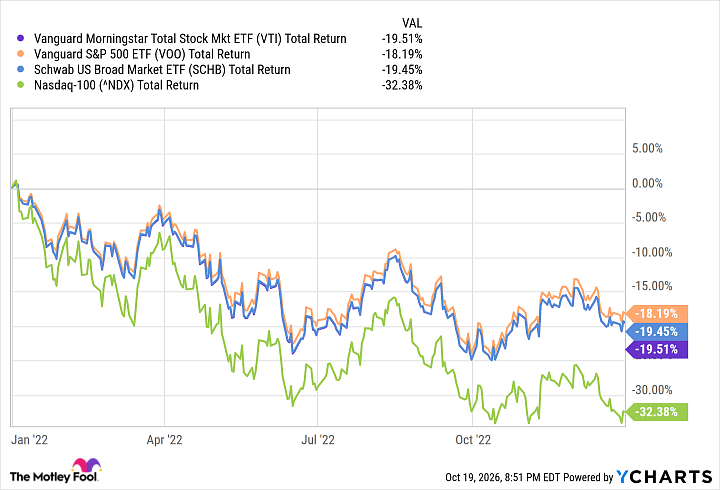
These three index funds can still go through short-term volatility and serious declines. But if we’re heading for a big tech stock sell-off, these three ETFs are likely to be less volatile than the tech-heavy Nasdaq-100. That’s because, even though they own major tech names and AI stocks, these 3 ETFs are more diversified and less tech-heavy than many tech ETFs.
In the most recent bear market of 2022, these three index funds performed much better than the Nasdaq-100:
VTI Total Return Level data by YCharts
Owning low-cost index funds won’t spare you from short-term volatility. This strategy is not guaranteed to deliver results; your investments in these three ETFs could still lose value. But it can help you ride out the storm.