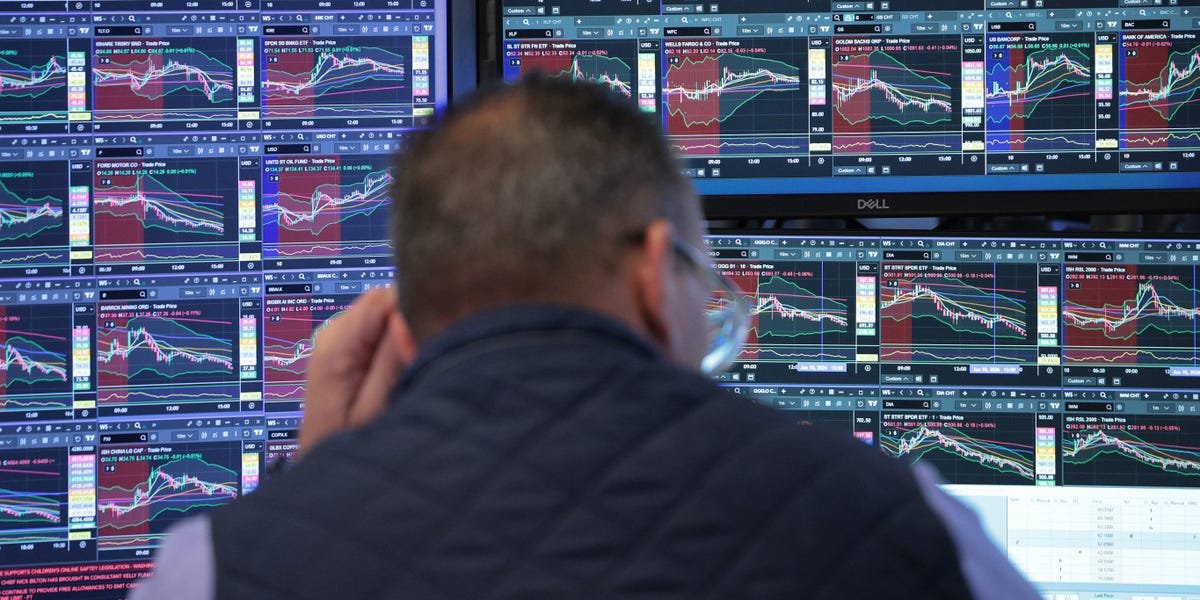
It’s been a wild week of a trading for US stocks, but market pros say investors should get used to it.
Wall Street is seeing volatility resurface, with stocks rocked by a re-escalation in the Iran war and squashed hopes of any interest rate cuts from the Federal Reserve in 2026.
The equity market has been surprisingly resilient in the first half of the year, but it’s been far from a straight line up.
The S&P 500 has recovered from its Iran-war lows at the end of March and then some, climbing to fresh record highs nearly 100 days into the war.
The mega-IPOs from SpaceX, Anthropic, and OpenAI are expected to add to mounting volatility risks as liquidity shifts and investors flock to the colossal offerings, but beyond the historic IPOs, here are four reasons stock market volatility could continue.
VIX technicals show signs more swings are coming
The Cboe Volatility Index, otherwise known as the VIX, is often considered the stock market’s fear gauge.
In recent trading sessions the VIX has surged, seeing its largest year-to-date single day jump of nearly 40%, topping the volatility spikes during the onset of the war in Iran.
Piper Sandler’s chief market technician Craig Johnson flagged that the VIX is above key levels, signaling investors are risk-off.
“The VIX rose by 11.8% after recapturing the 50-/200-day MAs, remaining above a critical resistance level of 20. Historically, a sustained level above 20 indicates an increase in equity volatility,” he wrote.
Tech-led gains bump up against higher rates
Tech has been one of the top-performing sectors in 2026, second only to energy, which has been driven higher by the historic Iran-war oil disruption.
The outsize influence of tech makes the market all the more sensitive to higher rates.
The market has repriced its expectations for the Federal Reserve to lower rates, pricing in a hold or even a rate hike through the rest of this year, compared to two to three cuts expected at the start of the year.
The 10-year Treasury yield is around 4.52%, above the level often flagged as a negative indicator for the equity outlook, after surging on the onset of the war in Iran. The 2-year yield was at 4.14%, above the current Fed rate, supporting a potential hike.
“Technology stocks are sensitive to interest rates: Higher rates can have a greater impact on growth-oriented sectors such as technology, contributing to larger market swings,” Cross Border Wealth explained.
AI spending sets up the potential for more swings
Within tech, AI spending has dominated the market narrative with Big Tech investing billions into AI.
The massive capex has fueled the AI trade on Wall Street and could contribute to heightened volatility.
Goldman Sachs analysts noted that AI spending is likely to exceed tech companies’ guides, which implies additional upside for the earnings and stock price of AI infrastructure beneficiaries.
Earnings have dominated tech-driven market moves higher, with some flagging it’s creating an AI earnings bubble, but recently valuations have expanded.
“Recent valuation expansion and positioning dynamics suggest additional volatility ahead,” Goldman said, adding that the P/E of the median AI infrastructure stock has hit its highest multiple since the launch of ChatGPT.

Goldman Sachs
They outlined, “Rapid price appreciation, elevated valuations, and crowded positioning in some slices of the infrastructure complex increase the risk of volatility.”
Midterm election cycle signals a volatile road ahead
Historically midterm election years tend to be volatile for equities.
Since 1970, midterm years have a median return standard deviation of almost 16%, compared with 13% in other years, according to research from Capital Group.
The stock market does tend to follow what Piper Sandler called a “jump, slump, and pump” progression.
This cycle is consistent with a trading pattern that has emerged through Trump’s presidencies, outlined by Jeffery Hirsch, a longtime market strategist and the editor of the Stock Trader’s Almanac.
Similarly, Oppenheimer analysts highlighted a “sell in July for a big October buy” strategy that also signals stock volatility ahead.
Read next
Naomi Buchanan is a Market Reporting Fellow at Business Insider covering financial markets and the economy. Prior to BI, Naomi covered markets news with a focus on Big Tech and AI at Investopedia. She has also worked at Yahoo Finance as part of the video uploading team and at Storyful, a News Corp. company, doing breaking news video verification.Naomi graduated from Fordham University with a double major in international political economics and Francophone studies as well as a minor in African studies.Have an interesting market story to share? Reach Naomi by email at nbuchanan@insider.com.

Follow Following
Every time publishes a story, you’ll get an alert straight to your inbox!
Look out for an alert in your inbox the next time publishes a story!
Every time a new story is published, you’ll get an alert straight to your inbox!
Look out for an alert in your inbox the next time a new story is published!
By clicking “Sign up”, you agree to receive emails from Business Insider. In addition, you accept Insider’s Terms of Service and Privacy Policy.