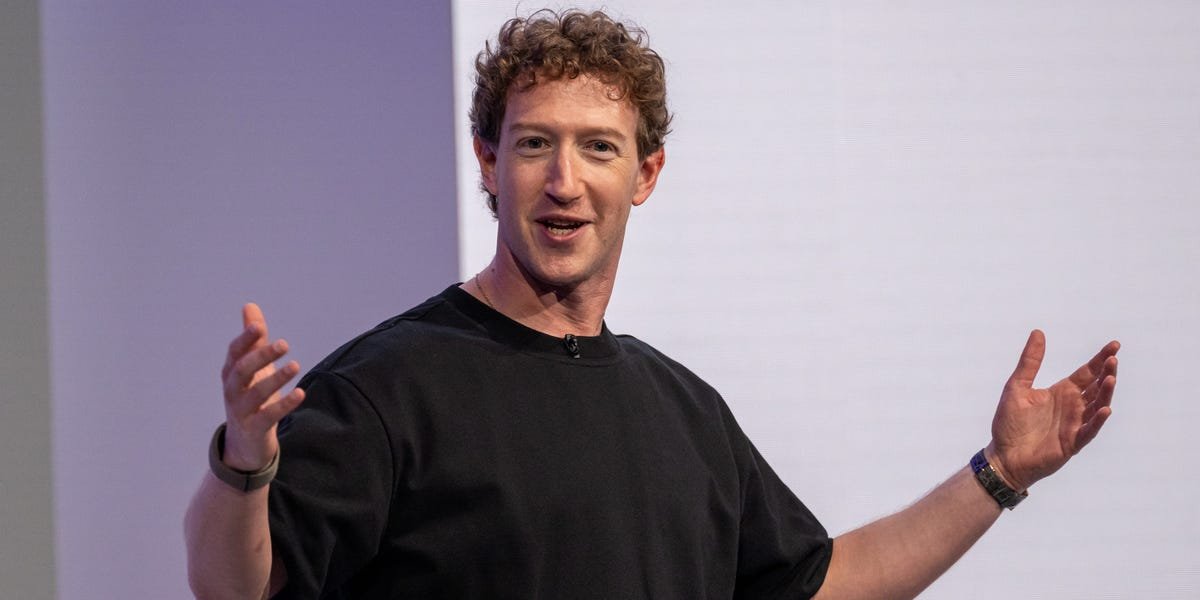
When are we going to stop counting out Mark Zuckerberg?
As concerns over AI mounted over the summer, Meta was one of the companies hit hardest. Investors were particularly skeptical about the firm’s massive capex-spending plans, especially since Meta was seen as more concentrated on AI than fellow hyperscalers like Microsoft.
But the roaring success of Muse, Meta’s new personal AI agent, has ignited a whole new discussion about AI use cases (“musecases,” anyone?) It’s also shed light on which parts of the market could win or lose in an era of agentic growth.
Let’s start with Meta itself. The company’s stock is at its highest level since last October, up 19% since Muse launched on Sept. 8. Much of that came Monday, when it soared 11% after Muse hit No. 1 on Apple’s App Store over the weekend.
Meta’s more zoomed-out stock chart is remarkably choppy. It seems that no matter how many times shares get knocked down, Zuck always has another ace up his sleeve.
But it’s important to note that the success of Muse so far has been based on rapid consumer adoption. Turning that into revenue is another story. At this point, investors are betting Meta can turn its enormous user base and app ecosystem into a lucrative new business.
The trust question
Muse’s breakout comes as Meta Connect — the company’s annual developer conference — begins today, giving the company a chance to address the fervor and tease what comes next.
Meta’s goal is to turn Muse into a new revenue stream beyond advertising. The basic version is free, but the company already offers $20- and $100-a-month tiers for heavier users. Its next challenge will be convincing people to hand over the reins of their lives — and pay for the privilege.
After all, Muse doesn’t just collect data. It can enter apps and websites to handle tasks like shopping, making travel plans, and writing emails. It could end up being a tough sell for Meta, which is such a lightning rod that its controversies become Hollywood movies.
A shuffling of winners and losers
This is far from just a Meta story. Chipmakers have been pulled along for the ride this week, with the Philadelphia Semiconductor Index up more than 6% in just two days.
Zooming in on the sector, there was a clear divide. On the winning side were CPU-exposed companies (Intel, AMD, Arm, etc.) whose products serve as the all-purpose brains that run software and coordinate tasks.
GPU-makers like Nvidia, meanwhile, struggled to get as much of a lift. They’ve been the darling of the AI trade to date, with a premium placed on their ability to crunch massive amounts of data at once.
Elsewhere in the tech space — judging by stock moves this week — cloud infrastructure, networking, cybersecurity, payments, and e-commerce are expected to be beneficiaries of a further agentic push. Shopify in particular has been on a tear after announcing a deal to integrate Muse with Shop Pay.
The losers are less obvious, as there hasn’t been a broad agentic-led sell-off. But one strategic loser could be Amazon, which blocked Muse from shopping on its platform. The company’s shares are basically flat for the week. The episode highlights potential market risk for closed e-commerce ecosystems.
There are also businesses that could be replaced by automation, including online travel agencies, insurance brokers, and comparison-shopping sites. If AI handles the clerical dirty work, the middleman may no longer be necessary.
Muse is another reminder that Meta can still turn a skeptical market on its head. Now Zuck & Co. have to prove it’s more than a two-week sensation.
Your guide to what’s moving markets
Read next
Joe is an executive editor at Business Insider and the author of First Trade, a daily markets newsletter. Sign up here.He oversees the newsroom’s markets, finance, and investing coverage, and previously ran the economy team. He started at Business Insider as a reporter in April 2017.Before joining BI, he was a stocks reporter at Bloomberg, where he also worked on teams focusing on foreign exchange, bonds and M&A. Before Bloomberg, he worked as an investment banking analyst at CIBC World Markets and Navigant Capital Advisors.Joe holds an MA in journalism from Stanford University and a BSBA from Washington University in St. Louis.