(This is the Warren Buffett Watch newsletter, news and analysis on all things Warren Buffett and Berkshire Hathaway. You can sign up here to receive it every Friday evening in your inbox.)
Berkshire added $17 billion of Alphabet shares in Q2
Roughly 60% of the 48.1 million shares added during the quarter were purchased by Berkshire directly from Alphabet in a $10 billion private placement sale announced by the companies in early June.
That suggests Berkshire bought around $7 billion of Alphabet shares on the open market.
Alphabet is, by far, the biggest addition of the quarter but Berkshire also made a significant addition to its bet on Delta Air Lines, increasing that position by 44%, or roughly $1.6 billion.
Its 57.3 million shares are currently valued at $5.1 billion.
Delta first returned to Berkshire’s portfolio in the first quarter. It, and three other airline stocks, were sold by Warren Buffett at a loss in the first quarter of 2020 amid a massive reduction in air travel as the COVID-19 pandemic was gaining steam.
Over the years, Buffett’s investment in airlines haven’t worked out well, prompting him to suggest in his 2007 letter to shareholders that if a “farsighted capitalist had been present at Kitty Hawk, he would have done his successors a huge favor by shooting Orville down.”
In other additions, Berkshire’s Macy’s holdings jumped by 142%, but that works out to an increase of just around $100 million due to its relatively small size.
And in the same quarter Berkshire announced its $6.8 acquisition of Taylor Morrison Home, it added around $280 million to its stake in homebuilder Lennar.
Still selling financials
Berkshire has been selling down its financial holdings in recent quarters and that trend continues.
It trimmed its Ally Financial stake by 7% and cut its Capital One holding by 58%.
Bank of America was reduced by a modest 5.9%, but due to the large size of the holding, that reduced the value of the stake by around $1.7 billion, the biggest dollar cut of the quarter.
Berkshire has reduced its BofA stake by 53% after eight consecutive quarters of selling.
The entire portfolio as of June 30 appears below.
‘Big Short’ investor Michael Burry’s big fear ‘comes true’
Michael Burry isn’t happy with the way Berkshire Hathaway CEO Greg Abel reduced the company’s massive cash pile during its second quarter.
In a Substack post on Sunday, Burry wrote his “biggest fear” was that Warren Buffett’s successor would not have the legendary investor’s “patience for the fat pitch.”
Now, he writes, “I believe this fear has come true.”
As a result, “I do not find Berkshire an attractive investment going forward.”
Burry, whose bet against the housing market ahead of the 2008 subprime mortgage crisis was immortalized in Michael Lewis’ 2010 book “The Big Short” and a 2015 film, acknowledges that “not too much of the cash pile has been spent” and the roughly $360 billion remaining is a lot of money.
But he’s concerned Abel’s “first steps look to be more framing moves than investment moves.”
In the comments section, Burry clarifies that he is not recommending that anyone go short on Berkshire.
A key element of Buffett’s investing strategy over the years was being disciplined enough to wait for very favorable opportunities, just as baseball legend Ted Williams would wait for a “fat pitch” that he could easily hit.
But, as Buffett told the New York Times in 2007, he could wait even longer than Williams could.
“What’s nice about investing is you don’t have to swing at pitches. You can watch pitches come in one inch above or one inch below your navel, and you don’t have to swing. No umpire is going to call you out. You can wait for the pitch you want.”
In the “Archives” clip below, Buffett and Charlie Munger discuss why they’ve been able to be patient unlike many professional money managers.
Stock falls despite resumption of buybacks
Some investors on Wall Street may share Burry’s concerns.
Both classes of Berkshire shares dropped more than 3% this week in the wake of the company’s second quarter spending, even though it included the first significant buybacks in two years.
BUFFETT & BERKSHIRE AROUND THE INTERNET
HIGHLIGHTS FROM CNBC’S BUFFETT ARCHIVE
Berkshire’s discipline is like ‘Ted Williams waiting for a fat pitch’ (2003)
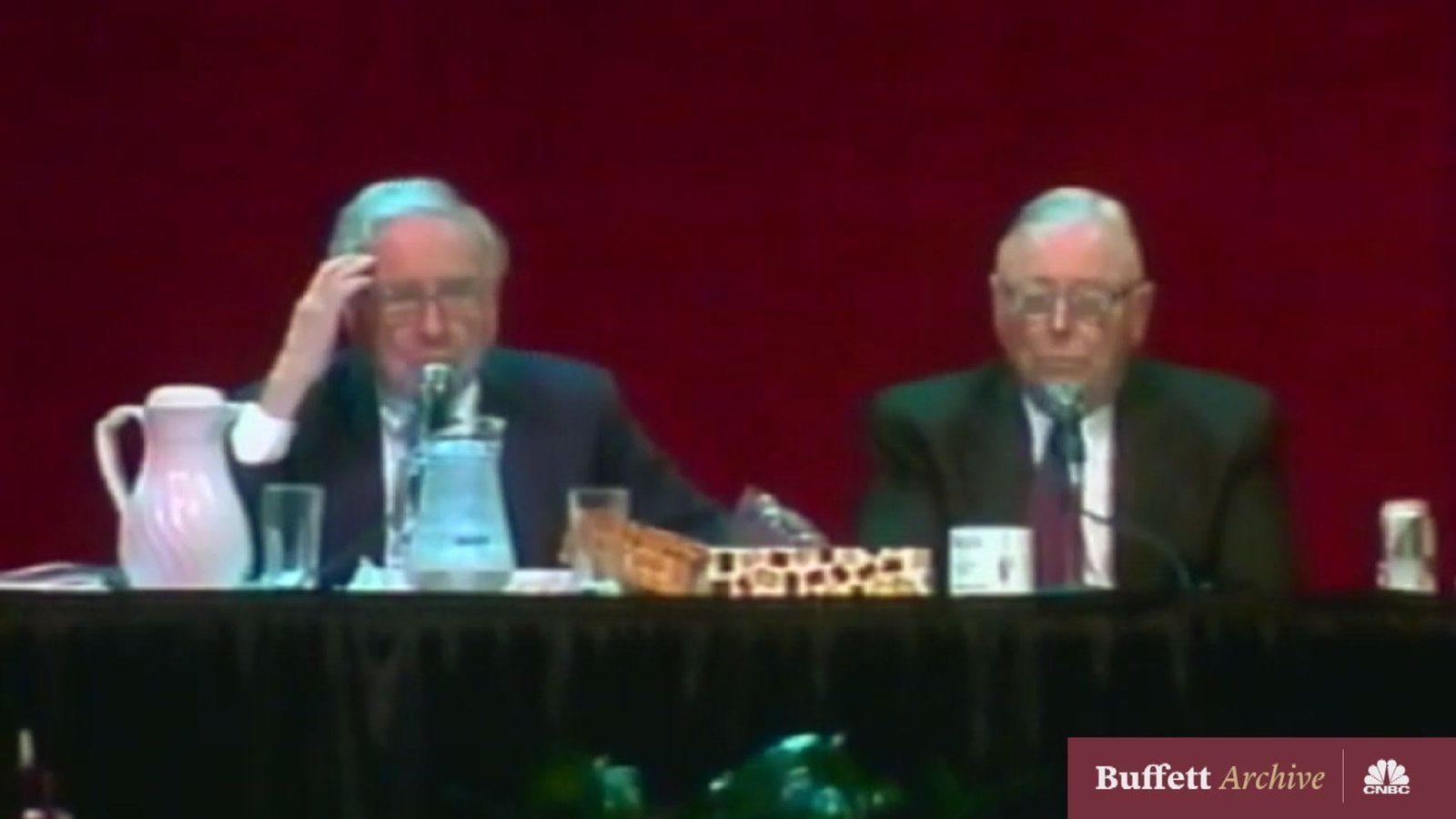
CHARLIE MUNGER: We have this simple, old-fashioned discipline, which Warren likens to Ted Williams waiting for a fat pitch.
I don’t know about Warren, but if you said to me, “Charlie, you can go into the business of managing money the way other people do, where you’re measured against indexes and you got consultants choosing consultants that are reviewing you to committees,” I would just hate it.
I would regard it as being put into shackles. And shackles where the very system was preventing me from delivering value.
Warren, how would you feel about that —
WARREN BUFFETT: Yeah, we wouldn’t
CHARLIE MUNGER: —chore?
WARREN BUFFETT: — do it. We wouldn’t do it. We never did do it, as a matter of fact.
And one of the, you know, the initial — when we formed the partnership on May 5th, 1956, I passed out to the seven limited partners something called the “ground rules.”
And, you know, I said, “Here’s what I can do and here’s what I can’t do. And here’s some things I don’t know whether I can do or not, maybe.” It was fairly short.
But the idea of setting out to do something that you know you can’t do, that can’t be — you know, that’s got to lead to problems.
I mean, if somebody tells me I have to high jump seven feet, and we could even move that down to four feet now — (laughter) — you know, between now and sundown or I’ll be shot, you know, I will go out and buy a bulletproof vest. (Laughter)
CHARLIE MUNGER: Yeah, the general system for money management requires people to pretend that they can do something that they can’t do, and to pretend to like it when they really don’t.
And I think that’s a terrible way to spend your life, but it’s very well paid. (Laughter)
BERKSHIRE STOCK WATCH
Four weeks
Twelve months
BRK.A stock price: $755,570.01
BRK.B stock price: $504.03
BRK.B P/E (TTM): 12.67
Berkshire market capitalization: $1,078,750,128,699
Berkshire Cash as of June 30: $365.5 billion (Down 8.0% from March 31)
Excluding Rail Cash and Subtracting T-Bills Payable: $359.2 billion (Down 3.8% from March 31)
Berkshire repurchased $4.5 billion of its shares in Q2 2026.
(All figures are as of the date of publication, unless otherwise indicated)
BERKSHIRE’S TOP EQUITY HOLDINGS – Aug. 14, 2026
Berkshire’s top holdings of disclosed publicly traded stocks in the U.S. and Japan, by market value, based on the latest closing prices.
Holdings are as of June 30, 2026, as reported in Berkshire Hathaway’s 13F filing on August 14, 2026, except for:
- Mitsubishi, which is as of August 28, 2025
The full list of holdings and current market values is available from CNBC.com’s Berkshire Hathaway Portfolio Tracker.
QUESTIONS OR COMMENTS
Please send any questions or comments about the newsletter to me at alex.crippen@nbcuni.com. (Sorry, but we don’t forward questions or comments to Buffett himself.)
If you aren’t already subscribed to this newsletter, you can sign up here.
Also, Buffett’s annual letters to shareholders are highly recommended reading. There are collected here on Berkshire’s website.
— Alex Crippen, Editor, Warren Buffett Watch