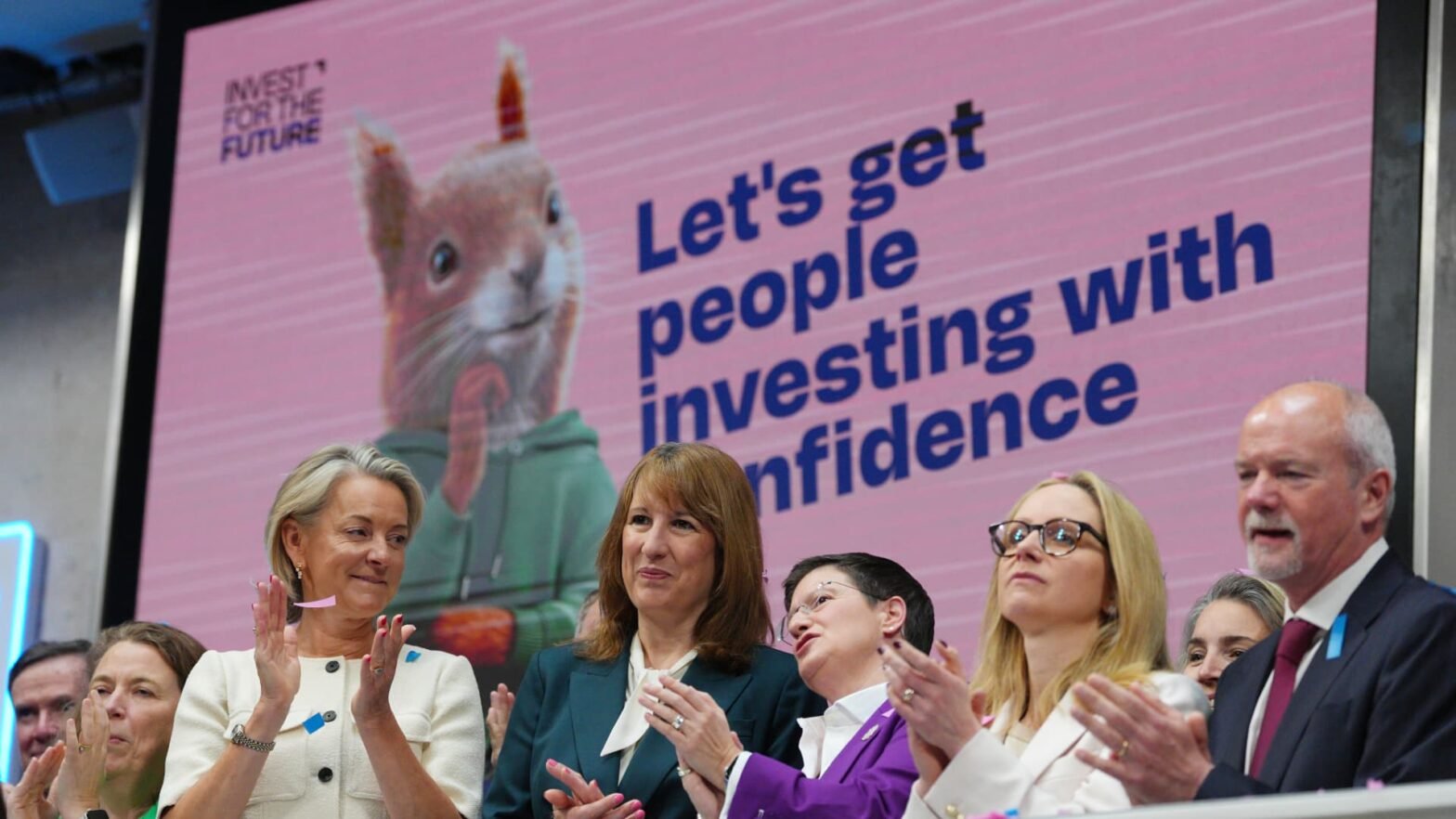
Chancellor Rachel Reeves, Julia Hoggett, CEO of London Stock Exchange, and Lucy Rigby, Economic Secretary to the Treasury, launch a new campaign to get Brits investing, at London Stock Exchange on April 23, 2026 in London, England.
Carl Court | Getty Images News | Getty Images
This report is from this week’s CNBC’s UK Exchange newsletter. Like what you see? You can subscribe here.
The dispatch
The U.K. financial services sector is hoping that, by the end of the year, Britons will be very familiar with a cartoon squirrel called Savvy.
The anthropomorphized rodent fronts an advertising campaign, costing a reported £20 million ($27 million) over the next three years, in support of the government-backed “Invest for the Future” initiative. The campaign, launched last Thursday, is supported by the industry’s biggest names, including Hargreaves Lansdown, Britain’s largest savings and investments platform and St James’s Place, its biggest wealth manager.
Others involved include insurers Aviva and Legal & General; Barclays, NatWest, HSBC U.K. and Lloyds, the “big four” commercial banks; asset managers Schroders and Jupiter; Alliance Witan, one of the U.K.’s oldest investment trusts; the London Stock Exchange and some big U.S. names with a strong U.K. presence, including Fidelity, JP Morgan Personal Investing and Vanguard.
Savvy and his green hoodie will initially appear on digital and social channels, along with advertising billboards, before hitting TV screens this autumn.
The aim is straightforward.
While the household savings ratio has improved in recent years, too many Britons are content to leave their savings in cash, regarding investing in equities as tantamount to gambling. The campaign cites findings from the Financial Conduct Authority, the financial regulator, that around 7 million adults hold more than £10,000 in cash savings that could be put to better use in the market.
As Sasha Wiggins, chief executive of Private Bank and Wealth Management at Barclays and the campaign’s chair, puts it: “The U.K. has a strong savings culture but a significant investing gap with too many still feeling investing is not for them.”
A Thatcherite campaign
It never used to be like this. The 1980s saw an explosion of interest in investing as Prime Minister Margaret Thatcher’s government privatized state-owned assets, including British Telecom, British Airways and British Gas — the latter supported by one of the most famous campaigns in U.K. advertising history, in 1986, as millions of Britons were exhorted to “tell Sid” to buy British Gas shares. Retail investors are still nicknamed “Sids” in the City of London.
Nigel Lawson, Thatcher’s chancellor (finance minister) from 1983 to 1989, provided further encouragement when, in 1986, he launched the Personal Equity Plan (later replaced by the Individual Savings Account) — a vehicle enabling Britons to invest in equities without being taxed on capital gains or dividends.
The momentum only grew when, in 1989, Abbey National (now part of Santander U.K) demutualized, sparking a wave among other mutuals, including Halifax, Norwich Union and Alliance & Leicester, to float on the stock market, introducing millions to the joys of share ownership for the first time. Enthusiasm dissipated when the dot-com bubble burst and fell further during the Global Financial Crisis.
The “Savvy the Squirrel” campaign has had a tricky birth. Several big names, including AJ Bell and Interactive Investor, the second and third-largest investment platforms, chose not to participate. In February, the Financial Times reported unhappiness with the unimaginative use of a squirrel, an icon regularly used down the years in advertising campaigns for savings products.
Others — including Steven Fine, the CEO of investment bank Peel Hunt — have also noted that, were the U.K. government genuine about encouraging investment, abolishing stamp duty on share purchases would be a bigger inducement.
There was also something darkly ironic that Sarah Breedon, a Bank of England deputy governor, warned of a possible stock market crash just a day after the launch.
But it would be churlish not to wish this campaign well. If even a fraction of the money currently tied up in cash is redirected into U.K. equities in particular, it will help drive economic growth, not to mention leaving Britons better off or more financially secure.
— Ian King
Need to know
UK royals head to the U.S. in the wake of war, shooting and rocky relations
The U.K.’s King Charles III and Queen Camilla’s state visit to the U.S., set to begin on Monday, comes at a time of heightened domestic and geopolitical tension for Washington and London.
Trump warns of ‘big tariff’ if UK doesn’t drop digital services tax on U.S. tech firms
U.S. President Donald Trump has delivered a stark warning to the U.K., threatening to impose steep tariffs on the country unless it drops its digital services tax on U.S. tech companies.
UK stocks are beating Wall Street — but the Iran war is putting the winning streak at risk
London-listed equities have extended their outperformance versus the U.S. into 2026 after a stellar 2025 – but cracks are beginning to show as the war in Iran drags on.
— Katrina Bishop
Coming Up
APRIL 28: Bank of England rate decision; Nationwide Housing Prices
MAY 1: Mortgage approvals for March