Anyone who is eager to know the answer to the question, “Will there be a recession this year?” is bound to feel frustrated and disappointed with the two most commonly given answers.
On the one hand, you’ll hear, “Yes, a recession will likely come,” which essentially means, “Recessions happen from time to time, and this bull market will wobble at some point.” The other common answer, even less definite then first, leaves you more in the dark: “No one can predict what happens to the market — your guess is as good as mine.”
Actually, both answers aren’t wrong in a basic sense: Recessions happen, and nobody can predict the day they will arrive. But that doesn’t mean we can’t gather a general sense of where the market is heading, of whether the conditions for a recession are beginning to take shape, or if something entirely different is beginning to form. When we look at some common recession indicators, the picture today might look less ominous than investors think.

Image source: Getty Images.
The good news
The good news is simply this: The U.S. economy is growing, employers are adding jobs, and many professional forecasters are actually very optimistic about future growth.
In the second quarter of 2026, the U.S. economy grew at an annual rate of 1.5%. True, this growth was slower than in the first quarter of 2026 (2.1%), and slower compared to the second quarter of 2025 (about 3.8%). Slow growth is something to watch keenly, but positive gross domestic product growth nevertheless shows that the economy is still expanding.
Then there’s the Conference Board’s Leading Economic Index (LEI), a widely followed gauge that looks for signs the economy might be slowing down or speeding up. At the end of August, the LEI had good news: The index rose 0.2% in July, turning its six-month growth rate positive for the first time in more than four years. Most components in the index were positive, with consumer expectations being a notable exception. The Conference Board took this as a sign that moderate economic growth could lie ahead.
Finally, the August survey of professional forecasters from the Philadelphia Fed was also positive. According to 32 forecasters, the U.S. economy seems to be in a better place than it was three months ago, with forecasts for 2.5% annualized growth in the third quarter and 2.3% in the fourth.
None of this screams “recession” in 2026. There is, however, something looming over the market that deserves attention.
The bad news
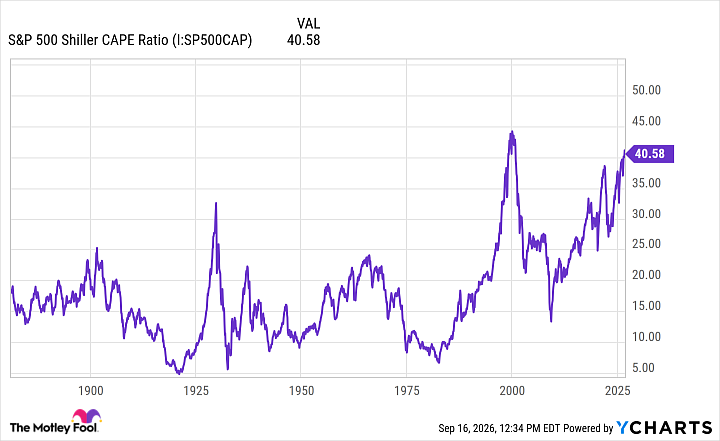
The S&P 500 (^GSPC +0.17%) has now entered extreme valuation territory not seen since the dot-com crash of 2000.
Data by YCharts.
The Shiller CAPE ratio, as shown above, has been hovering around 40 to 41. That makes this market the second most expensive in the last 156 years.
The CAPE, to be sure, doesn’t predict recessions. At the same time, periods with lower returns have often followed unusually high CAPE valuations.
So, is a recession coming in 2026? The good news: Indicators suggest it is not. The economy is growing, and will likely continue growing for the rest of the year. The bad news: Stock valuations are high, and future returns could be harder to come by. Thus, now more than ever, it’s important to favor strong businesses and high-quality stocks and be a little more cautious than usual.